


Unmyelinated axons show selective rostrocaudal pathology in the corpus callosum after traumatic brain injury
- PMID: 22318124
- PMCID: PMC3295246
- DOI: 10.1097/NEN.0b013e3182482590
Unmyelinated axons show selective rostrocaudal pathology in the corpus callosum after traumatic brain injury
Abstract
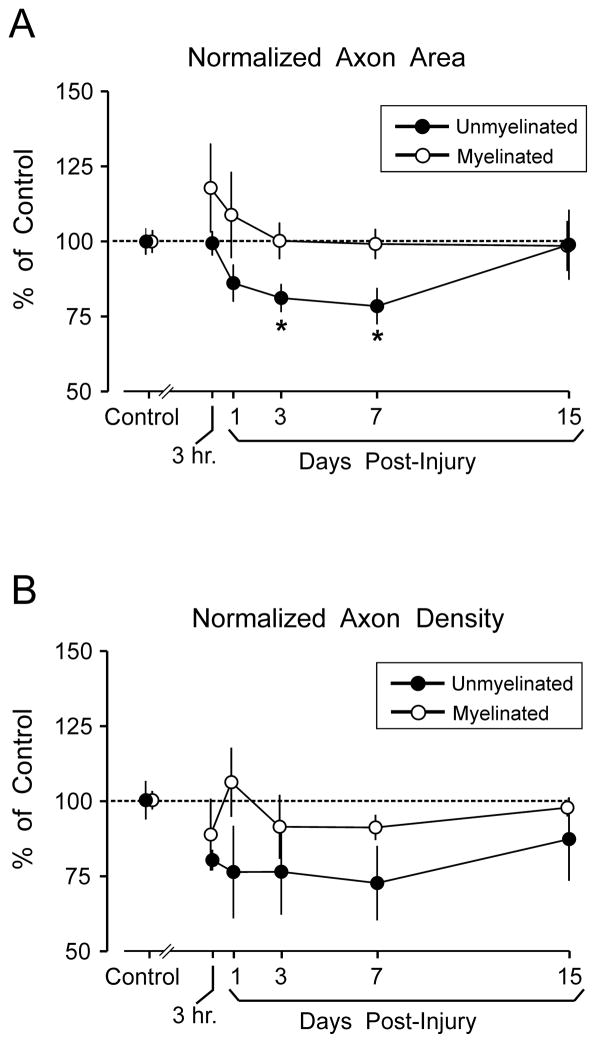
Axonal injury is consistently observed after traumatic brain injury (TBI). Prior research has extensively characterized the post-TBI response in myelinated axons. Despite evidence that unmyelinated axons comprise a numerical majority of cerebral axons, pathologic changes in unmyelinated axons after TBI have not been systematically studied. To identify morphologic correlates of functional impairment of unmyelinated fibers after TBI, we assessed ultrastructural changes in corpus callosum axons. Adult rats received moderate fluid percussion TBI, which produced diffuse injury with no contusion. Cross-sectional areas of 13,797 unmyelinated and 3,278 intact myelinated axons were stereologically measured at survival intervals from 3 hours to 15 days after injury. The mean caliber of unmyelinated axons was significantly reduced at 3 to 7 days and recovered by 15 days, but the time course of this shrinkage varied among the genu, mid callosum, and splenium. Relatively large unmyelinated axons seemed to be particularly vulnerable. Injury-induced decreases in unmyelinated fiber density were also observed, but they were more variable than caliber reductions. By contrast, no significant morphometric changes were observed in myelinated axons. The finding of a preferential vulnerability in unmyelinated axons has implications for current concepts of axonal responses after TBI and for development of specifically targeted therapies.
Figures
References
-
- Rutland-Brown W, Langlois JA, Thomas KE, et al. Incidence of traumatic brain injury in the United States, 2003. J Head Trauma Rehabil. 2006;21:544–8. - PubMed
-
- Skandsen T, Kvistad KA, Solheim O, et al. Prevalence and impact of diffuse axonal injury in patients with moderate and severe head injury: a cohort study of early magnetic resonance imaging findings and 1-year outcome. J Neurosurg. 2010;113:556–63. - PubMed
-
- Meythaler JM, Peduzzi JD, Eleftheriou E, et al. Current concepts: diffuse axonal injury-associated traumatic brain injury. Arch Phys Med Rehabil. 2001;82:1461–71. - PubMed
-
- Strich SJ. Shearing of nerve fibers as a cause of brain damage due to head injury: a pathological study of twenty cases. Lancet. 1961;2:443–8.
-
- Maxwell WL, Povlishock JT, Graham DL. A mechanistic analysis of nondisruptive axonal injury: a review. J Neurotrauma. 1997;14:419–40. - PubMed
