. 2012 Apr;86(8):4317-27.
doi: 10.1128/JVI.00069-12. Epub 2012 Feb 8.

RNA synthesis by the brome mosaic virus RNA-dependent RNA polymerase in human cells reveals requirements for de novo initiation and protein-protein interaction

Affiliations

RNA synthesis by the brome mosaic virus RNA-dependent RNA polymerase in human cells reveals requirements for de novo initiation and protein-protein interaction

Chennareddy V Subba-Reddy et al. J Virol. 2012 Apr.

Abstract

Brome mosaic virus (BMV) is a model positive-strand RNA virus whose replication has been studied in a number of surrogate hosts. In transiently transfected human cells, the BMV polymerase 2a activated signaling by the innate immune receptor RIG-I, which recognizes de novo-initiated non-self-RNAs. Active-site mutations in 2a abolished RIG-I activation, and coexpression of the BMV 1a protein stimulated 2a activity. Mutations previously shown to abolish 1a and 2a interaction prevented the 1a-dependent enhancement of 2a activity. New insights into 1a-2a interaction include the findings that helicase active site of 1a is required to enhance 2a polymerase activity and that negatively charged amino acid residues between positions 110 and 120 of 2a contribute to interaction with the 1a helicase-like domain but not to the intrinsic polymerase activity. Confocal fluorescence microscopy revealed that the BMV 1a and 2a colocalized to perinuclear region in human cells. However, no perinuclear spherule-like structures were detected in human cells by immunoelectron microscopy. Sequencing of the RNAs coimmunoprecipitated with RIG-I revealed that the 2a-synthesized short RNAs are derived from the message used to translate 2a. That is, 2a exhibits a strong cis preference for BMV RNA2. Strikingly, the 2a RNA products had initiation sequences (5'-GUAAA-3') identical to those from the 5' sequence of the BMV genomic RNA2 and RNA3. These results show that the BMV 2a polymerase does not require other BMV proteins to initiate RNA synthesis but that the 1a helicase domain, and likely helicase activity, can affect RNA synthesis by 2a.


Figures
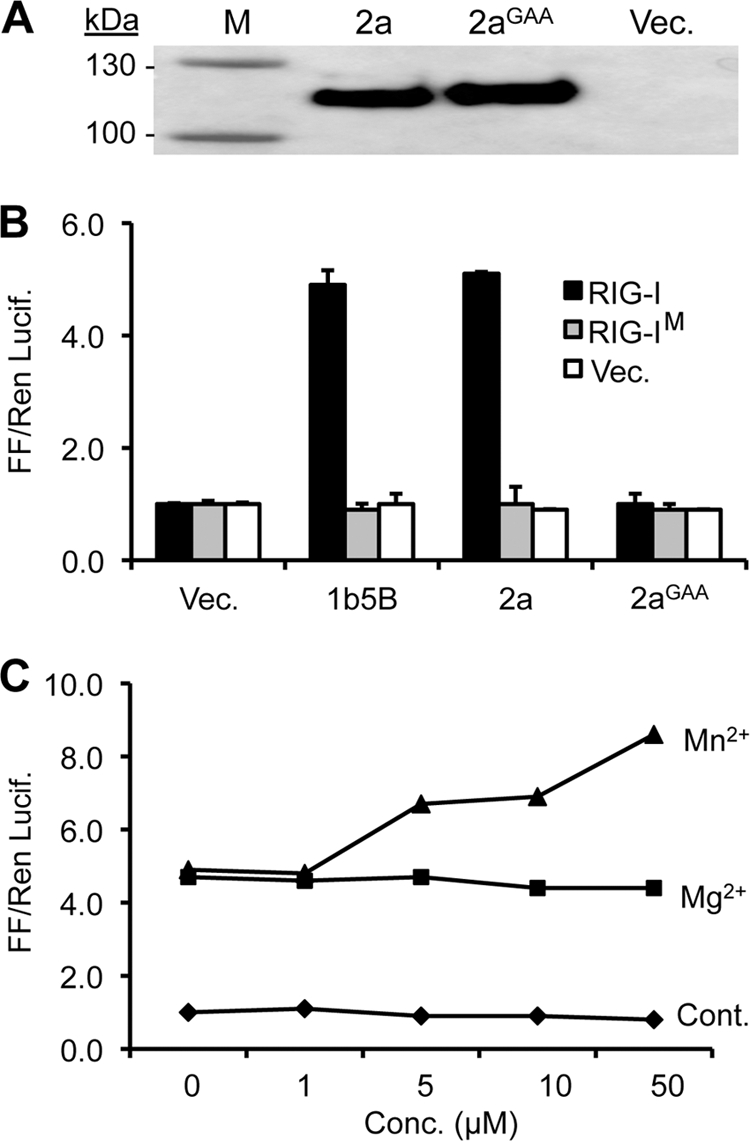
Fig 1
Fig 1
The BMV 2a polymerase can activate innate immunoreceptor-mediated signaling. (A) Western blot showing the expression of WT or the 2aGAA mutant protein from the HEK 293T cells used in the reporter experiment. The empty vector (Vec.) denotes a negative control. (B) Comparison of luciferase reporter levels induced by the BMV and HCV polymerases in transiently transfected HEK 293T cells. 2AGAA denotes an active-site mutant of the BMV 2a and RIG-IM that contains a K888E substitution that renders RIG-I defective for ligand binding. The ratios of the firefly to the Renilla luciferase levels were quantified as described in Materials and Methods and are shown on the y axis. The standard errors shown above the bars are from a minimum of three independent assays. (C) Mn2+, but not Mg2+, affects the 2a polymerase activity. The divalent metals were added directly to the medium of the cultured HEK 293T cells. The control reactions are from cells expressing RIG-I and the two luciferases but not the 2a polymerase. Each data point represents the mean of three independent assays.
Fig 2
Fig 2
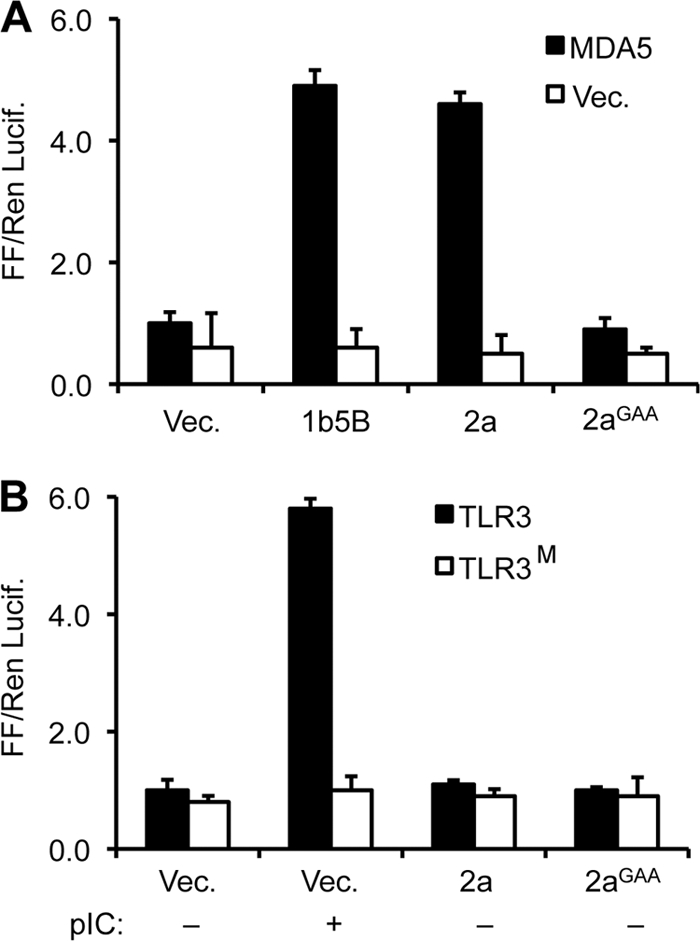
The BMV 2a protein can activate signaling by MDA5, but not TLR3. (A) Assay for the BMV 2a polymerase in HEK 293T cells with MDA5 as the innate immunoreceptor. (B) TLR3 signaling was not activated by the coexpression of the BMV 2a polymerase. TLR3M contains a H539E mutation that abrogates ligand binding and serves to demonstrate that signaling is dependent on the WT TLR3. Polyinosinic and poly(C) (pI:C), a TLR3 agonist, was added to the growth medium of cells to a final concentration of 1 μg/ml. All data for reporter assays in the present study are shown as means and the standard errors of at least three replicates in the experiment. Each result has been reproduced a minimum of twice, with consistent results.
Fig 3
Fig 3
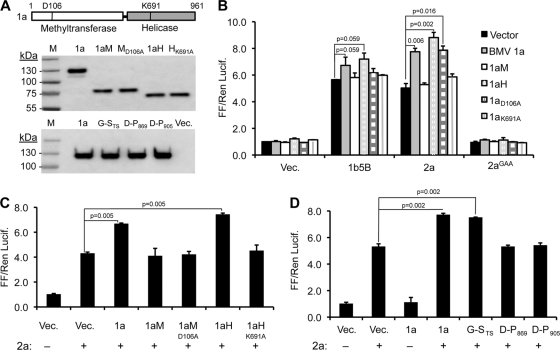
BMV 1a protein interacts with and enhances 2a polymerase activity. (A) At the top is a schematic of BMV 1a protein showing the locations of active-site residues in the methyltransferase (D106) and helicase (K691) domains. The middle and bottom panels are images from Western blots that show comparable expression of WT 1a and different 1a mutants in HEK 293T cells. (B) Effects of coexpressed WT or mutant 1a proteins on the activities of the 2a polymerase. (C) Effects of the active-site mutations in the truncated methyltransferase or helicase-like domains of the 1a protein on 2a polymerase activity. (D) Several mutations in 1a previously shown to affect BMV RNA replication in barley protoplasts also affect the ability to enhance 2a signaling. The results of statistically significant differences, as determined by the Student t test, with the P values are shown above the bars denoting the means of the results.
Fig 4
Fig 4
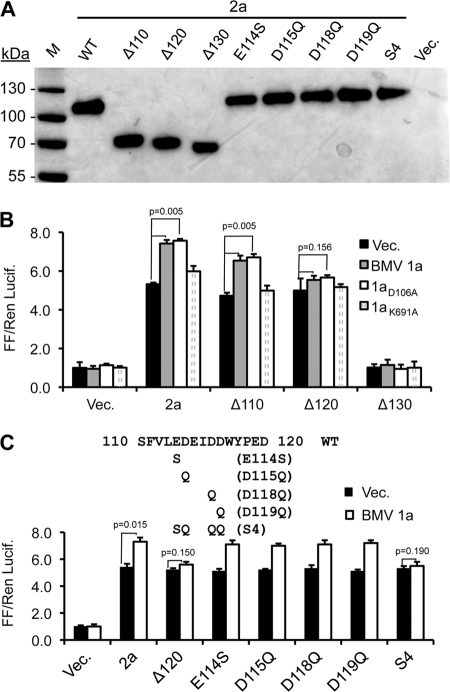
BMV 2a residues required for polymerase activity and for interaction with 1a. (A) Western blot of the expression of the WT BMV 2a and various N-terminal deletions and point mutants. The primary antibodies were described in the work of Kao et al. (14), and the secondary antibody was a horseradish peroxidase-linked goat anti-rabbit IgG. (B) Effects of deletions in 2a on activity and the enhancement of polymerase activity by the WT BMV 1a protein. All results were from transiently transfected HEK293T cells. Notably, Δ120 retained 2a polymerase activity, but the activity was not enhanced by coexpression with the BMV 1a protein. (C) Effects of the deletions and point mutations between residues 110 and 120 on 2a polymerase activity and interaction with BMV 1a. The names of the mutant constructs are in parentheses. The statistical analyses were performed using the Student t test, and the P values of key comparisons are shown. All of the single amino acid substitutions had P values of <0.01 compared to cells that do not express 1a.
Fig 5
Fig 5
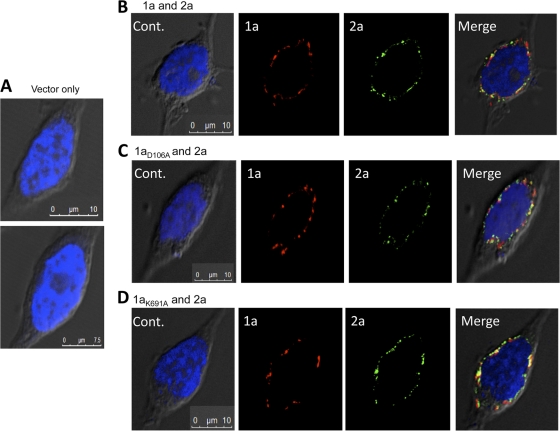
Colocalization of the BMV 1a and 2a proteins in 293T cells. Alexa Flour 488-conjugated anti-mouse and Texas Red-conjugated anti-goat antibodies were used as antibodies to recognize 1a and 2a antibodies, respectively. Cell nuclei were stained with DAPI and viewed using a DeltaVision personal DV fluorescence microscope (Applied Precision, Issaquah, WA) and a scanning confocal microscope (Leica TCS SP5). All images were collected at ×63 magnification. (A) Cells transfected with empty vector as control (Cont.). (B) Cells expressing both WT BMV 1a and 2a proteins. (C) Cells expressing 1aD106A mutant and WT 2a protein. (D) Cells expressing 1aK691A mutant and WT 2a protein.
Fig 6
Fig 6
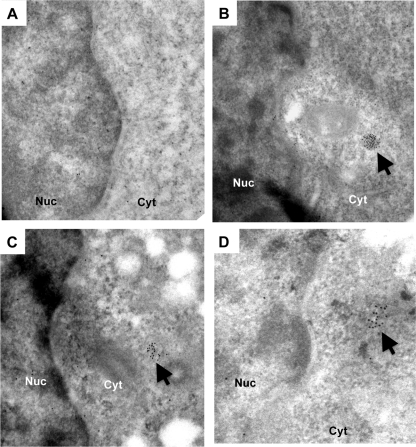
Immunoelectron microscopy of BMV 1a proteins. Sections of HEK 293T cells transfected with empty vector as a control were viewed under JEF-1010 transmission electron microscope (JEOL, Inc., Tokyo, Japan). The sections are stained with anti-1a antibody, followed by goat anti-rabbit antibodies conjugated to 10-nm colloidal gold. Representative sections where colloidal gold was detected are shown. In all images the nuclei are positioned to the left and labeled as “Nuc”. The arrows identify the clusters of colloidal gold. (A) Thin section of a HEK293T cell expressing WT BMV 1a protein. (B) Section of a cell expressing the 1aD106A mutant. (C) Section of a cell expressing 1aD106A mutant. (D) Section of a cell expressing 1aK691A mutant.
Fig 7
Fig 7
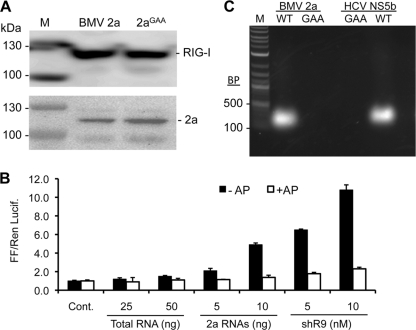
Analysis of the BMV 2a products made in 293T cells. (A) The top panel shows a Western blot analysis of the FLAG-tagged RIG-I protein immunoprecipitated from cells coexpressing the WT 2a or the 2aGAA mutant. The bottom panel shows an image from a Western blot of the total lysate from the cells, detecting 2a expression. “M” denotes protein molecular mass markers from Invitrogen, Inc. (B) A comparison of the immunostimulatory activity of RNAs coimmunoprecipitated with RIG-I cells expressing either WT 2a or the 2aGAA. The RNAs were quantified using a Nanodrop spectrometer and known amounts either mock-treated (□) or treated (■) with Antarctic phosphatase treatment (+AP) and then transfected into 293T cells expressing WT RIG-I. shR9 is triphosphorylated short hairpin RNA that is a known agonist of RIG-I signaling. Total RNA was extracted from 293T cells and used as a control. (C) cDNA products of RNAs that coimmunoprecipitated with the RIG-I proteins. The RNAs were ligated to adaptors and synthesized cDNAs by RT-PCR; the products were electrophoresed on an agarose gel and stained with ethidium bromide.
Fig 8
Fig 8
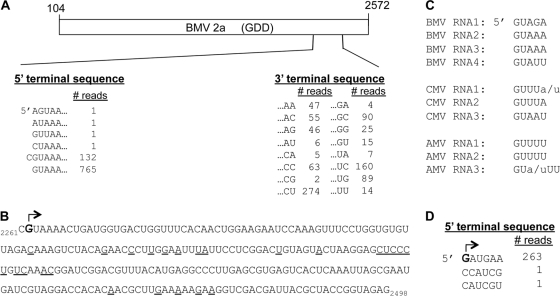
Features of RNAs coimmunoprecipitated with RIG-I and processed by pyrosequencing. (A) Summary of the 901 reads obtained from cells expressing the WT 2a polymerase. A schematic of the cDNA for the BMV 2a protein and the location of the reads from pyrosequencing within the 2a message are shown. A total of 855 of the reads initiated at either nt 2261 or nt 2262 within the BMV RNA2 sequence, the alignments of which are shown below and to the left of the schematic. The 3′ termini of the reads varied in location, but the terminal 2 nt are shown, along with the number of reads with these nucleotides. (B) The sequence of the longest of the 901 reads generated from cells expressing the BMV 2a protein. The preferred initiation nucleotide from all of the reads is identified with an arrow, and the 3′-most nucleotides in the reads are underlined. (C) Sequences present at the 5′ termini of the genomic RNAs of three members of the Bromoviridae family. CMV, cucumber mosaic virus; AMV, alfalfa mosaic virus. (D) A summary of the 5′-terminal nucleotides in the RNAs precipitated with the genotype 4A HCV NS5B polymerase. The arrow denotes the predominant 5′ nucleotide within the 265 sequences.

References

    1. Adkins S, Kao C. 1998. Subgenomic RNA promoters dictate the mode of recognition by bromoviral RNA-dependent RNA polymerases. Virology 252:1–8 - PubMed
    1. Ahlquist P. 2006. Parallels among positive-strand RNA viruses, reverse-transcribing viruses and double-stranded RNA viruses. Nat. Rev. Microbiol. 4:371–382 - PMC - PubMed
    1. Ahola T, den Boon JA, Ahlquist P. 2000. Helicase and capping enzyme active site mutations in brome mosaic virus protein 1a cause defects in template recruitment, negative-strand RNA synthesis, and viral RNA capping. J. Virol. 74:8803–8811 - PMC - PubMed
    1. Ahola T, Ahlquist P. 1999. Putative RNA capping activities encoded by brome mosaic virus: methylation and covalent binding of guanylate by replicase protein 1a. J. Virol. 73:10061–10069 - PMC - PubMed
    1. Baum A, Sachidnaandam R, Garcia-Sastre A. 2010. Preference of RIG-I for short viral RNA molecules in infected cells revealed by next-generation sequencing. Proc. Natl. Acad. Sci. U. S. A. 107:16303–16308 - PMC - PubMed

Publication types

LinkOut - more resources