


Review
doi: 10.3390/s100403882.
Epub 2010 Apr 15.
Metal oxide sensors for electronic noses and their application to food analysis
Affiliations
- PMID: 22319332
- PMCID: PMC3274253
- DOI: 10.3390/s100403882
Item in Clipboard
Review
Metal oxide sensors for electronic noses and their application to food analysis
Sensors (Basel).
2010.
Abstract
Electronic noses (E-noses) use various types of electronic gas sensors that have partial specificity. This review focuses on commercial and experimental E-noses that use metal oxide semi-conductors. The review covers quality control applications to food and beverages, including determination of freshness and identification of contaminants or adulteration. Applications of E-noses to a wide range of foods and beverages are considered, including: meat, fish, grains, alcoholic drinks, non-alcoholic drinks, fruits, milk and dairy products, olive oils, nuts, fresh vegetables and eggs.
Keywords: E-nose; electronic nose; food; metal oxide semi-conductor sensor.
Figures
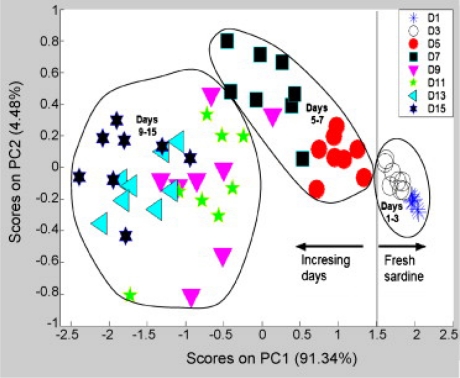
Scores plot of a PCA on sardine data using the six-element gas sensors array. A vertical line separating fresh samples from medium and aged ones and ellipses grouping fresh, medium and aged samples had been added for easy identification (reprinted from [29] with permission from Elsevier, copyright 2007).
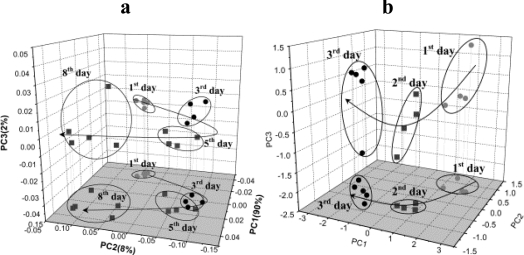
PCA plot based on E-nose measurements of (a) UHT milk and (b) pasteurized milk showing ageing of milk over 8 and 3 days respectively (reprinted from [37] with permission from Elsevier, copyright (2001).
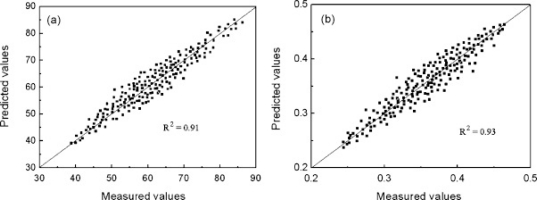
Predicted versus E-nose-measured values of egg quality indices from quadratic polynomial step regression models (a) Haugh unit and (b) yolk factor (reprinted from [46] with permission from Elsevier, copyright 2009).

Score plot of the first two canonical variables of the linear discriminate analysis based on the intensity of mass to charge ratio of 34 wines. The symbols represent the six geographical origins of Sauvignon Blanc wines samples. Loire (♦), Marlborough (▴), South Australia (Δ), Tasmania (•), Victoria (+), Western Australia (○) (reprinted from [80] with permission from Elsevier, copyright 2009).

Score plot of eight different beer brands measured with a MOSES II E-nose (a) without pre-separation unit and (b) with pre-separation unit consisted of thermostated gas chromatography column installed between the headspace sampler and the sensor array (reprinted from [71] with permission from Elsevier, copyright 2000).
References
-
- Gardner J., Bartlett P.N. Electronic Nose. Principles and Applications. Oxford University Press; Oxford, UK: 1999.
-
- Schaller E., Bosset J.O., Escher F. ‘Electronic noses’ and their application to food. Food Sci. Technol-Leb. 1998;31:305–316.
-
- Williams D.E. Semiconducting oxides as gas-sensitive resistors. Sens. Actuat. B. 1999;57:1–16.
Publication types
MeSH terms
LinkOut - more resources
Full Text Sources
Other Literature Sources
