. 2012;7(2):e31486.
doi: 10.1371/journal.pone.0031486. Epub 2012 Feb 2.

Multiple distant origins for green sea turtles aggregating off Gorgona Island in the Colombian eastern Pacific

Affiliations

Multiple distant origins for green sea turtles aggregating off Gorgona Island in the Colombian eastern Pacific

Diego F Amorocho et al. PLoS One. 2012.

Abstract

Mitochondrial DNA analyses have been useful for resolving maternal lineages and migratory behavior to foraging grounds (FG) in sea turtles. However, little is known about source rookeries and haplotype composition of foraging green turtle aggregations in the southeastern Pacific. We used mitochondrial DNA control region sequences to identify the haplotype composition of 55 green turtles, Chelonia mydas, captured in foraging grounds of Gorgona National Park in the Colombian Pacific. Amplified fragments of the control region (457 bp) revealed the presence of seven haplotypes, with haplotype (h) and nucleotide (π) diversities of h = 0.300±0.080 and π = 0.009±0.005 respectively. The most common haplotype was CMP4 observed in 83% of individuals, followed by CMP22 (5%). The genetic composition of the Gorgona foraging population primarily comprised haplotypes that have been found at eastern Pacific rookeries including Mexico and the Galapagos, as well as haplotypes of unknown stock origin that likely originated from more distant western Pacific rookeries. Mixed stock analysis suggests that the Gorgona FG population is comprised mostly of animals from the Galapagos rookery (80%). Lagrangian drifter data showed that movement of turtles along the eastern Pacific coast and eastward from distant western and central Pacific sites was possible through passive drift. Our results highlight the importance of this protected area for conservation management of green turtles recruited from distant sites along the eastern Pacific Ocean.


Conflict of interest statement

Competing Interests: The authors have declared that no competing interests exist.

Figures

Figure 1
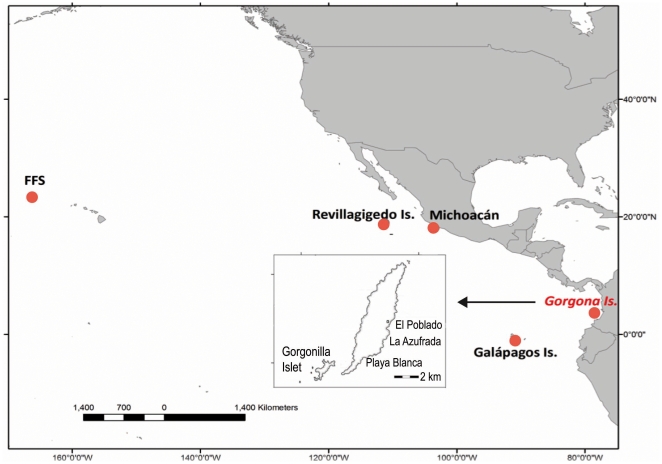
Figure 1. Location of Gorgona National Park in the Pacific.
Dots represent locations from where haplotypes were identified, excluding an Australasian hypothetical rookery. Turtles were caught by hand in the coral reefs of La Azufrada and Playa Blanca on the east side of the island.
Figure 2
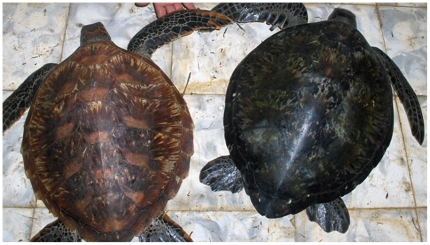
Figure 2. Observed variations in carapace color and shape of green turtle (Chelonia mydas) juveniles.
Variations corresponding to the Australasian (CMP21, CMP 22 and CMP 97) and central/eastern Pacific (CMP4, CMP 8, CMP 5, CMP 17) haplotypes (left and right turtles, respectively) caught at the Gorgona foraging study site. Putative west Pacific turtles exhibited a much lighter golden-brown coloration with indentation in the lower carapace edges, in contrast to the darker “black” carapaces of the typical eastern Pacific individuals. Photo: Javier Rodríguez-Zuluaga.
Figure 3
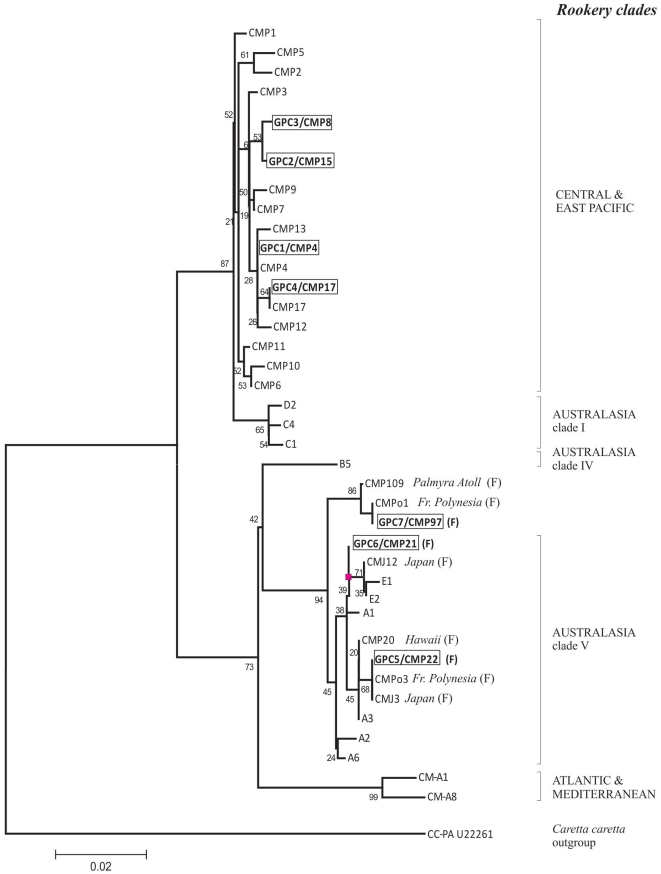
Figure 3. Phylogeny of representative green turtle mtDNA control region haplotypes.
Presented using the Neighbor-Joining method with branch lengths proportional to the sequence divergence indicated by the scale and the bootstrap values at each branch. A selection of haplotypes from central, eastern Pacific , and Australasian rookery clades as well as regional foraging grounds were included to help detect probable geographic origins for orphan haplotypes found at the Gorgona FG (CMP22, CMP97). Haplotypes for green turtles found at the study site are in boxes and bold type. Red square indicates presence of 10 bp insertion. Haplotypes from foraging or bycatch are indicated by an “F”, all others are from nesting sites. The Caretta caretta haplotype (GenBank acc. No. U22261) was used as an outgroup.
Figure 4
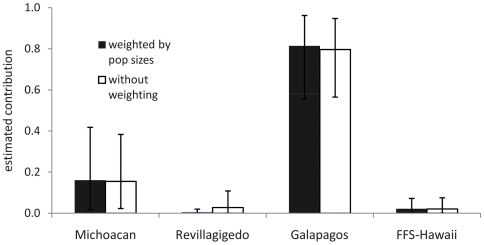
Figure 4. Bayesian mixed stock estimates of contributions to the Gorgona foraging ground by central and eastern Pacific rookeries, after excluding putative western Pacific “orphan” haplotypes.
Dark bars represent results using source population sizes (nests/yr) information; light bars without source population size. Source haplotype profiles used were obtained for Michoacan and Revillagigedo (Mexico), Galapagos (Ecuador) and French-Frigate Shoals Hawaii (USA). Error bars represent 97.5% and 2.5% percentile intervals.
Figure 5
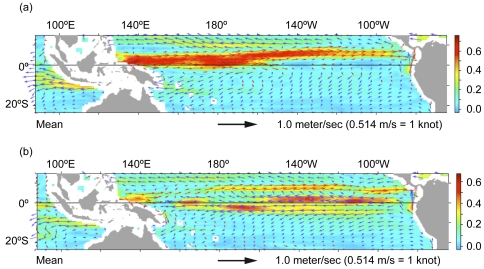
Figure 5. Mean surface ocean currents in the Pacific region 15°N–24°S 100°E–60°W from NOAA Ocean Surface Current Analyses- Real Time program.
(a) Averages for July–December 1997 (during a very intense El Niño) indicating the strong and extensive eastward flowing North Equatorial Counter-current (NEECC) as a major feature of the current pattern. (b) Averages for July–December 2000 (common, non-El Niño conditions) showing the presence of the NECC as weaker and reduced compared to the westward flowing Equatorial current. Red overlay vector arrows indicate eastward flows; blue arrows indicate westward flows. Colored contour plots indicate current speed (meters per second) according to scale on the right. Map and information downloaded from http://www.oscar.noaa.gov/datadisplay/.
Figure 6
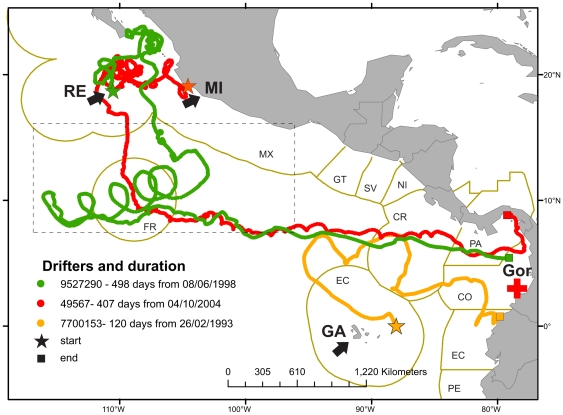
Figure 6. Satellite-tracked drifter buoy trajectories demonstrating potential ocean current pathways linking green turtle breeding areas in the Eastern Pacific with the Gorgona foraging site.
Tracks from three drifters deployed near Eastern Pacific breeding ground heading towards the vicinity of the Gorgona study site (red cross). RE = Revillagigedo Islands, Mexico; MI = Michoacan, Mexico; GA = Galapagos Islands, Ecuador; Gor = Gorgona Island, Colombia. Rectangle in broken lines highlight area with frequent eddies provoking recurrent looped tracks with increased speed (about 2X average) but longer entrainment within the current system. Countries' EEZ boundaries are indicated with two-letter abbreviations. Drifter data from NOAA/AOML Global Lagrangian Drifter Data (http://www.aoml.noaa.gov/envids/gld/krig/parttrk_id_temporal.php).
Figure 7
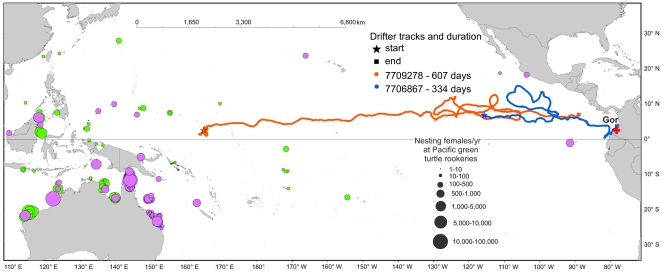
Figure 7. Satellite-tracked drifter buoy trajectories demonstrating potential ocean current pathways linking green turtle breeding areas in the Western Pacific with the Gorgona foraging site.
Two drifter tracks initiating on the eastern edge of Western Pacific green turtle habitats leading to areas near the Gorgona study site (red cross). Total duration indicated in the figures. Green turtle rookery locations and abundances derived from IOSEA Marine Turtle Mapping System (http://stort.unep-wcmc.org/imaps/indturtles) and the Marine Turtle Database maintained by C. J. Limpus at Queensland Parks and Wildlife Service, Australia. Purple circles indicate Pacific basin breeding colonies that have been genetically characterized (see Table 2); green circles show populations with no genetic studies. Drifter data from NOAA/AOML Global Lagrangian Drifter Data (http://www.aoml.noaa.gov/envids/gld/krig/parttrk_id_temporal.php).

References

    1. Luschi P, Hays GC, Papi F. A review of long-distance movements by marine turtles, and the possible role of ocean currents. OIKOS. 2003;103:293–302.
    1. Meylan A. Sea turtle migration - evidence from tag returns. In: Bjorndal KA, editor. Biology and Conservation of Sea Turtles. Washington, D.C.: Smithsonian Institution Press; 1982. pp. 91–100.
    1. Monzón-Arguello C, López-Jurado LF, Rico C, Marco A, López P, et al. Evidence from genetic and Langrarian drifter data for trasatlantic transport of small juvenile green turtles. Journal of Biogeography. 2010;37:1752–1766.
    1. Musick JA, Limpus CJ. Habitat utilization and migration in juvenile sea turtles. In: Lutz PL, Musick JA, editors. The Biology of Sea Turtles. Boca Ratón: CRC Press; 1997. pp. 137–164.
    1. Broderick AC, Coyne MS, Fuller WJ, Glen F, Godley DJ. Fidelity and over-wintering of sea turtles. Proceedings of the Royal Society B. 2007;274:1533–1538. - PMC - PubMed

Publication types