. 2012 Jul;166(6):1822-32.
doi: 10.1111/j.1476-5381.2012.01891.x.

Inhibition of airway hyper-responsiveness by TRPV1 antagonists (SB-705498 and PF-04065463) in the unanaesthetized, ovalbumin-sensitized guinea pig

Affiliations

Inhibition of airway hyper-responsiveness by TRPV1 antagonists (SB-705498 and PF-04065463) in the unanaesthetized, ovalbumin-sensitized guinea pig

I Delescluse et al. Br J Pharmacol. 2012 Jul.

Abstract

BACKGROUND AND PURPOSE Airway sensory nerves play a key role in respiratory cough, dyspnoea, airway hyper-responsiveness (AHR), all fundamental features of airway diseases [asthma and chronic obstructive pulmonary disease (COPD)]. Vagally mediated airway reflexes such as cough, bronchoconstriction and chest tightness originate from stimulation of airway sensory nerve endings. The transient receptor potential vanilloid 1 receptor (TRPV1) is present on peripheral terminals of airway sensory nerves and modulation of its activity represents a potential target for the pharmacological therapy of AHR in airway disease. EXPERIMENTAL APPROACH As guinea pig models can provide some of the essential features of asthma, including AHR, we have established the model with some classical pharmacological agents and examined the effect of the TRPV1 antagonists, SB-705498 and PF-04065463 on AHR to histamine evoked by ovalbumin (OA) in unanaesthetized sensitized guinea pigs restrained in a double chamber plethysmograph. Specific airway conductance (sGaw) derived from the airflow was calculated as a percentage of change from baseline. KEY RESULTS Cetirizine and salbutamol significantly inhibited OA-evoked bronchoconstriction [sGaw area under the curve (AUC): 70 and 78%, respectively]. Atropine, SB-705498 and PF-04065463 significantly inhibited OA-evoked AHR to histamine in unanaesthetized, OA-sensitized guinea pigs (sGaw AUC: 94%, 57% and 73%, respectively). Furthermore, this effect was not related to antagonism of histamine's activity. CONCLUSION AND IMPLICATIONS These data suggest that TRPV1 receptors located on airway sensory nerves are important in the development of AHR and that modulation of TRPV1-receptor activity represents a potential target for the pharmacological therapy of AHR in airway disease.


Figures

Figure 1
Figure 1
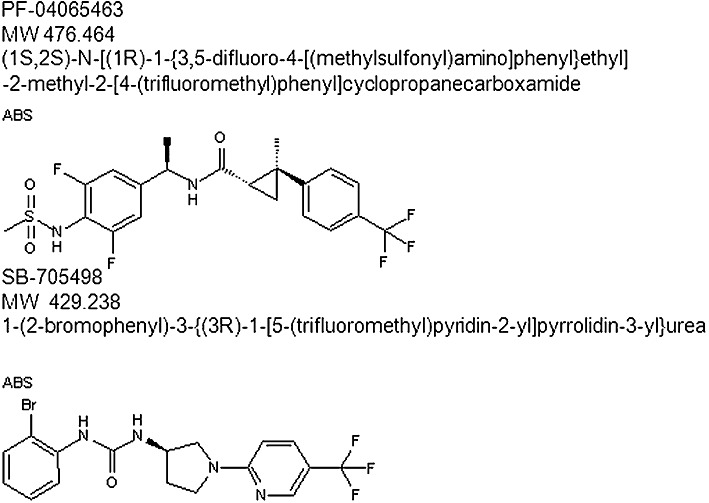
TRPV1 antagonist chemical structure.
Figure 2
Figure 2
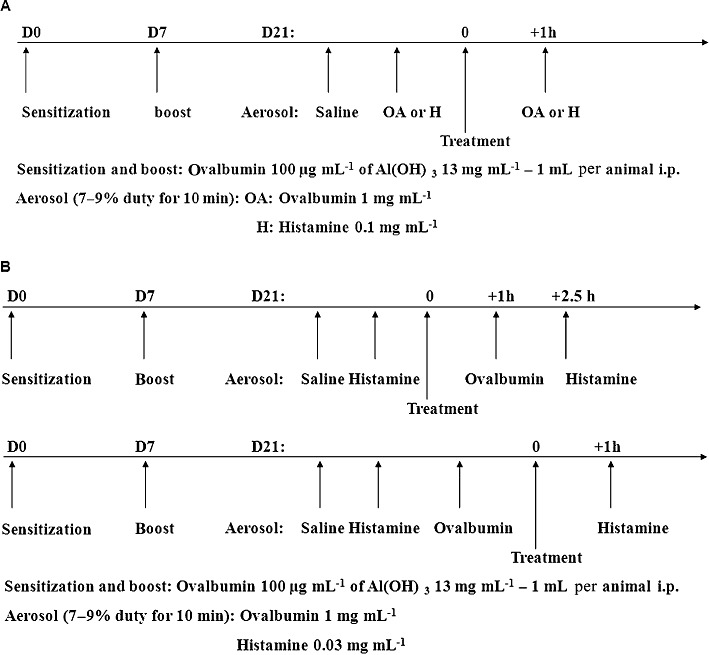
(A) Protocol employed for studying the effect of cetirizine on OA-induced bronchoconstriction. Also the same timings were used to study vehicle, SB-705498, PF-04065463 or atropine on histamine-induced bronchoconstriction. (B) Protocol employed for studying the responsiveness to a subthreshold aerosol of histamine before and after OA. Treatment 1 h before OA, 2.5 h before histamine with vehicle, SB-705498, PF-04065463, atropine or salbutamol in upper panel. Treatment after OA (1 h before histamine) with vehicle, atropine or SB-705498 in lower panel.
Figure 3
Figure 3
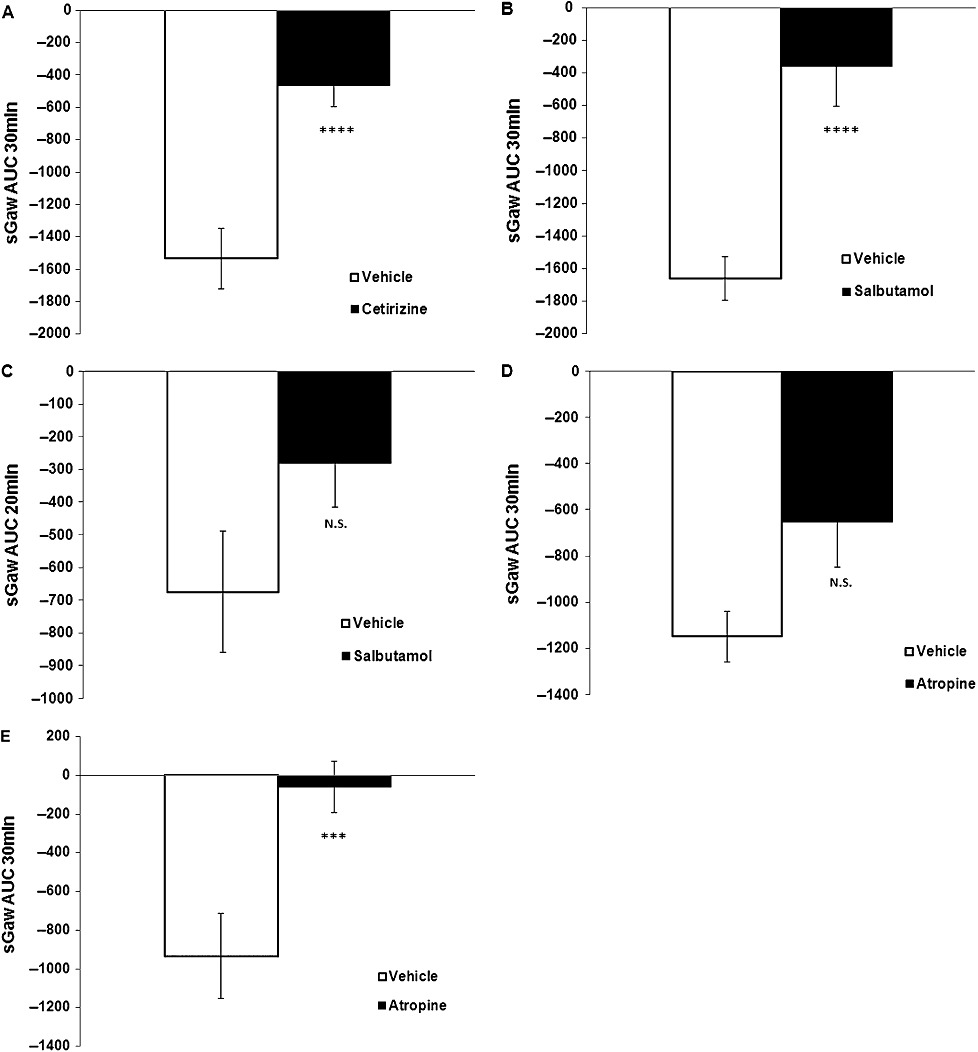
(A) Effect of cetirizine 10 mg·kg−1 i.p. (n = 6) on OA-evoked bronchoconstriction (sGaw AUC for 30 min = −463 ± 132) compared with saline 1 mL·kg−1 i.p. (n = 6) (sGaw AUC for 30 min = −1533 ± 185). Animals dosed 1 h before OA. Negative sGaw AUC ± SEM values show a bronchoconstriction. ****P < 0.001: significant inhibition of 70%. (B) Effect of salbutamol 3 mg·mL−1 i.t. (n = 8) on OA-evoked bronchoconstriction (sGaw AUC for 30 min = −359 ± 246) compared with saline 100 µL per animal i.t. (n = 10) (sGaw AUC for 30 min = −1661 ± 133). Animals dosed 1 h before OA. Negative sGaw AUC ± SEM values show a bronchoconstriction. ****P < 0.001: significant inhibition of 78%. (C) Lack of effect of salbutamol 3 mg·mL−1 i.t. (n = 8) on OA-evoked AHR to a subthreshold dose of histamine (sGaw AUC for 20 min = −282 ± 135) compared with saline, 100 µL per animal i.t. (n = 10) (sGaw AUC for 20 min = −674 ± 186). Animals were dosed 2.5 h before histamine. Negative sGaw AUC ± SEM values show a bronchoconstriction. P > 0.05: non-significant inhibition of 58%. (D) Lack of effect of atropine 10 mg·mL−1 i.p. (n = 8) on OA-induced bronchoconstriction (sGaw AUC for 30 min = −652 ± 199) compared with saline 1 mL·kg−1 i.p. (n = 8) (sGaw AUC for 30 min = −1150 ± 110). Animals were dosed 1 h before OA. Negative sGaw AUC ± SEM values show a bronchoconstriction. P > 0.05: non-significant inhibition of 43%. (E) Effect of atropine 10 mg·mL−1 i.p. (n = 8) on OA-evoked AHR to histamine (sGaw AUC for 30 min = −60 ± 133) compared with saline 1 mL·kg−1 i.p. (n = 8) (sGaw AUC for 30 min = −935 ± 219). Animals were dosed 1 h before OA and 2.5 h before AHR to a subthreshold dose of histamine. Negative sGaw AUC ± SEM values show a bronchoconstriction. ***P < 0.005: significant inhibition of 94%.
Figure 4
Figure 4
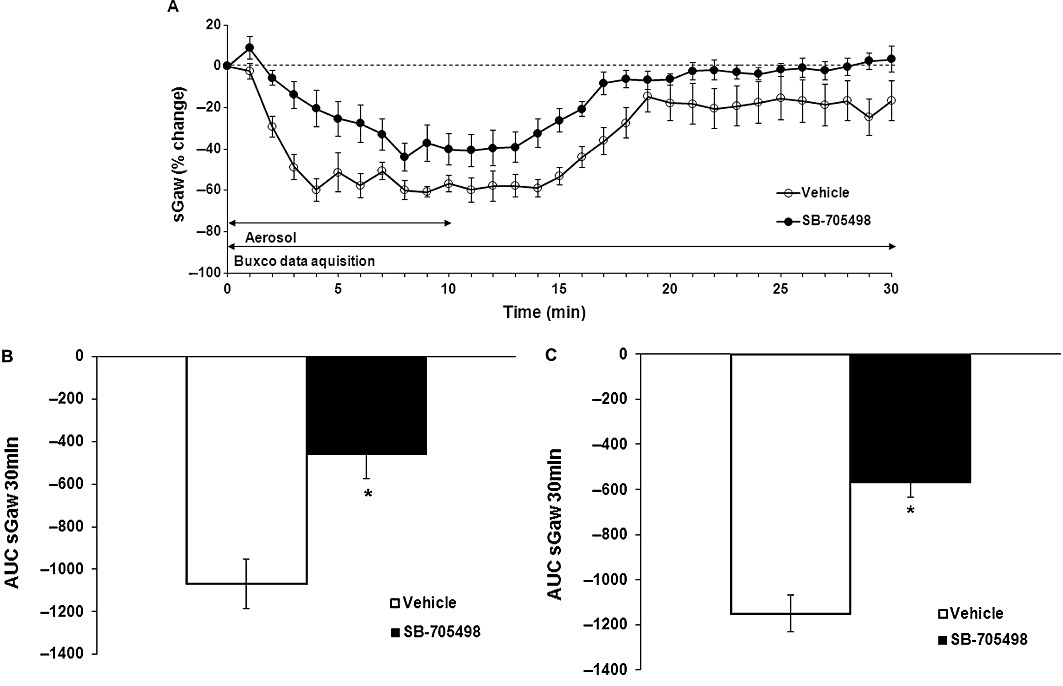
(A) Effect of SB-705498 10 mg·kg−1 p.o. (n = 11) on OA-evoked AHR to histamine (0.03 mg·mL−1) compared with methylcellulose 1 mL·kg−1 p.o. (n = 8) expressed as % change from the baseline sGaw values (10-min aerosol exposure then 20 min of recording) ± SEM. Negative values show a bronchoconstriction. (B) Effect of SB-705498 10 mg·kg−1 p.o. (n = 11) on OA-evoked AHR to histamine (0.03 mg·mL−1) (sGaw AUC for 30 min = −462 ± 114) compared with methylcellulose 1 mL·kg−1 p.o. (n = 8) (sGaw AUC for 30 min −1070 ± 116). Animals were dosed 1 h before OA and 2.5 h before a subthreshold dose of histamine. Negative sGaw AUC ± SEM values show a bronchoconstriction. *P < 0.05: significant inhibition of 57%. (C) Effect of SB-705498 10 mg·kg−1 p.o. (n = 9) on OA-evoked AHR to histamine (0.03 mg·mL−1) (sGaw AUC for 30 min = −569 ± 64) compared with methylcellulose 1 mL·kg−1 p.o. (n = 11) (sGaw AUC for 30 min −1151 ± 82). Animals were dosed after OA and 1 h before a subthreshold aerosol dose of histamine. Negative sGaw AUC ± SEM values show a bronchoconstriction. *P < 0.05: significant inhibition of 50%.
Figure 5
Figure 5
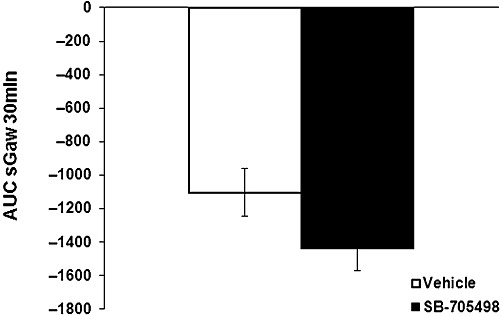
Lack of effect of SB-705498 10 mg·kg−1 p.o. (n = 8) on histamine-induced bronchoconstriction (sGaw AUC for 30 min = −1442 ± 129) compared with methylcellulose 1 mL·kg−1 p.o. (n = 7) (sGaw AUC for 30 min −1106 ± 143). Animals were dosed 1 h before histamine (0.1 mg·mL−1) aerosol. Negative sGaw AUC ± SEM values show a bronchoconstriction. SB-705498 had no antagonist activity against this effect of histamine.
Figure 6
Figure 6
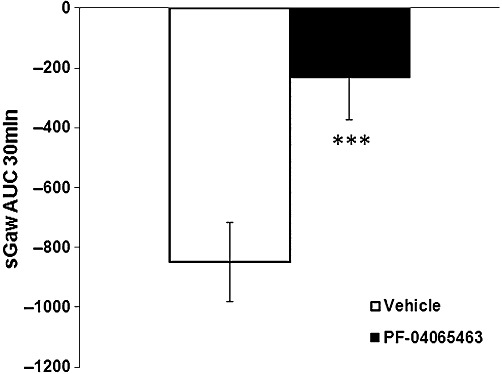
Effect of PF-04065463 10 mg·kg−1 p.o. (n = 16) on OA-evoked AHR to histamine (0.03 mg·mL−1) (sGaw AUC for 30 min = −232 ± 141) compared with methylcellulose 1 mL·kg−1 p.o. (n = 16) (sGaw AUC for 30 min −851 ± 133). Animals were dosed 1 h before OA and 2.5 h before a subthreshold dose of histamine. Negative sGaw AUC ± SEM values show a bronchoconstriction. ***P < 0.005: significant inhibition of 73%.

References

    1. Adcock JJ. TRPV1 receptors in sensitisation of cough and pain reflexes. Pulm Pharmacol Ther. 2009;22:65–70. - PubMed
    1. Alexander SPH, Mathie A, Peters JA. Guide to receptors and channels (GRAC), 5th edition. Br J Pharmacol. 2011;164(Suppl. 1):S1–S324. - PMC - PubMed
    1. Bhattacharya A, Scott BP, Nasser N, Ao H, Maher MP, Dubin AE, et al. Pharmacology and antitussive efficacy of 4-(3-trifluoromethylpyridin-2-yl)-piperazine-1-carboxylic acid (5-trifluromethyl-pyridin-2-yl)-amide (JNJ17203212), a transient receptor potential vanilloid 1 antagonist in guinea pigs. J Pharmacol Exp Ther. 2007;323:665–674. - PubMed
    1. Carr MJ, Undem BJ. Inflammation-induced plasticity of the afferent innervation of the airways. Environ Health Perspect. 2001;109:567–571. - PMC - PubMed
    1. Caterina MJ, Schumacher MA, Tominaga M, Rosen TA, Levine JD, Julius D. The capsaicin receptor: a heat activated ion channel in the pain pathway. Nature. 1997;389:816–824. - PubMed

MeSH terms