


Review
doi: 10.1016/j.ceb.2011.12.013.
Epub 2012 Feb 8.
A jumbo problem: mapping the structure and functions of the nuclear pore complex
Affiliations
- PMID: 22321828
- PMCID: PMC3472030
- DOI: 10.1016/j.ceb.2011.12.013
Item in Clipboard
Review
A jumbo problem: mapping the structure and functions of the nuclear pore complex
Curr Opin Cell Biol.
2012 Feb.
Abstract
Macromolecular assemblies can be intrinsically refractive to classical structural analysis, due to their size, complexity, plasticity and dynamic nature. One such assembly is the nuclear pore complex (NPC). The NPC is formed from ∼450 copies of 30 different proteins, called nucleoporins, and is the sole mediator of exchange between the nucleus and the cytoplasm in eukaryotic cells. Despite significant progress, it has become increasingly clear that new approaches, integrating different sources of structural and functional data, will be needed to understand the functional biology of the NPC. Here, we discuss the latest approaches trying to address this challenge.
Copyright © 2012 Elsevier Ltd. All rights reserved.
Figures
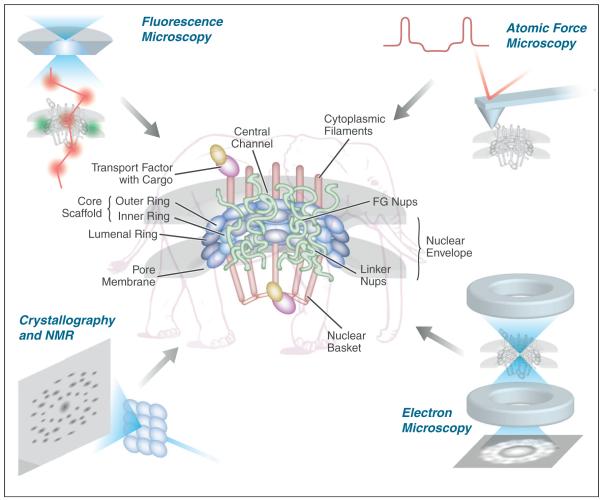
The NPC, and the traffic through it, has been visualized by many different techniques, representatives of which are shown here: fluorescence microscopy including single molecule techniques, atomic force microscopy, scanning electron microscopy, transmission electron microscopy, molecular modeling, and crystallography and NMR.
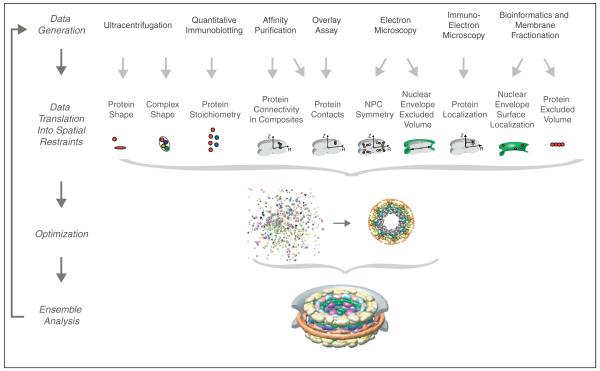
Determining the architecture of the NPC by integrating various types of data. Data from various experiments are translated into ‘spatial restraints’, encoding the information each experiment reveals about the relative position of each component in the NPC. An ensemble of structural solutions that satisfy the data is then obtained by minimizing the violations of the spatial restraints, starting from many different random configurations. This ensemble is analyzed in terms of protein positions, contacts, and configuration [32,36].
References
-
- Weis K. Nucleocytoplasmic transport: cargo trafficking across the border. Curr Opin Cell Biol. 2002;14:328–335. - PubMed
-
- Wente SR. Gatekeepers of the nucleus. Science. 2000;288:1374–1377. - PubMed
-
- Peters R. Translocation through the nuclear pore: Kaps pave the way. Bioessays. 2009 - PubMed
-
- Terry LJ, Shows EB, Wente SR. Crossing the nuclear envelope: hierarchical regulation of nucleocytoplasmic transport. Science. 2007;318:1412–1416. - PubMed
Publication types
MeSH terms
Substances
Grants and funding
LinkOut - more resources
Full Text Sources
