. 2012 Jun;40(11):4783-93.
doi: 10.1093/nar/gks055. Epub 2012 Feb 9.

The global repressor FliZ antagonizes gene expression by σS-containing RNA polymerase due to overlapping DNA binding specificity

Affiliations

The global repressor FliZ antagonizes gene expression by σS-containing RNA polymerase due to overlapping DNA binding specificity

Christina Pesavento et al. Nucleic Acids Res. 2012 Jun.

Abstract

FliZ, a global regulatory protein under the control of the flagellar master regulator FlhDC, was shown to antagonize σ(S)-dependent gene expression in Escherichia coli. Thereby it plays a pivotal role in the decision between alternative life-styles, i.e. FlhDC-controlled flagellum-based motility or σ(S)-dependent curli fimbriae-mediated adhesion and biofilm formation. Here, we show that FliZ is an abundant DNA-binding protein that inhibits gene expression mediated by σ(S) by recognizing operator sequences that resemble the -10 region of σ(S)-dependent promoters. FliZ does so with a structural element that is similar to region 3.0 of σ(S). Within this element, R108 in FliZ corresponds to K173 in σ(S), which contacts a conserved cytosine at the -13 promoter position that is specific for σ(S)-dependent promoters. R108 as well as C(-13) are also crucial for DNA binding by FliZ. However, while a number of FliZ binding sites correspond to known σ(S)-dependent promoters, promoter activity is not a prerequisite for FliZ binding and repressor function. Thus, we demonstrate that FliZ also feedback-controls flagellar gene expression by binding to a site in the flhDC control region that shows similarity only to a -10 element of a σ(S)-dependent promoter, but does not function as a promoter.


Figures
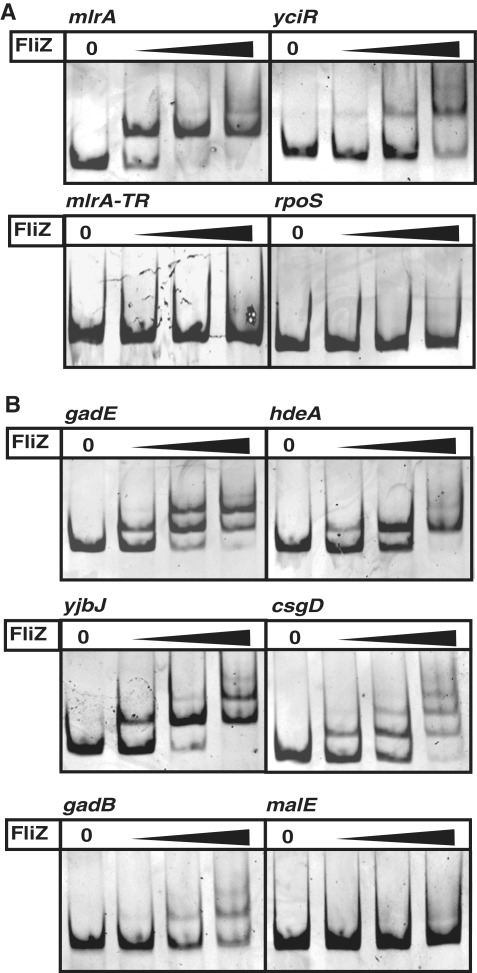
Figure 1.
Figure 1.
FliZ binding to promoter DNA. Electrophoretic mobility shift assays with FliZ (20, 40, 80 nM) are shown for (A) DNA-fragments (6 nM) comprising the promoter regions of the σS-dependent genes mlrA and yciR and control fragments containing part of the translated region of the mlrA gene (mlrA-TR) and the σ70-dependent rpoS promoter, and (B) DNA-fragments containing promoters from other FliZ-controlled genes previously identified (10).
Figure 2.
Figure 2.
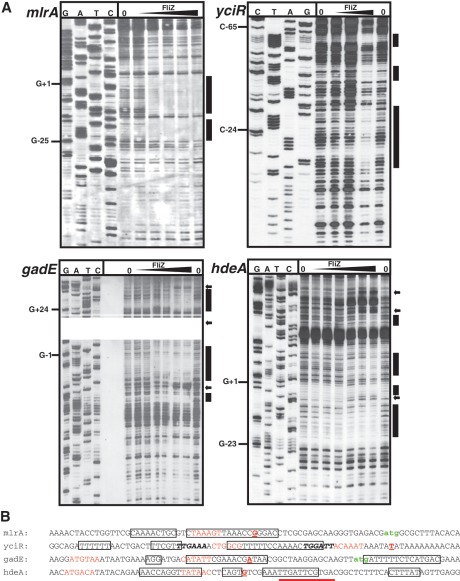
FliZ binding sites in σS-dependent promoters. (A) Non-radioactive DNase I footprint analysis was performed with FliZ and DIG-labeled DNA fragments containing the promoter regions of mlrA as well as yciR, gadE and hdeA genes. FliZ-binding sites are indicated by bars and were mapped to the promoter sequences and marked by boxes (B). Positions of enhanced DNase cleavage are marked by arrows. Transcriptional start sites have been determined before: mlrA (Supplementary Figure S4), yciR (24), gadE (60), hdeA (61). −10 and −35 elements are colored in red, transcriptional start sites are printed as bold, red, underlined letters; translational start sites are labeled in green; potential alternative −35 and −10 regions in the yciR promoter (see text) are indicated by bold, italic letters; a sequence with partial similarity to a σS-dependent −10 region on the opposite strand of the hdeA promoter region is underlined.
Figure 3.
Figure 3.
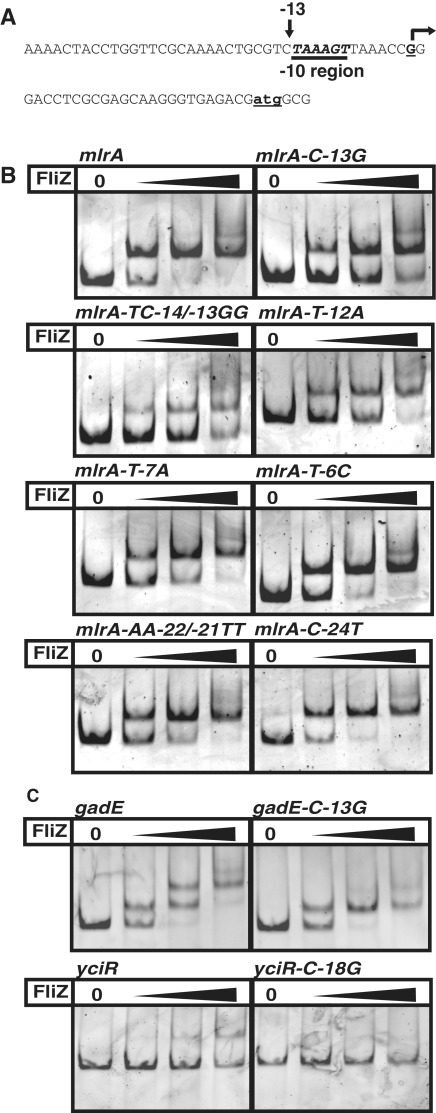
Promoter region nucleotides involved in FliZ binding. Several sites in the mlrA promoter sequence (A, B) as well as C(−13) in the gadE promoter sequence and the suggested alternative yciR promoter (or promoter-like sequence) (C) were replaced as indicated and the effects of these mutations on FliZ-binding were tested by EMSA as described in Figure 1.
Figure 4.
Figure 4.
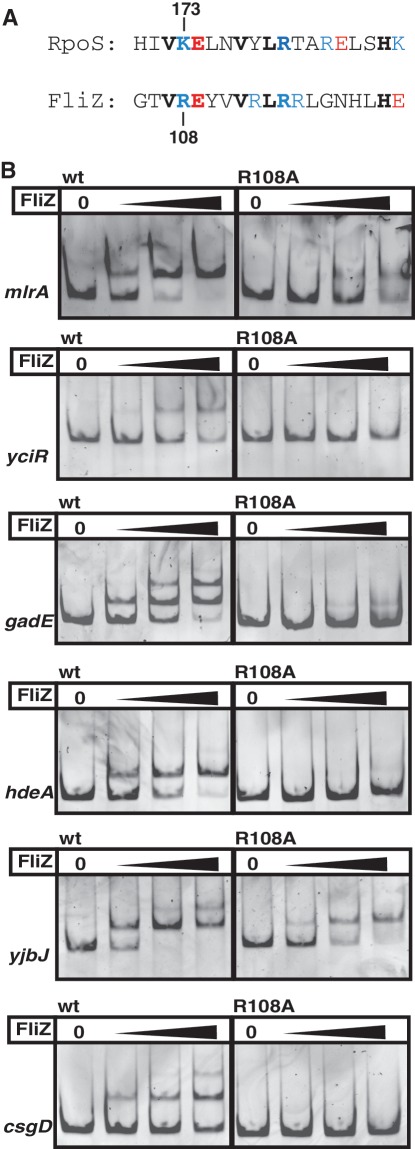
FliZ and σS use a similar element for DNA binding. (A) Alignment of a putative α-helix in the C-terminal region of FliZ with the extended −10 recognition helix 3.0 of σS (RpoS). Positively charged residues are shown in blue, negatively charged residues in red. (B) FliZ wild-type (wt) and FliZ-R108A binding to FliZ-target promoter DNAs was compared by EMSA (20, 40, 80 nM FliZ).
Figure 5.
Figure 5.
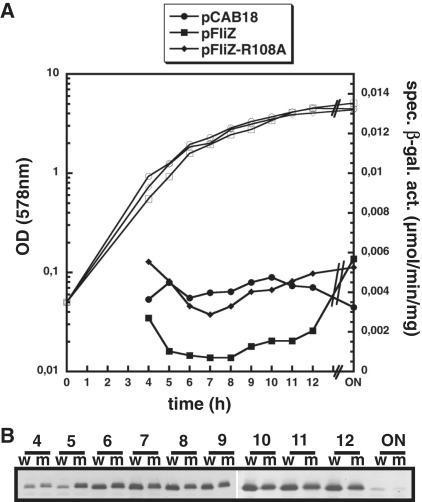
The R108A mutation eliminates FliZ repression of the σS-dependent gene yciR. (A) Expression of a single-copy yciR::lacZ fusion in ΔfliZ mutant (m) strains producing equal levels of either wt FliZ or FliZ-R108A from low copy plasmids or carrying the vector alone (pCAB18) was determined in cells growing in LB medium at 28°C (ON, over night). (B) in parallel, cellular levels of FliZ and FliZ-R108A were determined by immunoblot analysis (w, wt FliZ; m, FliZ-R108A). For technical reasons, two separate blots, comprising samples taken at 4–9 h and 10 h to ON were combined in (B).
Figure 6.
Figure 6.
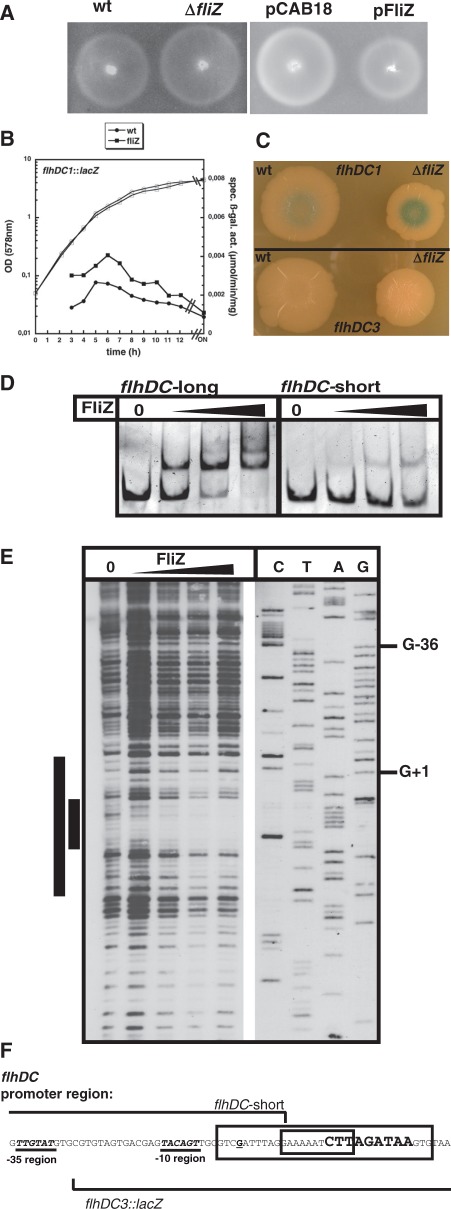
FliZ directly affects motility by repressing flhDC expression. (A) Motility of strain W3110 (wt) and its derivatives carrying ΔfliZ, or the low copy plasmids pCAB18 (vector control) or pFliZ was tested at 28°C. (B) Expression of a single-copy transcriptional lacZ fusion to the flhDC promoter (flhDC1::lacZ) was determined in fliZ+ and fliZ cells growing in LB medium at 28°C. (C) Expression in wild-type (wt) and ΔfliZ cells of the same fusion (flhDC1::lacZ) and of a fusion (flhDC3::lacZ) that does not include the full vegetative flhDC promoter but carries the ‘−10 σS-promoter-like element’ (F); cells were grown on LB/agar plates without salt at 28°C for 7 days. (D) Binding of FliZ to DNA fragments with (flhDC-long) or without (flhDC-short) the ‘−10 σS-promoter-like element’ downstream of the flhDC transcriptional start site was compared by EMSA (80, 160, 320 nM FliZ). (E) The FliZ-binding site in the flhDC upstream regulatory region was determined by non-radioactive DNaseI footprint analysis and the binding site was mapped to the promoter sequence (F). A core binding site and potential upstream and downstream extensions are indicated by smaller and larger bars (E) and boxes (F). The transcriptional start site (62) is printed as a bold, underlined letter and the ‘−10 σS-promoter-like element’ downstream of the flhDC promoter is printed in bold, larger letters. The start of the region present in flhDC3::lacZ and the end of the flhDC-short DNA fragment used in (D) are indicated.
Figure 7.
Figure 7.
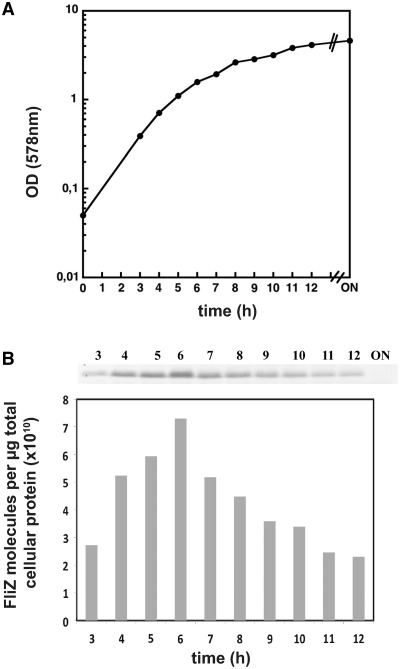
Cellular levels of FliZ during the growth cycle. OD578 (A) and cellular levels of FliZ (B) were determined in cells growing in LB medium at 28°C. FliZ levels were determined by immunoblot analysis, using defined amounts of purified FliZ as a reference for calculating absolute cellular protein levels (in molecules per μg total cellular protein; see Supplementary Figure S9). 6 µg of cellular protein was applied per lane. The experiment was done three times and a representative experiment is shown. FliZ levels in the ON sample were below detection (which corresponds to <5% of maximal levels determined). Based on direct measurements of cell numbers (as colony forming units), cellular FliZ contents were also calculated in molecules per cell (Supplementary Figure S10).

References

    1. Ferenci T. Hungry bacteria-definition and properties of a nutritional state. Environ. Microbiol. 2001;3:605–611. - PubMed
    1. Hengge R. The general stress response in Gram-negative bacteria. In: Storz G, Hengge R, editors. Bacterial Stress Responses. Washington, DC: ASM Press; 2010. pp. 25–289.
    1. Todesco M, Balasubramanian S, Hu TT, Traw MB, Horton M, Epple P, Kuhns C, Sureshkumar S, Schwartz C, Lanz C, et al. Natural allelic variation underlying a major fitness trade-off in Arabidopsis thaliana. Nature. 2010;465:632–636. - PMC - PubMed
    1. Nyström T. Growth versus maintenance: a trade-off dictated by RNA polymerase availability and sigma factor competition? Mol. Microbiol. 2004;54:855–862. - PubMed
    1. Gruber TM, Gross CA. Multiple sigma subunits and the partitioning of bacterial transcription space. Annu. Rev. Microbiol. 2003;57:441–466. - PubMed

Publication types

MeSH terms