


Allylic Amines as Key Building Blocks in the Synthesis of (E)-Alkene Peptide Isosteres
- PMID: 22323894
- PMCID: PMC3272643
- DOI: 10.1021/op2002613
Allylic Amines as Key Building Blocks in the Synthesis of (E)-Alkene Peptide Isosteres
Abstract
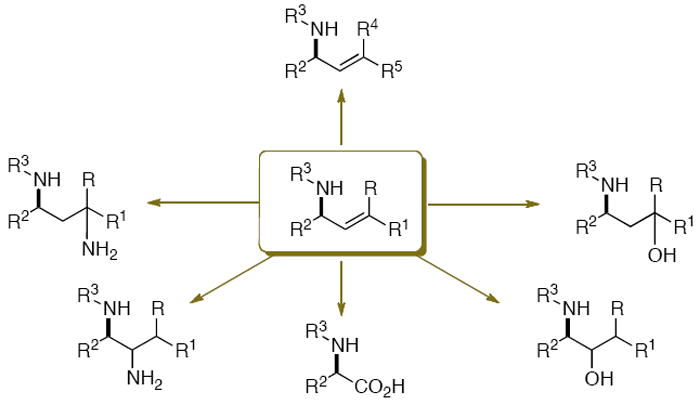
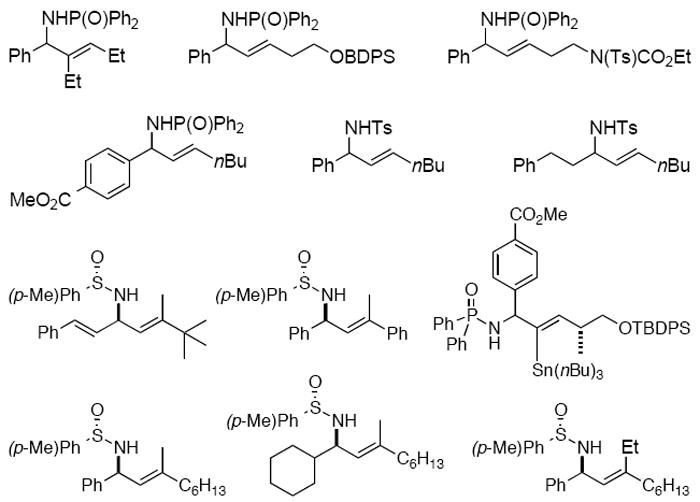
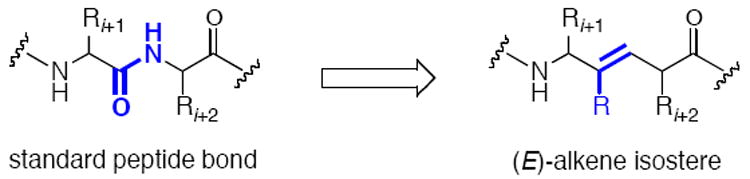
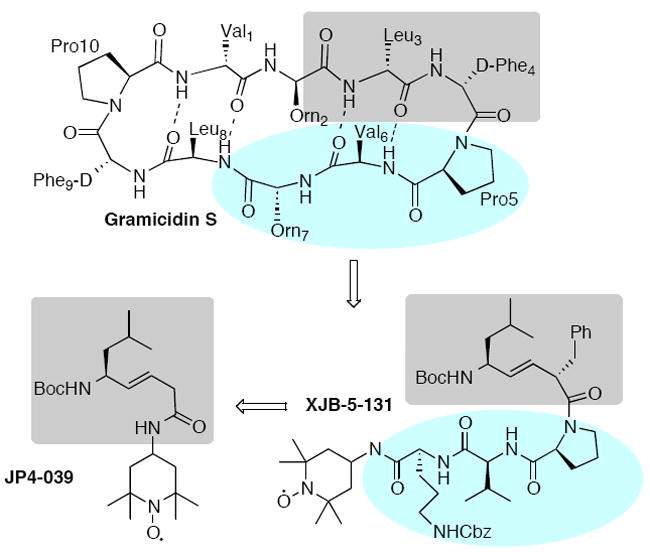
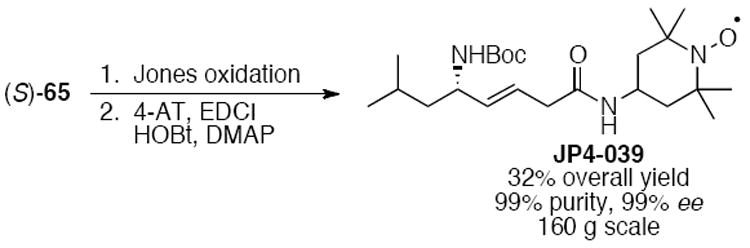
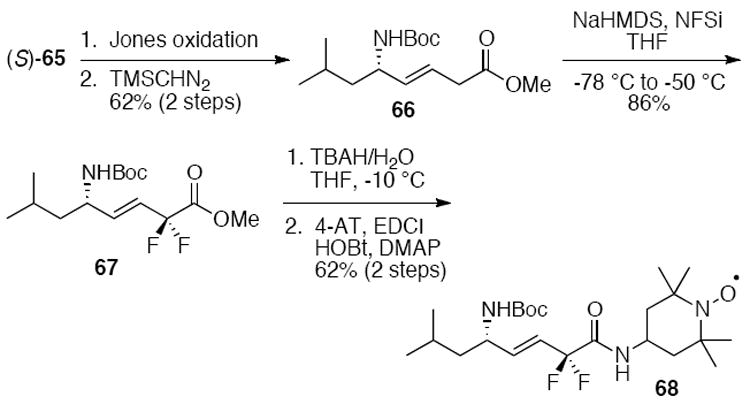
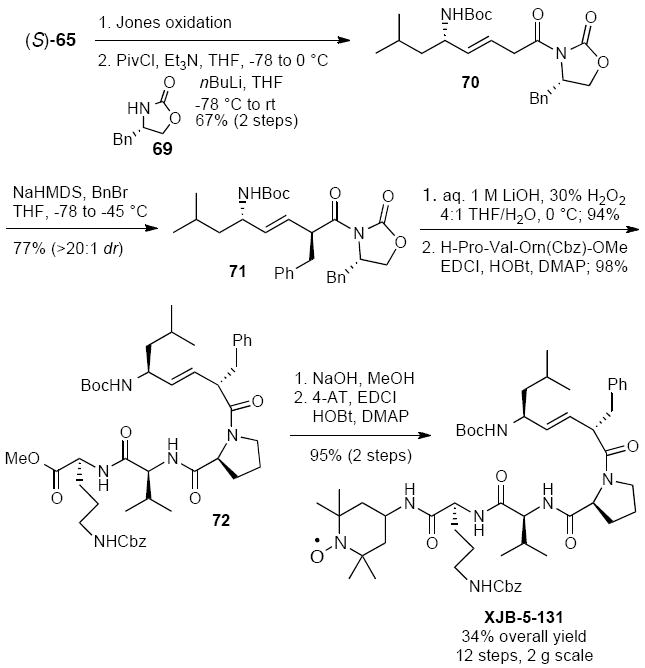
Nucleophilic imine additions with vinyl organometallics have developed into efficient, high yielding, and robust methodologies to generate structurally diverse allylic amines. We have used the hydrozirconation-transmetalation-imine addition protocol in the synthesis of allylic amine intermediates for peptide bond isosteres, phosphatase inhibitors, and mitochondria-targeted peptide mimetics. The gramicidin S-derived XJB-5-131 and JP4-039 and their analogs have been prepared on up to 160 g scale for preclinical studies. These (E)-alkene peptide isosteres adopt type II' β-turn secondary structures and display impressive biological properties, including selective reactions with reactive oxygen species (ROS) and prevention of apoptosis.
Figures
References
-
- Johannsen M, Jørgensen KA. Chem Rev. 1998;98:1689. - PubMed
- Anderson CE, Overman LE. J Am Chem Soc. 2003;125:12412. - PubMed
- Berkowitz DB, Maiti G. Org Lett. 2004;6:2661. - PMC - PubMed
- Grossman RB, Davis WM, Buchwald SL. J Am Chem Soc. 1991;113:2321.
- Patel SJ, Jamison TF. Angew Chem Int Ed. 2004;43:3941. - PubMed
- Ngai M-Y, Barchuk A, Krische MJ. J Am Chem Soc. 2007;129:12644. - PubMed
- Denmark SE, Weber T, Piotrowski DW. J Am Chem Soc. 1987;109:2224.
- Cogan DA, Liu G, Ellman J. Tetrahedron. 1999;55:8883.
- Brak K, Ellman JA. J Am Chem Soc. 2009;131:3850. - PubMed
- Reynolds TE, Binkley MS, Scheidt KA. Org Lett. 2008;10:5227. - PubMed
- Skucas E, Ngai M-Y, Komanduri V, Krische MJ. Acct Chem Res. 2007;40:1394. - PubMed
-
- Li CS, Deschenes D, Desmarais S, Falgueyret J-P, Gauthier JY, Kimmel DB, Léger S, Massé F, McGrath ME, McKay DJ, Percival MD, Riendeau D, Rodan SB, Thérien M, Truong V-L, Wesolowski G, Zamboni R, Black WC. Bioorg Med Chem Lett. 2006;16:1985. - PubMed
- Zanda M. New J Chem. 2004;28:1401.
- Leftheris K, Kline T, Vite GD, Cho YH, Bhide RS, Patel DV, Patel MM, Schmidt RJ, Weller HN, Andahazy ML, Carboni JM, Gullo-Brown JL, Lee FYF, Ricca C, Rose WC, Yan N, Barbacid M, Hunt JT, Meyers CA, Seizinger BR, Zahler R, Manne V. J Med Chem. 1996;39:224. - PubMed
-
- Dondoni A, Perrone D. Tetrahedron Lett. 1992;33:7259.
- Vabeno J, Lejon T, Nielsen CU, Steffansen B, Chen W, Ouyang H, Borchardt RT, Luthman K. J Med Chem. 2004;47:1060. - PubMed
Grants and funding
LinkOut - more resources
Full Text Sources
Other Literature Sources