Oncoplastic surgical techniques for personalized breast conserving surgery in breast cancer patient with small to moderate sized breast
- PMID: 22323910
- PMCID: PMC3268920
- DOI: 10.4048/jbc.2011.14.4.253
Oncoplastic surgical techniques for personalized breast conserving surgery in breast cancer patient with small to moderate sized breast
Abstract
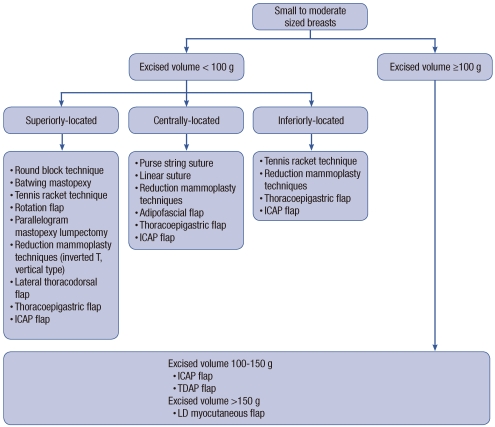
Oncoplastic surgery has revolutionized the field of breast conserving surgery (BCS). The final aims of this technique are to obtain an adequate resection margin that will reduce the rate of local recurrence while simultaneously improving cosmetic outcomes. To obtain successful results after oncoplastic surgery, it is imperative that patients be risk-stratified based on risk factors associated with positive margins, that relevant imaging studies be reviewed, and that the confirmation of negative margins be confirmed during the initial operation. Patients who had small- to moderate-sized breasts are the most likely to be dissatisfied with the cosmetic outcome of surgery, even if the defect is small; therefore, oncoplastic surgery in this population is warranted. Reconstruction of the remaining breast tissue is divided into volume displacement and volume replacement techniques. The use of the various oncoplastic surgeries is based on tumor location and excised breast volume. If the excised volume is less than 100 g, the tumor location is used to determine which technique should be used, with the most commonly used technique being volume displacement. However, if the excised volume is greater than 100 g, the volume replacement method is generally used, and in cases where more than 150 g is excised, the latissimus dorsi myocutaneous flap may be used to obtain a pleasing cosmetic result. The local recurrence rate after oncoplastic surgery was lower than that of conventional BCS, as oncoplastic surgery reduced the rate of positive resection margins by resecting a wider section of glandular tissue. If the surgeon understands the advantages and disadvantages of oncoplastic surgery, and the multidisciplinary breast team is able to successfully collaborate, then the success rate of BCS with partial breast reconstruction can be increased while also yielding a cosmetically appealing outcome.
Keywords: Defect; Oncoplastic surgery; Personalized; Personalized medicine; Repairing.
Conflict of interest statement
The authors declare that they have no competing interests.
Figures
References
-
- Arriagada R, Lê MG, Guinebretiore JM, Dunant A, Rochard F, Tursz T. Late local recurrences in a randomised trial comparing conservative treatment with total mastectomy in early breast cancer patients. Ann Oncol. 2003;14:1617–1622. - PubMed
-
- Fisher B, Anderson S, Bryant J, Margolese RG, Deutsch M, Fisher ER, et al. Twenty-year follow-up of a randomized trial comparing total mastectomy, lumpectomy, and lumpectomy plus irradiation for the treatment of invasive breast cancer. N Engl J Med. 2002;347:1233–1241. - PubMed
-
- Veronesi U, Cascinelli N, Mariani L, Greco M, Saccozzi R, Luini A, et al. Twenty-year follow-up of a randomized study comparing breast-conserving surgery with radical mastectomy for early breast cancer. N Engl J Med. 2002;347:1227–1232. - PubMed
-
- Al-Ghazal SK, Blamey RW. Cosmetic assessment of breast-conserving surgery for primary breast cancer. Breast. 1999;8:162–168. - PubMed
-
- Clough KB, Cuminet J, Fitoussi A, Nos C, Mosseri V. Cosmetic sequelae after conservative treatment for breast cancer: classification and results of surgical correction. Ann Plast Surg. 1998;41:471–481. - PubMed
LinkOut - more resources
Full Text Sources