Ischemic complications occurring in the contralateral hemisphere after surgical treatment of adults with moyamoya disease
- PMID: 22323934
- PMCID: PMC3272508
- DOI: 10.3340/jkns.2011.50.6.492
Ischemic complications occurring in the contralateral hemisphere after surgical treatment of adults with moyamoya disease
Abstract
Objective: Direct revascularization surgery is regarded as the most effective method of treatment of adults with moyamoya disease. These patients, however, have a higher risk of perioperative ischemic complications than do patients with atherosclerotic stroke, and are at risk for ischemic complications in the hemisphere contralateral to the one operated on. We investigated the incidence and risk factors for ischemic stroke in the contralateral hemisphere after surgical treatment of adults with moyamoya disease.
Methods: We retrospectively reviewed the medical records and results of neuroimaging studies on 79 hemispheres of 73 consecutive patients with adult moyamoya disease (mean±SD age, 37.96±11.27 years; range, 18-62 years) who underwent direct bypass surgery over 6 years.
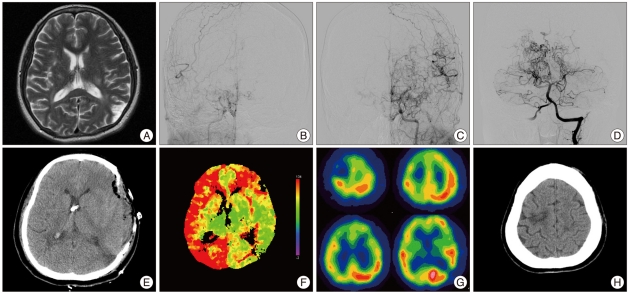
Results: Ischemic complications occurred in 4 of 79 (5.1%) contralateral hemispheres, one with Suzuki stage 3 and three with Suzuki stage 4. Three patients showed posterior cerebral artery (PCA) involvement by moyamoya vessels. Advanced stage of moyamoya disease (Suzuki stages 4/5/6; p=0.001), PCA involvement (p=0.001) and postoperative hypotension (mean arterial blood pressure <80% of preoperative mean arterial blood pressure) on the first (p<0.0001) and second (p=0.003) days after surgery were significantly correlated with postoperative contralateral ischemic complications.
Conclusion: In patients with advanced moyamoya disease and involvement of the PCA, intentional hypotension can result in ischemic stroke in the hemisphere contralateral to the one operated on. Careful control of perioperative blood pressure is crucial for good surgical results.
Keywords: Cerebral revascularization; Complications; Moyamoya diseases; Perioperative period.
Figures
References
-
- Fujimura M, Kaneta T, Shimizu H, Tominaga T. Symptomatic hyperperfusion after superficial temporal artery-middle cerebral artery anastomosis in a child with moyamoya disease. Childs Nerv Syst. 2007;23:1195–1198. - PubMed
-
- Furuya K, Kawahara N, Morita A, Momose T, Aoki S, Kirino T. Focal hyperperfusion after superficial temporal artery-middle cerebral artery anastomosis in a patient with moyamoya disease. Case report. J Neurosurg. 2004;100:128–132. - PubMed
-
- Guzman R, Lee M, Achrol A, Bell-Stephens T, Kelly M, Do HM, et al. Clinical outcome after 450 revascularization procedures for moyamoya disease. Clinical article. J Neurosurg. 2009;111:927–935. - PubMed
-
- Houkin K, Ishikawa T, Yoshimoto T, Abe H. Direct and indirect revascularization for moyamoya disease surgical techniques and peri-operative complications. Clin Neurol Neurosurg. 1997;99(Suppl 2):S142–S145. - PubMed
-
- Iwama T, Hashimoto N, Tsukahara T, Murai B. Peri-operative complications in adult moyamoya disease. Acta Neurochir (Wien) 1995;132:26–31. - PubMed
LinkOut - more resources
Full Text Sources