


Impact of periodontal therapy on the subgingival microbiota of severe periodontitis: comparison between good responders and individuals with refractory periodontitis using the human oral microbe identification microarray
- PMID: 22324467
- PMCID: PMC3971922
- DOI: 10.1902/jop.2012.110566
Impact of periodontal therapy on the subgingival microbiota of severe periodontitis: comparison between good responders and individuals with refractory periodontitis using the human oral microbe identification microarray
Abstract
Background: This study compares the changes to the subgingival microbiota of individuals with "refractory" periodontitis (RP) or treatable periodontitis (good responders [GR]) before and after periodontal therapy by using the Human Oral Microbe Identification Microarray (HOMIM) analysis.
Methods: Individuals with chronic periodontitis were classified as RP (n = 17) based on mean attachment loss (AL) and/or >3 sites with AL ≥2.5 mm after scaling and root planing, surgery, and systemically administered amoxicillin and metronidazole or as GR (n = 30) based on mean attachment gain and no sites with AL ≥2.5 mm after treatment. Subgingival plaque samples were taken at baseline and 15 months after treatment and analyzed for the presence of 300 species by HOMIM analysis. Significant differences in taxa before and post-therapy were sought using the Wilcoxon test.
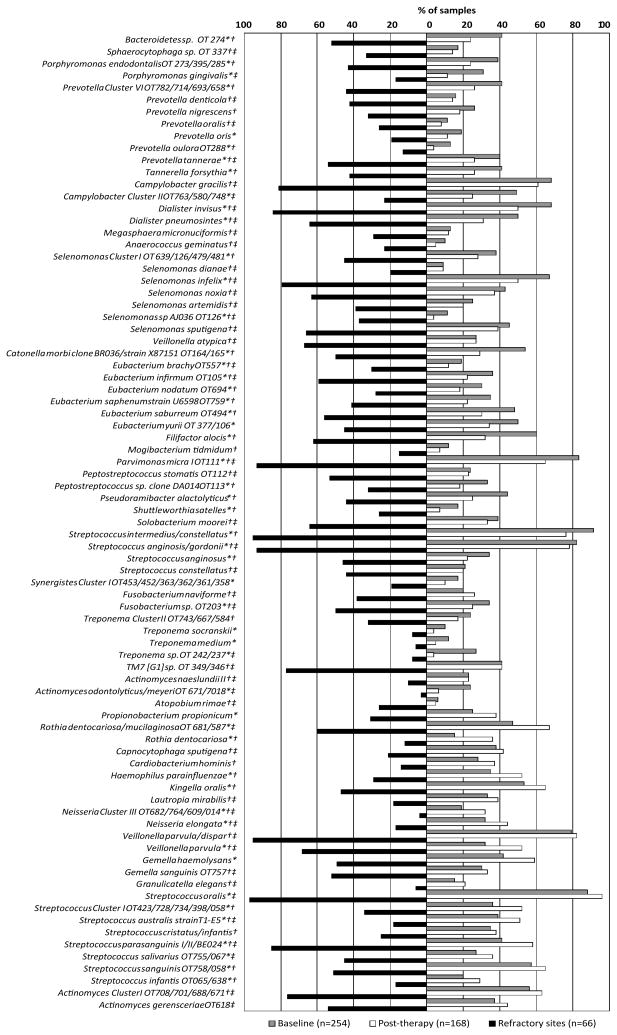
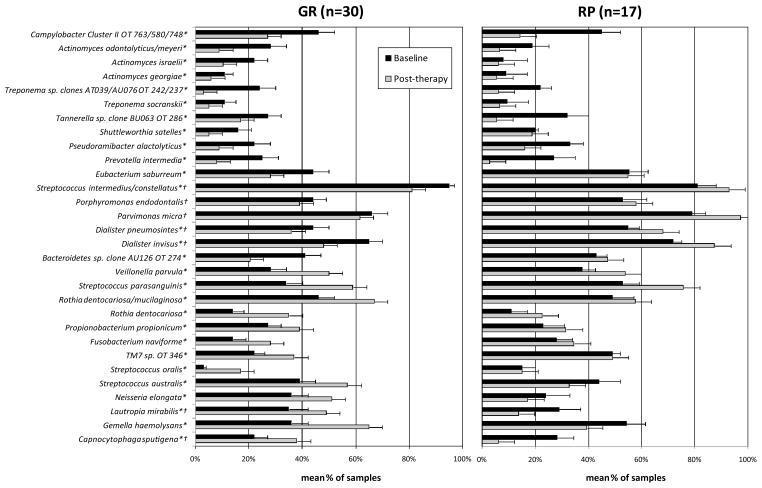
Results: The majority of species evaluated decreased in prevalence in both groups after treatment; however, only a small subset of organisms was significantly affected. Species that increased or persisted in high frequency in RP but were significantly reduced in GR included Bacteroidetes sp., Porphyromonas endodontalis, Porphyromonas gingivalis, Prevotella spp., Tannerella forsythia, Dialister spp., Selenomonas spp., Catonella morbi, Eubacterium spp., Filifactor alocis, Parvimonas micra, Peptostreptococcus sp. OT113, Fusobacterium sp. OT203, Pseudoramibacter alactolyticus, Streptococcus intermedius or Streptococcus constellatus, and Shuttlesworthia satelles. In contrast, Capnocytophaga sputigena, Cardiobacterium hominis, Gemella haemolysans, Haemophilus parainfluenzae, Kingella oralis, Lautropia mirabilis, Neisseria elongata, Rothia dentocariosa, Streptococcus australis, and Veillonella spp. were more associated with therapeutic success.
Conclusion: Persistence of putative and novel periodontal pathogens, as well as low prevalence of beneficial species was associated with chronic refractory periodontitis.
Conflict of interest statement
The authors report no conflicts of interest related to this study.
Figures
References
-
- Haffajee AD, Teles RP, Socransky SS. The effect of periodontal therapy on the composition of the subgingival microbiota. Periodontol 2000. 2006;42:219–258. - PubMed
-
- Teles RP, Haffajee AD, Socransky SS. Microbiological goals of periodontal therapy. Periodontol 2000. 2006;42:180–218. - PubMed
-
- Lindhe J, Westfelt E, Nyman S, Socransky SS, Haffajee AD. Long-term effect of surgical/non-surgical treatment of periodontal disease. J Clin Periodontol. 1984;11:448–458. - PubMed
-
- Hirschfeld L, Wasserman B. A long-term survey of tooth loss in 600 treated periodontal patients. J Periodontol. 1978;49:225–237. - PubMed
-
- MacFall WT., Jr Tooth loss in 100 treated patients with periodontal disease. A long-term study. J Periodontol. 1982;53:539–549. - PubMed
Publication types
MeSH terms
Substances
Grants and funding
LinkOut - more resources
Full Text Sources
Other Literature Sources
Medical
Miscellaneous
