. 2012 Jun;33(3):261-71.
doi: 10.1016/j.neuro.2012.01.014. Epub 2012 Feb 4.

FMRI reveals abnormal central processing of sensory and pain stimuli in ill Gulf War veterans

Affiliations

FMRI reveals abnormal central processing of sensory and pain stimuli in ill Gulf War veterans

Kaundinya Gopinath et al. Neurotoxicology. 2012 Jun.

Abstract

Many veterans chronically ill from the 1991 Gulf War exhibit symptoms of altered sensation, including chronic pain. In this study of 55 veterans of a Construction Battalion previously examined in 1995-1996 and 1997-1998, brain activation to innocuous and noxious heat stimuli was assessed in 2008-2009 with a quantitative sensory testing fMRI protocol in control veterans and groups representing three syndrome variants. Testing outside the scanner revealed no significant differences in warm detection or heat pain threshold among the four groups. In the fMRI study, Syndrome 1 and Syndrome 2, but not Syndrome 3, exhibited hypo-activation to innocuous heat and hyper-activation to noxious heat stimuli compared to controls. The results indicate abnormal central processing of sensory and painful stimuli in 2 of 3 variants of Gulf War illness and call for a more comprehensive study with a larger, representative sample of veterans.


Figures

Figure 1
Figure 1
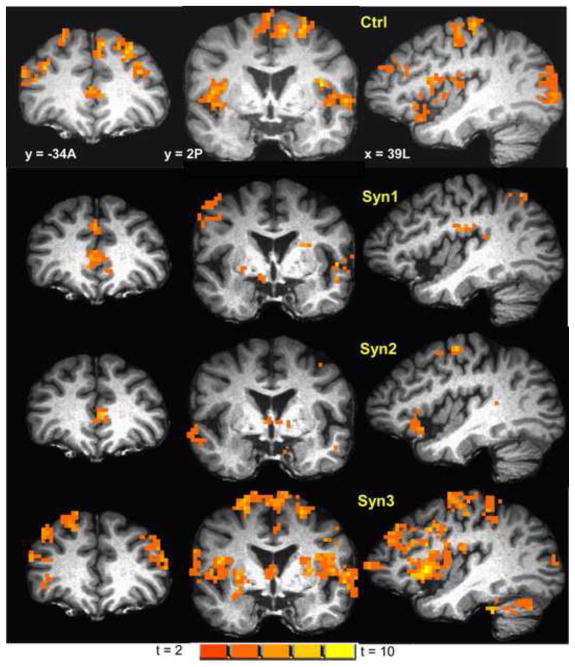
Map of BOLD fMRI brain activation from innocuous heat stimulation of the ventrum of the right forearm in controls (1-sample two-tailed t-test map; cluster-level p < 0.001), overlaid on a representative subject’s spatially normalized high-resolution anatomic. Slice locations in RAI Talairach co-ordinates. Left hemisphere is on the right side of the coronal slices. Figure shows innocuous heat activation in a number of areas including DLPFC, S1, S2, insula and SMA. Activation maps for Syn1, Syn2 and Syn3, at the same slice locations and with same color-scale as controls are also displayed.
Figure 2
Figure 2
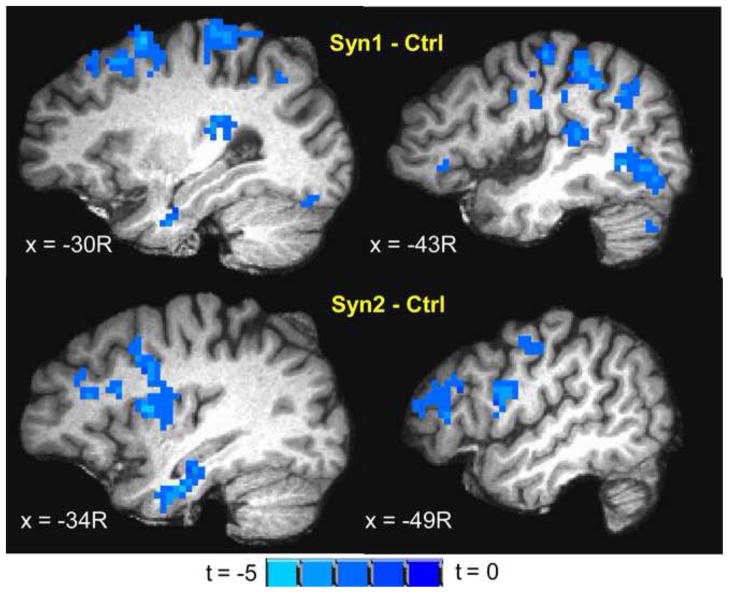
Inter group differences (ANOVA t-contrast; cluster-level p < 0.05) in brain activation to innocuous heat stimulation of ventrum of the right forearm overlaid on a representative subject’s spatially normalized high-resolution anatomic. Slice locations in RAI Talairach co-ordinates. (top) Syn1 – Ctrl showing decreased activation to innocuous heat in Syn1 in S1, S2, insula, DLPFC, precentral gyrus and IPL; (bottom) Syn2 – Ctrl showing decreased activation to innocuous heat in Syn2 in S2, insula, DLPFC and precentral gyrus.
Figure 3
Figure 3
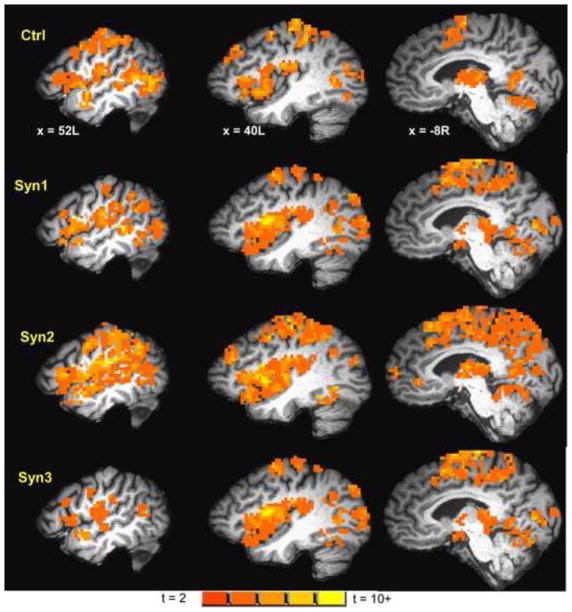
Map of BOLD fMRI brain activation from noxious heat stimulation of the ventrum of the right forearm in controls (1-sample two-tailed t-test map; cluster-level p < 0.0001), heat overlaid on a representative subject’s spatially normalized high-resolution anatomic. Slice locations in RAI Talairach co-ordinates. Figure shows activation to noxious heat in a number of areas including S1, S2, insula, STG, thalamus, and cerebellum. Activation maps for Syn1, Syn2 and Syn3, at the same slice locations and with same color-scale as controls are also displayed.
Figure 4
Figure 4
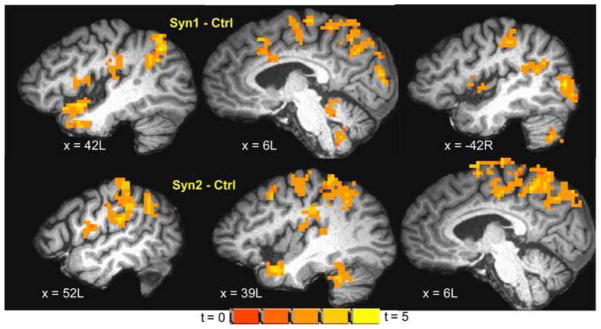
Inter group differences (ANOVA t-contrast; cluster-level p < 0.05) in brain activation to noxious heat stimulation of ventrum of the right forearm overlaid on a representative subject’s spatially normalized high-resolution anatomic. Slice locations in RAI Talairach co-ordinates. (top) Syn1 – Ctrl showing increased activation to noxious heat in Syn1 in S1, S2, insula, IPL, SMA, PCL, BA7 and cerebellum; (bottom) Syn2 – Ctrl showing increased activation to noxious heat in Syn2 in similar regions.

References

    1. Apkarian AV, Bushnell MC, Treede RD, Zubieta JK. Human brain mechanisms of pain perception and regulation in health and disease. Eur J Pain. 2005;9:463–84. - PubMed
    1. Binns JH, Cherry N, Golomb BA, Graves JC, Haley RW, Knox ML, et al. In: Report of Research Advisory Committee on Gulf War Veterans’ Illnesses. Affairs V, editor. Topeka, KS: 2004.
    1. Borsook D, Moulton EA, Tully S, Schmahmann JD, Becerra L. Human cerebellar responses to brush and heat stimuli in healthy and neuropathic pain subjects. Cerebellum. 2008;7:252–72. - PubMed
    1. Bradesi S. Role of spinal cord glia in the central processing of peripheral pain perception. Neurogastroenterol Motil. 2010;22:499–511. - PMC - PubMed
    1. Calley CS, Kraut MA, Spence JS, Briggs RW, Haley RW, Hart J., Jr The neuroanatomic correlates of semantic memory deficits in patients with Gulf War illnesses: a pilot study. Brain Imaging Behav. 2010;4:248–55. - PubMed

Publication types

MeSH terms