


The androgen/androgen receptor axis in prostate cancer
- PMID: 22327838
- PMCID: PMC4161359
- DOI: 10.1097/CCO.0b013e32835105b3
The androgen/androgen receptor axis in prostate cancer
Abstract
Purpose of review: The review highlights recently discovered mechanisms that sustain castration-resistant prostate cancer (CRPC) growth and describes advances in CRPC therapeutics.
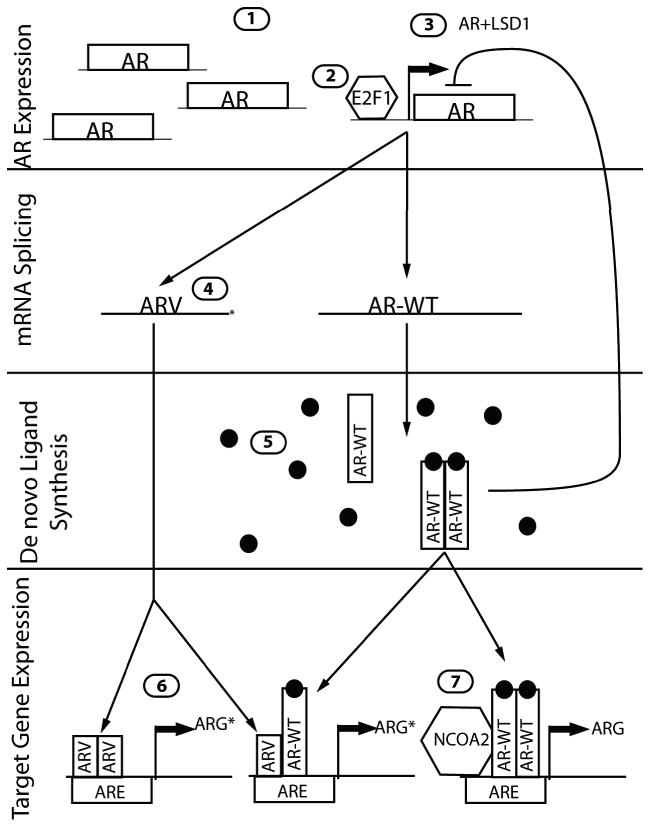
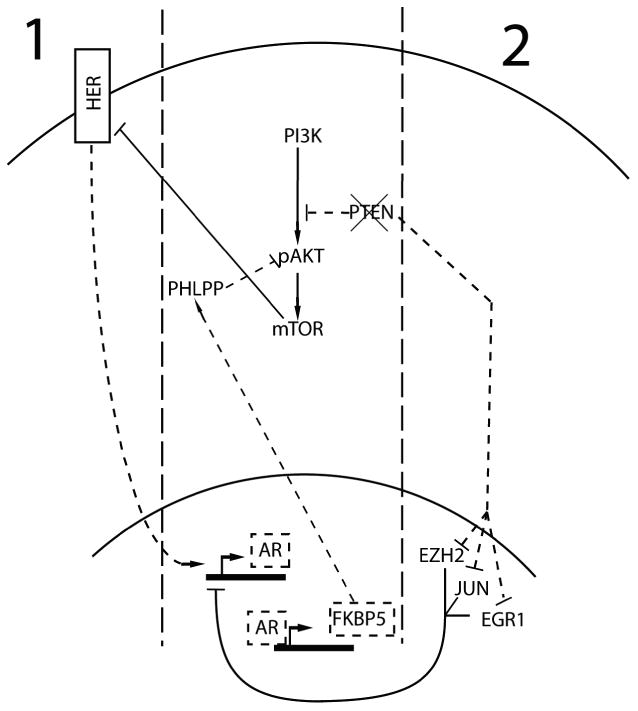
Recent findings: Recent reports have shed new light on the molecular processes underlying CRPC survival during androgen deprivation therapy (ADT). This study summarizes recent findings and comments on their clinical relevance. Included in this review is a discussion on molecular mechanisms that regulate androgen receptor (AR) signaling in normal prostate epithelium and CRPC, biologically significant differences in the androgen-regulated transcriptional programs of androgen-dependent prostate cancer and CRPC, and recent discoveries involving de-novo androgen production and transport. We review the status and results of current clinical trials and finally, discuss the implications of evidence suggesting a declining importance of AR signaling in prostate cancers with PTEN loss.
Summary: Advances in the understanding of AR signaling in CRPC have identified novel drug targets and improved the rational design of targeted therapy, while illuminating a subset of prostate cancers that may progress to become completely independent of the AR signaling program.
Figures
References
-
- Jemal A, Siegel R, Xu J, et al. Cancer statistics, 2010. CA Cancer J Clin. 2010 Sep-Oct;60(5):277–300. - PubMed
-
- Andersen RJ, Mawji NR, Wang J, et al. Regression of castrate-recurrent prostate cancer by a small-molecule inhibitor of the amino-terminus domain of the androgen receptor. Cancer Cell. 2010 Jun 15;17(6):535–46. This study documents the development of the first N-terminal AR inhibitor, EPI-001. Epi-001 inhibits the transcriptional activity full-length AR and LBD-deficient AR variants. - PubMed
-
- Attard G, Reid AH, Yap TA, et al. Phase I clinical trial of a selective inhibitor of CYP17, abiraterone acetate, confirms that castration-resistant prostate cancer commonly remains hormone driven. J Clin Oncol. 2008 Oct 1;26(28):4563–71. - PubMed
-
- Scher HI, Beer TM, Higano CS, et al. Antitumour activity of MDV3100 in castration-resistant prostate cancer: a phase 1-2 study. Lancet. 2010 Apr 24;375(9724):1437–46. A clinical trial demonstrating improvement in serum PSA and radiographic progression in patients treated with the novel antiandrogen MDV3100. - PMC - PubMed
Publication types
MeSH terms
Substances
Grants and funding
LinkOut - more resources
Full Text Sources
Other Literature Sources
Medical
Research Materials
