


Are shoulders with a reverse shoulder prosthesis strong enough? A pilot study
- PMID: 22328239
- PMCID: PMC3392387
- DOI: 10.1007/s11999-012-2277-8
Are shoulders with a reverse shoulder prosthesis strong enough? A pilot study
Abstract
Background: It has been suggested that limited active ROM of reverse shoulder prostheses relates to lack of strength. However, the postoperative strength has not been quantified.
Questions/purposes: We therefore measured joint torques in patients with reverse shoulder prostheses and correlated torques with functional scores.
Methods: We recruited 33 patients (age, 72 ± 8 years) with a reverse prosthesis (37 shoulders, 21 primary and 16 revisions). We obtained Constant-Murley, DASH, and Simple Shoulder Test ([D]SST) scores, and performed two isokinetic protocols (abduction/adduction and external/internal rotation) at 60° per second. Minimum followup was 4 months (average, 23 months; range, 4-63 months).
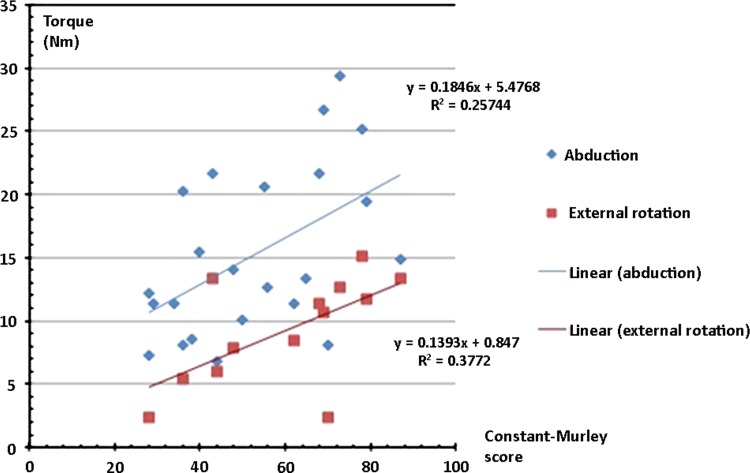
Results: Twenty-three patients (24 shoulders; 13 primaries, 11 revisions) were able to perform at least one of the defined tasks. Mean abduction and adduction torques were 15 Nm ± 7 Nm and 16 Nm ± 10 Nm (19%-78% of normal shoulders). External and internal rotation tasks could be performed by only 13 patients (14 shoulders; nine primary, five revisions) generating 9 Nm ± 4 Nm and 8 Nm ± 3 Nm, respectively (13%-71% of normal shoulders). We found moderate correlations between Constant-Murley, DASH and (D)SST (D = Dutch translation) scores and abduction and external rotation.
Conclusions: Patients with a reverse prosthesis had reduced strength when compared with normal values reported in the literature (only 65% of patients could perform the protocol). This effect was greatest for external rotation and might explain clinical outcomes with which a moderately strong relationship was observed. Our observations suggest limited strength is a major factor in reduced ROM.
Figures
References
Publication types
MeSH terms
LinkOut - more resources
Full Text Sources
Medical
