. 2012 Jun 14;116(23):6798-805.
doi: 10.1021/jp212457w. Epub 2012 Mar 2.

Side chain independent recognition of aminoacyl adenylates by the Hint1 transcription suppressor

Affiliations
Free PMC article

Side chain independent recognition of aminoacyl adenylates by the Hint1 transcription suppressor

Jing Wang et al. J Phys Chem B. .
Free PMC article

Abstract

Human Hint1 suppresses specific gene transcription by interacting with the transcription factor MITF in mast cells. Hint1 activity is connected to lysyl-tRNA synthetase (LysRS), a member of the universal aminoacyl tRNA synthetase family that catalyzes specific aminoacylation of their cognate tRNAs, through an aminoacyl adenylate (aa-AMP) intermediate. During immune activation, LysRS produces a side-product diadenosine tetraphosphate (Ap(4)A) from the condensation of Lys-AMP with ATP. The pleiotropic signaling molecule Ap(4)A then binds Hint1 to promote activation of MITF-target gene transcription. Earlier work showed that Hint1 can also bind and hydrolyze Lys-AMP, possibly to constrain Ap(4)A production. Because Ap(4)A can result from condensation of other aa-AMP's with ATP, the specificity of the Hint1 aa-AMP-hydrolysis activity is of interest. Here we show that Hint1 has broad specificity for adenylate hydrolysis, whose structural basis we revealed through high-resolution structures of Hint1 in complex with three different aa-AMP analogues. Hint1 recognizes only the common main chain of the aminoacyl moiety, and has no contact with the aa side chain. The α-amino group is anchored by a cation-pi interaction with Trp123 at the C-terminus of Hint1. These results reveal the structural basis for the remarkable adenylate surveillance activity of Hint1, to potentially control Ap(4)A levels in the cell.


Figures
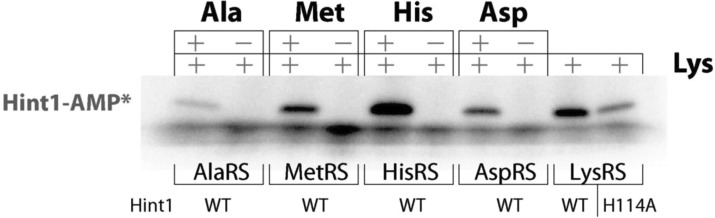
Figure 1
Figure 1
aa-AMP hydrolysis by Hint1 is general. Hint1 was incubated with alpha-32P-ATP, l-lysine, and separately with five different tRNA synthetases, with/without the cognate amino acids. The reaction was quenched at 1 min and analyzed by SDS-PAGE and autoradiography. Although lysine is present in each reaction mixture, Hint1-AMP only forms when LysRS is present, or when there is another tRNA synthetase with its cognate amino acid. An active site mutant Hint1_H114A, which was characterized in this work, was also used to coincubate with LysRS and l-Lys.
Figure 2
Figure 2
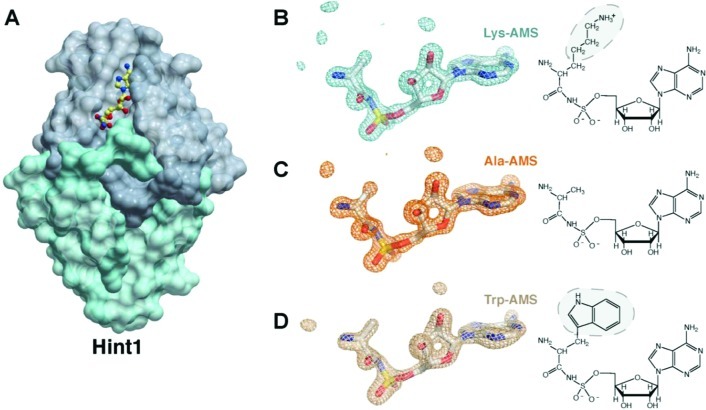
Complex structure of human Hint1 with Lys-AMS, Ala-AMS, and Trp-AMS. (A) Dimeric structure of Hint1 in complex with Lys-AMS. One subunit of the Hint1 dimer contains the ligand. (B–D) Electron density maps of the bound aa-AMS analogues. The refined 2Fo-Fc density maps are shown at 1.0 σ. Chemical structures of the analogues are shown on the right, with electron densities missing from the side chains highlighted by shading on the chemical structures.
Figure 3
Figure 3
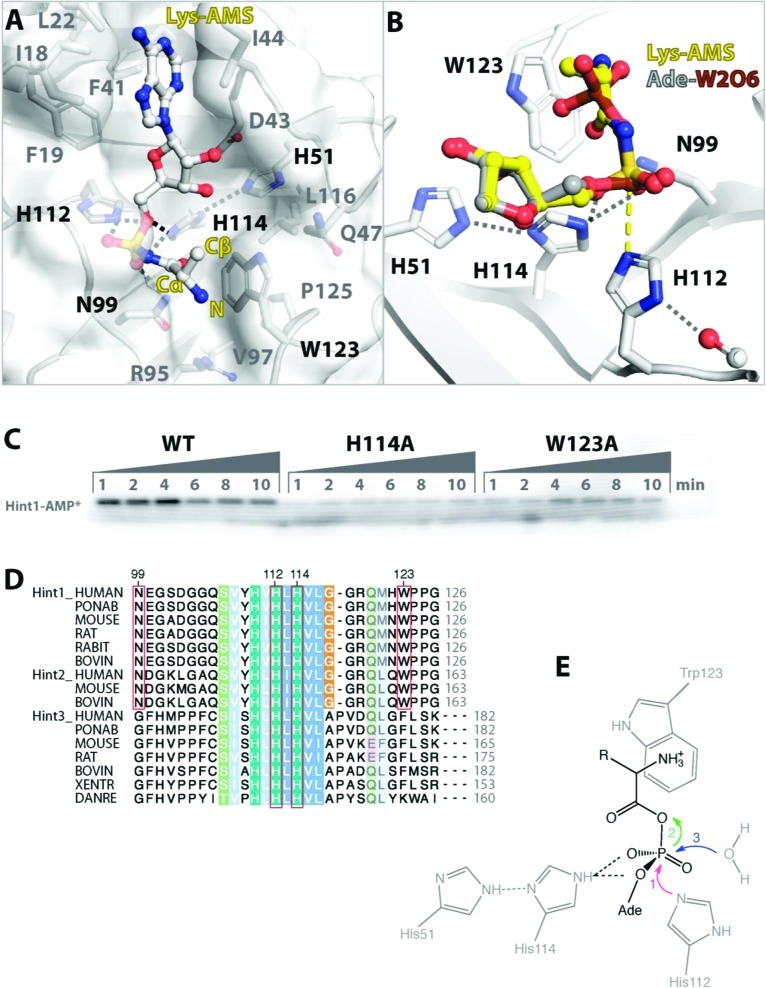
Hydrolysis of Lys-AMP by Hint1. (A) Detailed interaction of Lys-AMS with human Hint1. The α-amino group of the lysyl group in Lys-AMS forms a cation-π interaction with the aromatic ring of Trp123. (B) Structural superimposition of Hint1/Lys-AMS with the transition state complex of Hint1/adenosine-5′-ditungstate (Ade-W2O6, PDB 6FIT). The sulfate group of Lys-AMS is located close to the α tungstate group of Ade-W2O6. A yellow dashed line indicates the covalent bond formed between the α tungsten (brown) and Nε of the H112 side chain. The overlapped adenosine moieties of these two ligands are not shown. (C) Formation of the covalent Hint1-AMP intermediate shows the important role of H114 and W123 for hydrolysis of Lys-AMP. The reaction conditions are as described in the legend to Figure 1. (D) Sequence alignment of vertebrate HINT proteins. Critical residues involved in the binding and hydrolysis of aa-AMP's are boxed in red, and are conserved in Hint1’s and its Hint2 paralogs (which function in mitochondria). Different residues are found in Hint3's, whose function is less characterized. (E) Catalytic mechanism proposed for the hydrolysis of aa-AMP's by human Hint1.
Figure 4
Figure 4
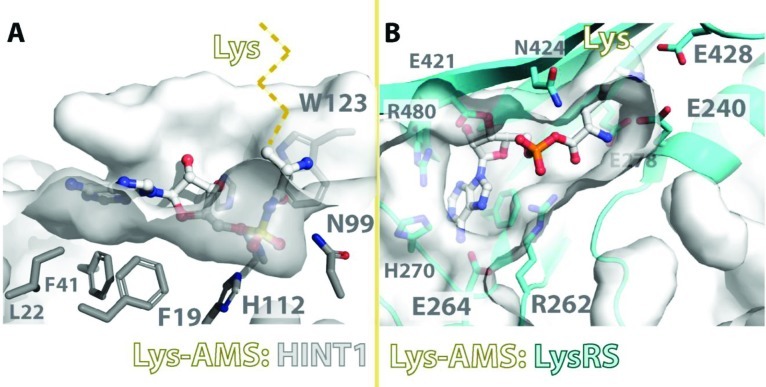
Recognition of Lys-AMP by Hint1 vs LysRS. The Lys-AMS binding pocket of human Hint1 in comparison with the pocket of LysRS (PDB 1E1T) shows side chain independent recognition of Lys-AMP by Hint1. Residues responsible for recognition of the lysyl-AMS in Hint1 and LysRS are depicted. The potential direction of the Lys side chain in the Hint1/Lys-AMS structure is shown as a dashed line.

References

    1. Brenner C.; Bieganowski P.; Pace H. C.; Huebner K. J. Cell. Physiol. 1999, 181, 179–187. - PMC - PubMed
    1. Su T.; Suzui M.; Wang L.; Lin C. S.; Xing W. Q.; Weinstein I. B. Proc. Natl. Acad. Sci. U.S.A. 2003, 100, 7824–7829. - PMC - PubMed
    1. Li H.; Zhang Y.; Su T.; Santella R. M.; Weinstein I. B. Oncogene 2006, 25, 713–721. - PubMed
    1. Li H.; Balajee A. S.; Su T.; Cen B.; Hei T. K.; Weinstein I. B. J. Cell Biol. 2008, 183, 253–265. - PMC - PubMed
    1. Weiske J.; Huber O. J. Biol. Chem. 2006, 281, 27356–27366. - PubMed

Publication types

MeSH terms