Review
. 2012 May;14(5):644-55.
doi: 10.1111/j.1462-5822.2012.01774.x. Epub 2012 Mar 8.

Human cytomegalovirus persistence

Affiliations
Review

Human cytomegalovirus persistence

Felicia Goodrum et al. Cell Microbiol. 2012 May.

Abstract

Viral persistence is the rule following infection with all herpesviruses. The β-herpesvirus, human cytomegalovirus (HCMV), persists through chronic and latent states of infection. Both of these states of infection contribute to HCMV persistence and to the high HCMV seroprevalence worldwide. The chronic infection is poorly defined molecularly, but clinically manifests as low-level virus shedding over extended periods of time and often in the absence of symptoms. Latency requires long-term maintenance of viral genomes in a reversibly quiescent state in the immunocompetent host. In this review, we focus on recent advances in the biology of HCMV persistence, particularly with respect to the latent mode of persistence. Latently infected individuals harbour HCMV genomes in haematopoietic cells and maintain large subsets of HCMV-specific T-cells. In the last few years, impressive advances have been made in understanding virus-host interactions important to HCMV infection, many of which will profoundly impact HCMV persistence. We discuss these advances and their known or potential impact on viral latency. As herpesviruses are met with similar challenges in achieving latency and often employ conserved strategies to persist, we discuss current and future directions of HCMV persistence in the context of the greater body of knowledge regarding α- and γ-herpesviruses persistence.


Figures

Figure 1
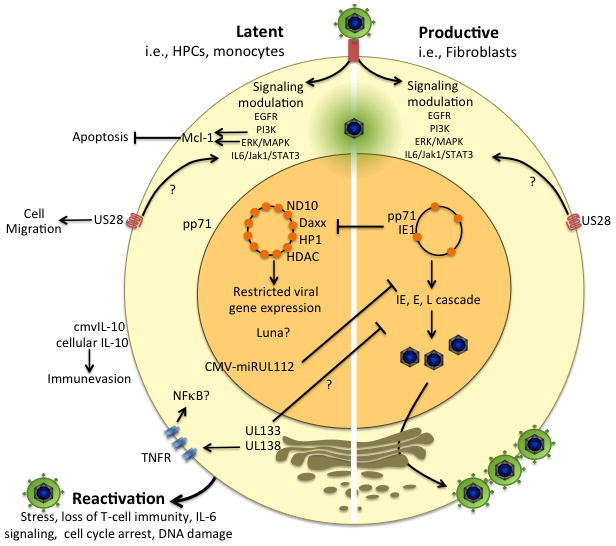
Figure 1. Key virus-cell interactions contributing to viral fate decisions
The outcome of infection is dictated through complex and opposing virus-host interactions that promote cellular states that are permissive or restrictive to viral replication. Signaling events initiated either upon viral entry or following viral gene expression are undoubtedly critical to establishing cellular environments for productive replication or latency. The cellular Mcl-1 survival protein is upregulated in cells that support a latent infection by PI3K or MAPK/ERK activation. US28 is a viral chemokine receptor homologue that functions importantly in signaling during both productive and latent states of infection, and may promote viral dissemination by upregulating monocyte and macrophage motility. US28 activates IL6/JAK1/STAT3 signaling but the impact of this action on the productive or latent infections are not known. Transport of the pp71 tegument protein into the nucleus is critical to intrinsic ND10 defenses and chromatinization of the virus genome to permit viral gene expression. Retention of pp71 in the cytoplasm and a failure to disarm ND10 defenses may contribute to latency. The IE1-72kDa gene product also functions to inhibit intrinsic ND10 defenses and innate defenses for productive replication. Further, latency-associated viral determinants including UL133-UL138 and miR-UL112 impede viral replication to favor the latent state. miR-UL112 directly inhibits IE gene expression, but the mechanism by which UL133-UL138 suppresses viral replication is not know. While UL138 enhances TNFR on the cell surface, how this activity and subsequent activation of NFκB contributes to the latent HCMV infection is not known. miR-UL112 and cmvIL-10 function to assuage the immune response to latently infected cells. The outcome of infection is highly dependent upon the cell type infected. While other reservoirs of latent and productive infection exist (i.e, endothelial, epithelial), molecular aspects of persistence in these cells have not yet been thoroughly investigated. For some pathways and determinants indicated in the diagram, mechanistic details or the precise role in latency are not fully know, as indicated by the question mark.

References

    1. Ahn JH, Hayward GS. The major immediate-early proteins IE1 and IE2 of human cytomegalovirus colocalize with and disrupt PML-associated nuclear bodies at very early times in infected permissive cells. J Virol. 1997;71:4599–4613. - PMC - PubMed
    1. Avdic S, Cao JZ, Cheung AK, Abendroth A, Slobedman B. Viral Interleukin-10 Expressed by Human Cytomegalovirus during the Latent Phase of Infection Modulates Latently Infected Myeloid Cell Differentiation. J Virol. 2011;85:7465–7471. - PMC - PubMed
    1. Bego M, Maciejewski J, Khaiboullina S, Pari G, St Jeor S. Characterization of an antisense transcript spanning the UL81–82 locus of human cytomegalovirus. J Virol. 2005;79:11022–11034. - PMC - PubMed
    1. Bego MG, Keyes LR, Maciejewski J, St Jeor SC. Human cytomegalovirus latency-associated protein LUNA is expressed during HCMV infections in vivo. Arch Virol. 2011;156:1847–1851. - PubMed
    1. Beisser PS, Laurent L, Virelizier JL, Michelson S. Human cytomegalovirus chemokine receptor gene US28 is transcribed in latently infected THP-1 monocytes. J Virol. 2001;75:5949–5957. - PMC - PubMed

Publication types