


Comparison of methods to assess energy expenditure and physical activity in people with spinal cord injury
- PMID: 22330189
- PMCID: PMC3240915
- DOI: 10.1179/2045772311Y.0000000046
Comparison of methods to assess energy expenditure and physical activity in people with spinal cord injury
Abstract
Objective: To compare different methods of assessing energy expenditure (EE) and physical activity (PA) in people with spinal cord injury (SCI) under community-dwelling conditions.
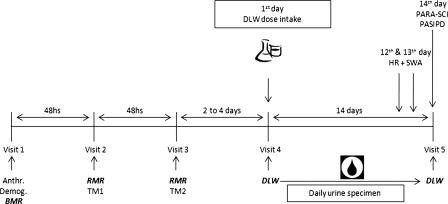
Methods: A reference standard encompassing the doubly labelled water (DLW) technique, heart rate monitoring (FLEX-HR), a multi-sensor armband (SenseWear Armband (SWA)), and two PA recall questionnaires were employed in 14 people with SCI to estimate EE and leisure-time PA.
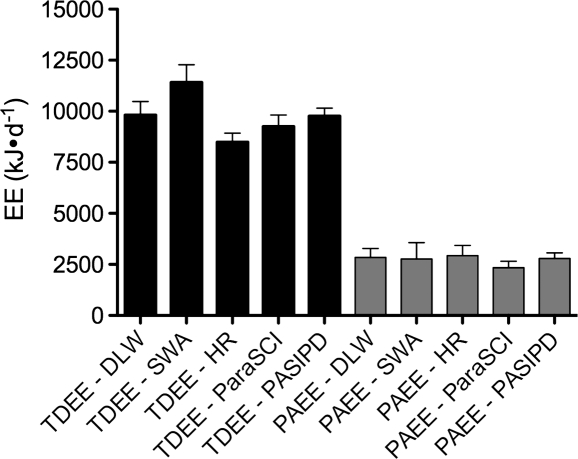
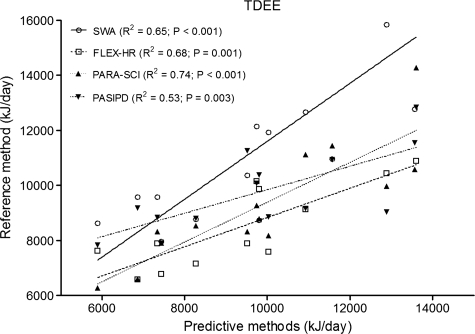
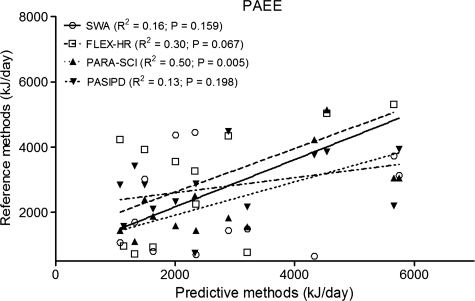
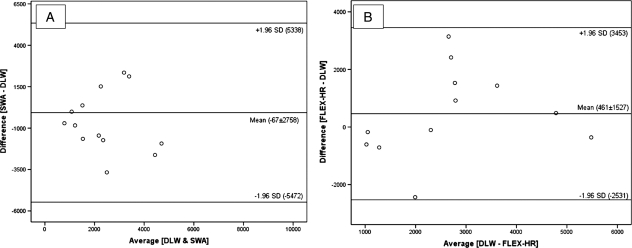
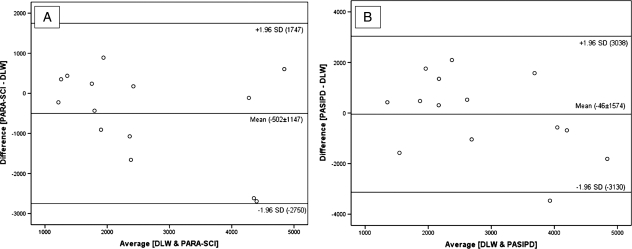
Results: Mean total daily energy expenditure (TDEE) assessed by DLW, FLEX-HR, and SWA were 9817 ± 2491 kJ/day, 8498 ± 1516 kJ/day, and 11414 ± 3242 kJ/day, respectively. Physical activity energy expenditure (PAEE) quantified by DLW was 2841 ± 1626 kJ/day, 2935 ± 1732 kJ/day estimated from FLEX-HR, and 2773 ± 2966 kJ/day derived from SWA. After converting the PA recall questionnaire data to EE in kJ/day, PAEE for the Physical Activity Recall Assessment for People with Spinal Cord Injury (PARA-SCI) was 2339 ± 1171 kJ/day and for Physical Activity Scale for Individuals with Physical Disabilities (PASIPD) 749 ± 1026 kJ/day. DLW-quantified PAEE was moderately associated with PARA-SCI (R(2) = 0.62, P < 0.05), but not with the other estimates of PAEE (R(2) ranged between 0.13 and 0.30, P > 0.05).
Conclusion: Our findings revealed that the PARA-SCI recall questionnaire was the best estimate of PAEE compared to the reference standard DLW approach. Although the between-method variability for SWA, FLEX-HR, and PASIPD-derived PAEE was small, there was a weak association between these methods and the criterion DLW technique. The best estimate of DLW-quantified TDEE was by FLEX-HR. SWA significantly overestimated TDEE in this population.
Figures
References
-
- Levine JA. Measurement of energy expenditure. Public Health Nutr 2005;8(7A):1123–32 - PubMed
-
- Buchholz AC, Pencharz PB. Energy expenditure in chronic spinal cord injury. Curr Opin Clin Nutr Metab Care 2004;7(6):635–9 - PubMed
-
- Sedlock DA, Laventure SJ. Body-composition and resting energy-expenditure in long-term spinal-cord injury. Paraplegia 1990;28(7):448–54 - PubMed
-
- Buchholz AC, McGillivray CF, Pencharz PB. Physical activity levels are low in free-living adults with chronic paraplegia. Obes Res 2003;11(4):563–70 - PubMed
-
- Bauman WA. Carbohydrate and lipid metabolism in chronic spinal cord injury. J Spinal Cord Med 2001;24(4):266–77 - PubMed
Publication types
MeSH terms
LinkOut - more resources
Full Text Sources
Medical
