Targeting glucose metabolism for cancer therapy
- PMID: 22330683
- PMCID: PMC3280882
- DOI: 10.1084/jem.20120162
Targeting glucose metabolism for cancer therapy
Abstract
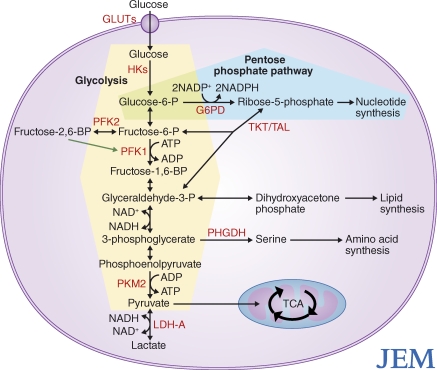
Cellular transformation is associated with the reprogramming of cellular pathways that control proliferation, survival, and metabolism. Among the metabolic changes exhibited by tumor cells is an increase in glucose metabolism and glucose dependence. It has been hypothesized that targeting glucose metabolism may provide a selective mechanism by which to kill cancer cells. In this minireview, we discuss the benefits that high levels of glycolysis provide for tumor cells, as well as several key enzymes required by cancer cells to maintain this high level of glucose metabolism. It is anticipated that understanding which metabolic enzymes are particularly critical for tumor cell proliferation and survival will identify novel therapeutic targets.
Figures
References
-
- Anastasiou D., Poulogiannis G., Asara J.M., Boxer M.B., Jiang J.K., Shen M., Bellinger G., Sasaki A.T., Locasale J.W., Auld D.S., et al. 2011. Inhibition of pyruvate kinase M2 by reactive oxygen species contributes to cellular antioxidant responses. Science. 334:1278–1283 10.1126/science.1211485 - DOI - PMC - PubMed
Publication types
MeSH terms
Substances
Grants and funding
LinkOut - more resources
Full Text Sources
Other Literature Sources