. 2011 Jul 26;1(1):11.
doi: 10.1186/2042-1001-1-11.

Epigenetic remodelling of brain, body and behaviour during phase change in locusts

Affiliations

Epigenetic remodelling of brain, body and behaviour during phase change in locusts

Malcolm Burrows et al. Neural Syst Circuits. .

Abstract

The environment has a central role in shaping developmental trajectories and determining the phenotype so that animals are adapted to the specific conditions they encounter. Epigenetic mechanisms can have many effects, with changes in the nervous and musculoskeletal systems occurring at different rates. How is the function of an animal maintained whilst these transitions happen? Phenotypic plasticity can change the ways in which animals respond to the environment and even how they sense it, particularly in the context of social interactions between members of their own species. In the present article, we review the mechanisms and consequences of phenotypic plasticity by drawing upon the desert locust as an unparalleled model system. Locusts change reversibly between solitarious and gregarious phases that differ dramatically in appearance, general physiology, brain function and structure, and behaviour. Solitarious locusts actively avoid contact with other locusts, but gregarious locusts may live in vast, migrating swarms dominated by competition for scarce resources and interactions with other locusts. Different phase traits change at different rates: some behaviours take just a few hours, colouration takes a lifetime and the muscles and skeleton take several generations. The behavioural demands of group living are reflected in gregarious locusts having substantially larger brains with increased space devoted to higher processing. Phase differences are also apparent in the functioning of identified neurons and circuits. The whole transformation process of phase change pivots on the initial and rapid behavioural decision of whether or not to join with other locusts. The resulting positive feedback loops from the presence or absence of other locusts drives the process to completion. Phase change is accompanied by dramatic changes in neurochemistry, but only serotonin shows a substantial increase during the critical one- to four-hour window during which gregarious behaviour is established. Blocking the action of serotonin or its synthesis prevents the establishment of gregarious behaviour. Applying serotonin or its agonists promotes the acquisition of gregarious behaviour even in a locust that has never encountered another locust. The analysis of phase change in locusts provides insights into a feedback circuit between the environment and epigenetic mechanisms and more generally into the neurobiology of social interaction.


Figures

Figure 1
Figure 1
Body and brain changes between solitarious and gregarious locusts. (A) Differences in colouration and body size and shape in final larval instar and adult solitarious and gregarious locusts are shown. (B) Differences in brain size and proportions of particular regions in solitarious (left) and gregarious (right) brains of adult locusts are shown. Data from [13]. Regions in the midbrain (MBr) include the olfactory antennal lobe (AL) and three neuropils in the mushroom body: the olfactory primary calyx (pcx), the gustatory accessory calyx (acx) and the multimodal lobes (lb). The optic lobe (OL) comprises three successive visual neuropils: the lamina (la), the medulla (me) and the lobula (lo). Absolute total brain size is 27% larger in gregarious locusts. The remaining numbers refer to the differences in proportions of different brain regions relative to total brain size. Positive numbers indicate that a region is disproportionally larger in gregarious locusts than in solitarious locusts (**P < 0.01; *P < 0.05; +P < 0.1).
Figure 2
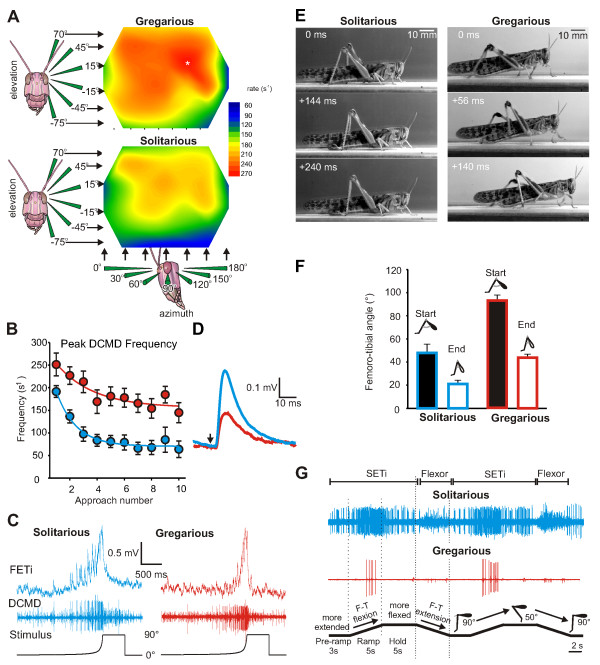
Figure 2
Differences in identified neurons and neuronal circuits between solitarious and gregarious locusts. (A) The receptive field organization of the visual looming detector neuron DCMD across a visual hemisphere in solitary and gregarious locusts is shown. Maximum spike rates of DCMD are colour-coded. Data from [23]. (B) The DCMD of solitarious locusts (blue) shows more pronounced habituation to a visual stimulus repeated at 45-second intervals than that in gregarious locusts (red). (C) Compound EPSP response in FETi (upper trace) evoked by activity in the DCMD (middle trace) following exposure to a looming stimulus (angular subtense to 90°, lower trace) is shown. (D) EPSPs evoked by individual DCMD spikes in FETi are twice the amplitude in solitarious locusts (blue) compared to those in gregarious locusts (red). Data for (B) through (D) are from [24]. (E) Individual frames from walking sequences of solitarious and gregarious locusts are shown. (F) Histograms of excursions of the hind femorotibial joint during a walking step by solitarious and gregarious locusts are shown. (G) SETi shows tonic activity and a consistently greater response during an imposed resistance reflex of the hind femorotibial joint in solitarious locusts compared to gregarious locusts. Data for (E) through (G) are from [28].
Figure 3
Figure 3
Changes from solitarious to gregarious behaviour occur rapidly and are mediated by serotonin. (A) Behaviour of a solitarious locust (top) and a gregarious locust (bottom) in the test arena is shown. A group of gregarious locusts is presented behind a clear, perforated wall to the right. Shown are representative tracks over ten minutes. After an initial jump, the solitarious locust moves slowly away from the group of locusts and spends a large proportion of the time motionless. The gregarious locust covers much more ground, spends a significant period close to the locust group and is rarely still. (B) Long-term solitarious and long-term gregarious locusts differ markedly in the amounts of key neurotransmitters and neuromodulators found in the CNS. Data from solitarious locusts (blue) are expressed as multiples of the amount found in gregarious (red) CNS (error bars are standard errors of the mean). (C) Time course of changes in serotonin in different brain regions during the entire phase change process, from the initial separation of long-term gregarious locusts through up to three generations of isolation, followed by increasing durations of crowding of long-term solitarious locusts; optic lobes (blue), central brain (red), thoracic ganglia (green). Data for (B) and (C) are from [36]. (D) Serotonin is (i) necessary and (ii) sufficient to induce behavioural gregarization. Histograms showing proportions of locusts displaying fully solitarious (Pgreg = 0 to 0.2) through to fully gregarious (Pgreg = 0.8 to 1) behaviour as measured in the arena (A). In (i), locusts were injected with the serotonin synthesis inhibitor α-methyl tryptophan (AMTP) or a saline control and then subjected to gregarizing stimuli for two hours; AMTP-treated locusts remained solitarious, unlike the controls. In (ii), serotonin or saline was topically applied to the thoracic ganglia for two hours in the complete absence of gregarizing stimuli; serotonin promoted gregarious behaviour. (E) Diagrammatic summary of the behavioural gregarization pathway and the role of serotonin as revealed by pharmacological manipulations such as those shown in (D).

References

    1. Warkentin KM. Adaptive plasticity in hatching age: a response to predation risk trade-offs. Proc Natl Acad Sci USA. 1995;92:3507–3510. doi: 10.1073/pnas.92.8.3507. - DOI - PMC - PubMed
    1. Marcuccilli CJ, Miller RJ. CNS stress response: too hot to handle? Trends Neurosci. 1994;17:135–138. doi: 10.1016/0166-2236(94)90085-X. - DOI - PubMed
    1. Brönmark C, Miner JG. Predator-induced phenotypical change in body morphology in crucian carp. Science. 1992;258:1348–1350. doi: 10.1126/science.258.5086.1348. - DOI - PubMed
    1. Charmantier A, McCleery RH, Cole LR, Perrins C, Kruuk LE, Sheldon BC. Adaptive phenotypic plasticity in response to climate change in a wild bird population. Science. 2008;320:800–803. doi: 10.1126/science.1157174. - DOI - PubMed
    1. Hunt J, Brooks R, Jennions MD, Smith MJ, Bentsen CL, Bussière LF. High-quality male field crickets invest heavily in sexual display but die young. Nature. 2004;432:1024–1027. doi: 10.1038/nature03084. - DOI - PubMed

LinkOut - more resources