


Bovine milk as a source of functional oligosaccharides for improving human health
- PMID: 22332060
- PMCID: PMC3090169
- DOI: 10.3945/an.111.000455
Bovine milk as a source of functional oligosaccharides for improving human health
Abstract
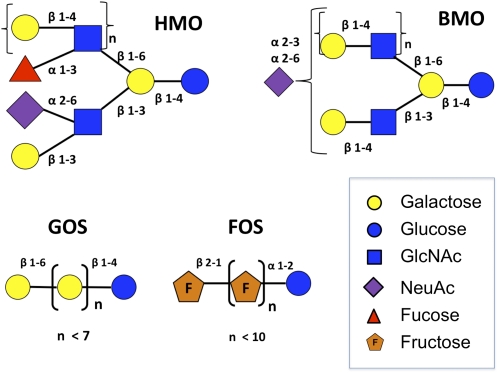
Human milk oligosaccharides are complex sugars that function as selective growth substrates for specific beneficial bacteria in the gastrointestinal system. Bovine milk is a potentially excellent source of commercially viable analogs of these unique molecules. However, bovine milk has a much lower concentration of these oligosaccharides than human milk, and the majority of the molecules are simpler in structure than those found in human milk. Specific structural characteristics of milk-derived oligosaccharides are crucial to their ability to selectively enrich beneficial bacteria while inhibiting or being less than ideal substrates for undesirable and pathogenic bacteria. Thus, if bovine milk products are to provide human milk-like benefits, it is important to identify specific dairy streams that can be processed commercially and cost-effectively and that can yield specific oligosaccharide compositions that will be beneficial as new food ingredients or supplements to improve human health. Whey streams have the potential to be commercially viable sources of complex oligosaccharides that have the structural resemblance and diversity of the bioactive oligosaccharides in human milk. With further refinements to dairy stream processing techniques and functional testing to identify streams that are particularly suitable for enriching beneficial intestinal bacteria, the future of oligosaccharides isolated from dairy streams as a food category with substantiated health claims is promising.
Conflict of interest statement
Author disclosures: A. M. Zivkovic and D. Barile received research funding from the Dairy Research Institute and the California Dairy Research Foundation.
Figures
References
-
- Kunz C, Rudloff S, Baier W, Klein N, Strobel S. Oligosaccharides in human milk: structural, functional, and metabolic aspects. Annu Rev Nutr. 2000;20:699–722 - PubMed
-
- Eiwegger T, Stahl B, Schmitt J, Boehm G, Gerstmayr M, Pichler J, Dehlink E, Loibichler C, Urbanek R, et al. Human milk-derived oligosaccharides and plant-derived oligosaccharides stimulate cytokine production of cord blood T-cells in vitro. Pediatr Res. 2004;56:536–40 - PubMed
Publication types
MeSH terms
Substances
Grants and funding
LinkOut - more resources
Full Text Sources
Other Literature Sources
Medical
