Review
. 2011 Nov;2(6):463-71.
doi: 10.3945/an.111.001008. Epub 2011 Nov 3.

The impact of nutrition on differential methylated regions of the genome

Affiliations
Review

The impact of nutrition on differential methylated regions of the genome

Anne Parle-McDermott et al. Adv Nutr. 2011 Nov.

Abstract

Nutrition has always played an important role in health and disease, ranging from common diseases to its likely contribution to the fetal origins of adult disease. However, deciphering the molecular details of this role is much more challenging. The impact of nutrition on the methylome, i.e., DNA methylation, has received particular attention in more recent years. Our understanding of the complexity of the methylome is evolving as efforts to catalog the DNA methylation differences that exist between different tissues and individuals continue. We review selected examples of animal and human studies that provide evidence that, in fact, specific genes and DNA methylation sites are subject to change during development and during a lifetime as a direct response to nutrition. Investigation of the methyl donors folate, choline, and methionine provide the most compelling evidence of a role in mediating DNA methylation changes. Although a number of candidate regions/genes have been identified to date, we are just at the beginning in terms of cataloging so-called nutrient-sensitive methylation variable positions in humans.


Conflict of interest statement

Author disclosures: M. Ozaki and A. Parle-McDermott, no conflicts of interest.

Figures
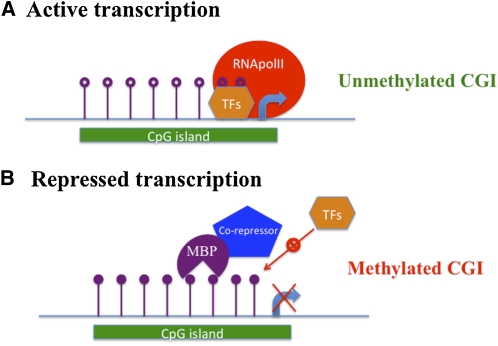
FIGURE 1
FIGURE 1
The role of CGI methylation in the control of gene transcription. Unmethylated and methylated CGIs in the promoter region of a given gene are shown. Open circle lollipops indicate unmethylated cytosines; closed circle lollipops indicate methylated cytosines. The nucleosomes of chromatin are not shown. (A) Unmethylated CGIs are usually in a transcriptionally permissive state in tandem with specific histone modifications. TFs recognize specific DNA motifs in the promoter and facilitate binding of the RNA polymerase II (RNApolII) complex to initiate transcription at the transcription start site (curved arrow). (B) Methylated CGIs are associated with a transcriptionally repressed state. This is thought to be due to the binding of MBP, which recognizes methylated cytosines, which subsequently recruit co-repressor complexes that influence the chromatin state via histone deacetylases and ultimately prevent binding by TFs. An alternative mechanism is that methylated cytosines directly prevent binding of TFs. CGI, CpG island; MBP, methyl-binding protein; TFs, transcription factors.
FIGURE 2
FIGURE 2
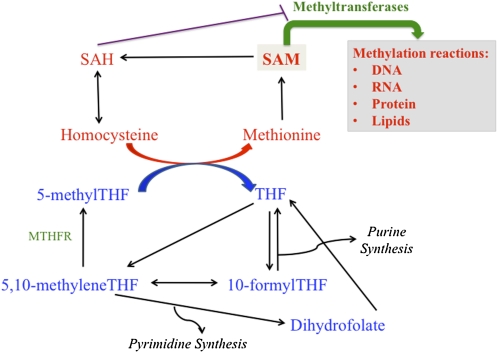
A simplified view of cytoplasmic 1C folate metabolism. Not all enzymes are shown. The reactions in blue supply the 1Cs required for DNA synthesis. The reactions in red form part of the folate pathway that produces the methyl donor SAM. A range of methyltransferase enzymes catalyze the transfer of the methyl group (CH3) from SAM to a number of substrates including DNA, i.e., methylation reactions. SAH is an inhibitor of methyltransferase enzymes. MTHFR, methyltetrahydrofolate reductase enzyme; SAH, S-adenosylhomocysteine; SAM, S-adenosylmethionine THF, tetrahydrofolate.

References

    1. Lister R, Pelizzola M, Dowen RH, Hawkins RD, Hon G, Tonti-Filippini J, Nery JR, Lee L, Ye Z, Ngo Q-M, et al. Human DNA methylomes at base resolution show widespread epigenominc differences. Nature. 2009;462:315–22 - PMC - PubMed
    1. Kriaucionis S, Heintz N. The nuclear DNA base 5-hydroxymethylcytosine is present in Purkinje neurons and the brain. Science. 2009;324:929–30 - PMC - PubMed
    1. Tahiliani M, Koh KP, Shen Y, Pastor WA, Bandukwala H, Brudno Y, Agarwal S, Iyer LM, Liu DR, Aravind L, et al. Conversion of 5-methylcytosine to 5-hydroxymethylcytosine in mammalian DNA by MLL partner TET1. Science. 2009;324:930–5 - PMC - PubMed
    1. Choi S-W, Friso S. Epigenetics: A new bridge between nutrition and health. Adv Nutr. 2010;1:8–16 - PMC - PubMed
    1. Esteller M. Aberrant DNA methylation as a cancer-inducing mechanism. Annu Rev Pharmacol Toxicol. 2005;45:629–56 - PubMed