


Drug intake is sufficient, but conditioning is not necessary for the emergence of compulsive cocaine seeking after extended self-administration
- PMID: 22334124
- PMCID: PMC3358752
- DOI: 10.1038/npp.2012.6
Drug intake is sufficient, but conditioning is not necessary for the emergence of compulsive cocaine seeking after extended self-administration
Abstract
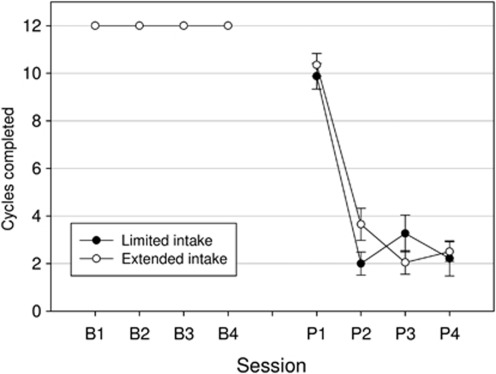
Compulsive drug seeking, which is characterized by continued instrumental effort despite contingent punishment, has been shown to emerge after extended drug self-administration. Exactly what aspect of drug self-administration drives the appearance of addictive behavior is unclear, but the mechanistic explanations that have been offered differ in one key respect. On one hand, it has been suggested that dysfunctional conditioning during self-administration drives unrealistic reward expectations, ultimately producing resistance to punishment. If this is indeed the pathological process that drives compulsive behavior, then compulsivity should be apparent only in the presence of the pavlovian and instrumental stimuli that underwent frequent pairing with the drug reward. On the other hand, it has also been suggested that extended drug intake produces general changes to reward and decision-making circuits that manifest as compulsive drug seeking. Unfortunately, conditioning history and drug intake are generally intrinsically intertwined. However, here we used an animal model of compulsive cocaine seeking to selectively manipulate drug intake and the degree of conditioning in the test context, to investigate which of the two is more important for the emergence of compulsive cocaine seeking. The results show that extended drug intake alone is sufficient, but extended conditioning in the test context is not necessary for the emergence of compulsive cocaine seeking, resolving a fundamental question in addiction research.
Figures
References
-
- Ahmed SH, Kenny PJ, Koob GF, Markou A. Neurobiological evidence for hedonic allostasis associated with escalating cocaine use. Nat Neurosci. 2002;5:625–626. - PubMed
-
- Arroyo M, Markou A, Robbins TW, Everitt BJ. Acquisition, maintenance and reinstatement of intravenous cocaine self-administration under a second-order schedule of reinforcement in rats: effects of conditioned cues and continuous access to cocaine. Psychopharmacology. 1998;140:331–344. - PubMed
-
- Berke JD, Hyman SE. Addiction, dopamine, and the molecular mechanisms of memory. Neuron. 2000;25:515–532. - PubMed
-
- Cardinal RN. Whisker, version 1.0 2001.
-
- Cardinal RN, Everitt BJ. Neural and psychological mechanisms underlying appetitive learning: links to drug addiction. Curr Opin Neurobiol. 2004;14:156–162. - PubMed
MeSH terms
Substances
Grants and funding
LinkOut - more resources
Full Text Sources
