Review
. 2012 Apr 7;41(7):2545-61.
doi: 10.1039/c2cs15327k. Epub 2012 Feb 14.

Design of polymeric nanoparticles for biomedical delivery applications

Affiliations
Review

Design of polymeric nanoparticles for biomedical delivery applications

Mahmoud Elsabahy et al. Chem Soc Rev. .

Abstract

Polymeric nanoparticles-based therapeutics show great promise in the treatment of a wide range of diseases, due to the flexibility in which their structures can be modified, with intricate definition over their compositions, structures and properties. Advances in polymerization chemistries and the application of reactive, efficient and orthogonal chemical modification reactions have enabled the engineering of multifunctional polymeric nanoparticles with precise control over the architectures of the individual polymer components, to direct their assembly and subsequent transformations into nanoparticles of selective overall shapes, sizes, internal morphologies, external surface charges and functionalizations. In addition, incorporation of certain functionalities can modulate the responsiveness of these nanostructures to specific stimuli through the use of remote activation. Furthermore, they can be equipped with smart components to allow their delivery beyond certain biological barriers, such as skin, mucus, blood, extracellular matrix, cellular and subcellular organelles. This tutorial review highlights the importance of well-defined chemistries, with detailed ties to specific biological hurdles and opportunities, in the design of nanostructures for various biomedical delivery applications.


Figures
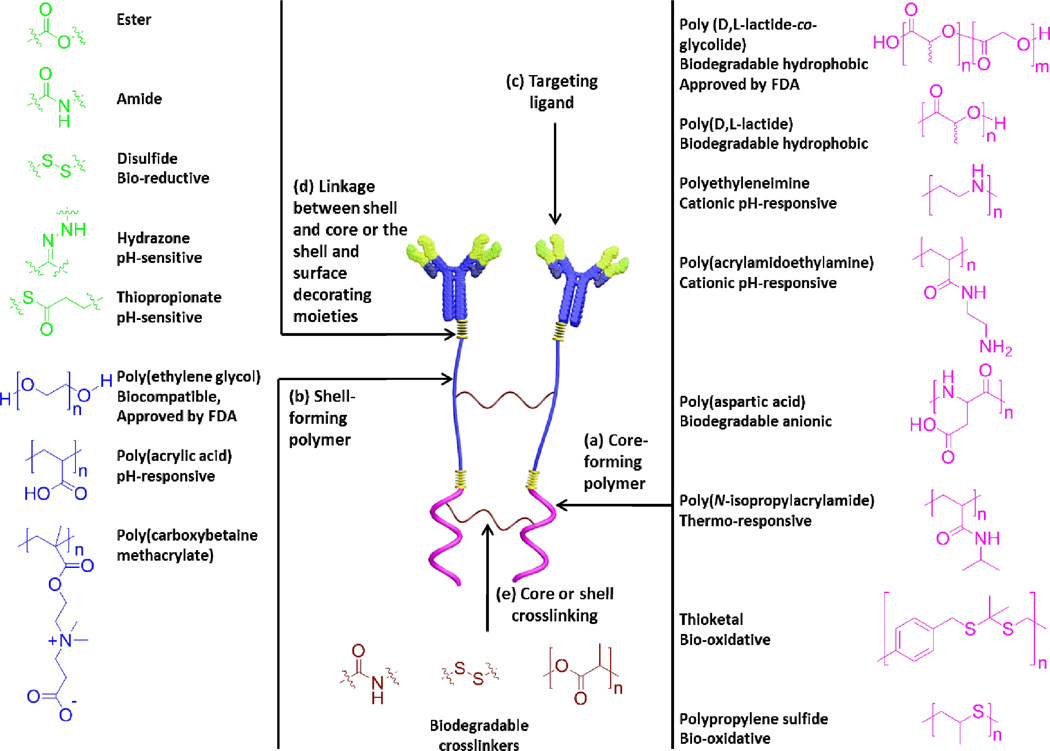
Fig. 1
Fig. 1
Building blocks of various types of polymeric nanoparticles with examples of some commonly used polymers and linkages. The main building blocks of polymeric nanoparticles are usually comprised of core-forming polymer; hydrophobic or charged (a), shell-forming polymer; neutral, hydrophilic and flexible properties are important for stealth nanoparticles (b), targeting ligand for selective cellular uptake and accumulation at target sites (c), and linkages between the shell and core and/or targeting moieties (d). Stimuli-responsiveness (pH, temperature, enzymatic, reductive or oxidative, etc.) can be imparted into the core, shell and/or the linkages. Shell or core-crosslinking can be also utilized to enhance the stability of nanoparticles (e).
Fig. 2
Fig. 2
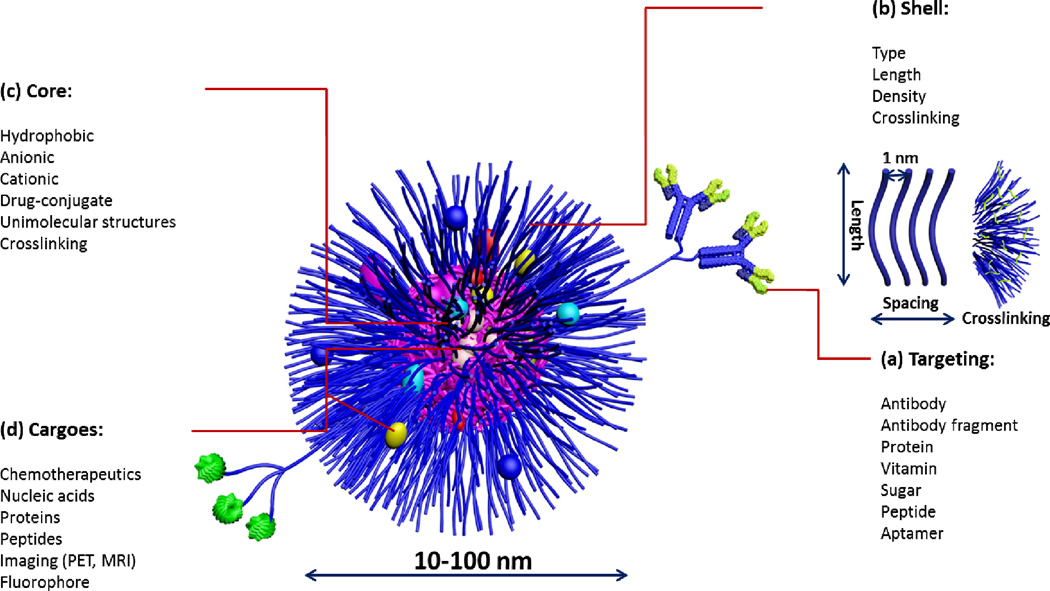
Composition of multifunctional nanoparticles for biomedical delivery applications: (a) clusters of targeting moieties have been shown to be important for multivalent binding to receptors for enhanced cellular uptake; the use of various ligands (antibody, antibody fragment, peptide) depends on the therapeutic application and disease type, (b) shell: length, spacing and crosslinking of the shell are critical parameters that dictate the blood cir culation time and stability of nanoparticles with ~1 nm spacing found to be efficient in preventing protein adsorption, (c) core: nature of the core dictates the type of the drug to be encapsulated. Crosslinking and conjugation of drugs to the core-forming polymer are common strategies for enhancing the stability of nanoparticles and drug-encapsulation efficiency, respectively. (d) drug: a wide range of therapeutics can be used ranging from small molecules to macromolecular cargoes.
Fig. 3
Fig. 3
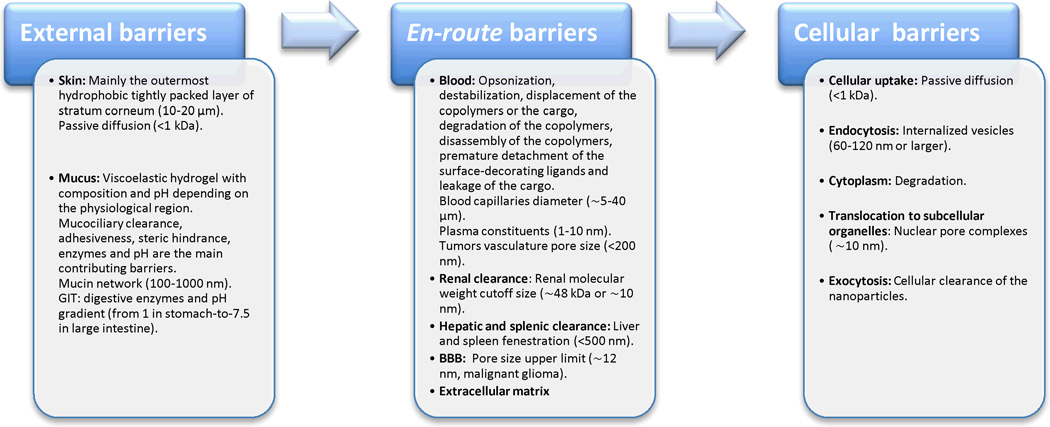
Barriers towards the delivery of polymeric nanoparticles can be classified into external barriers (skin and mucosa), en-route barriers (mainly destabilization and clearance in the blood and the extracellular matrix) and cellular and subcellular barriers.
Fig. 4
Fig. 4
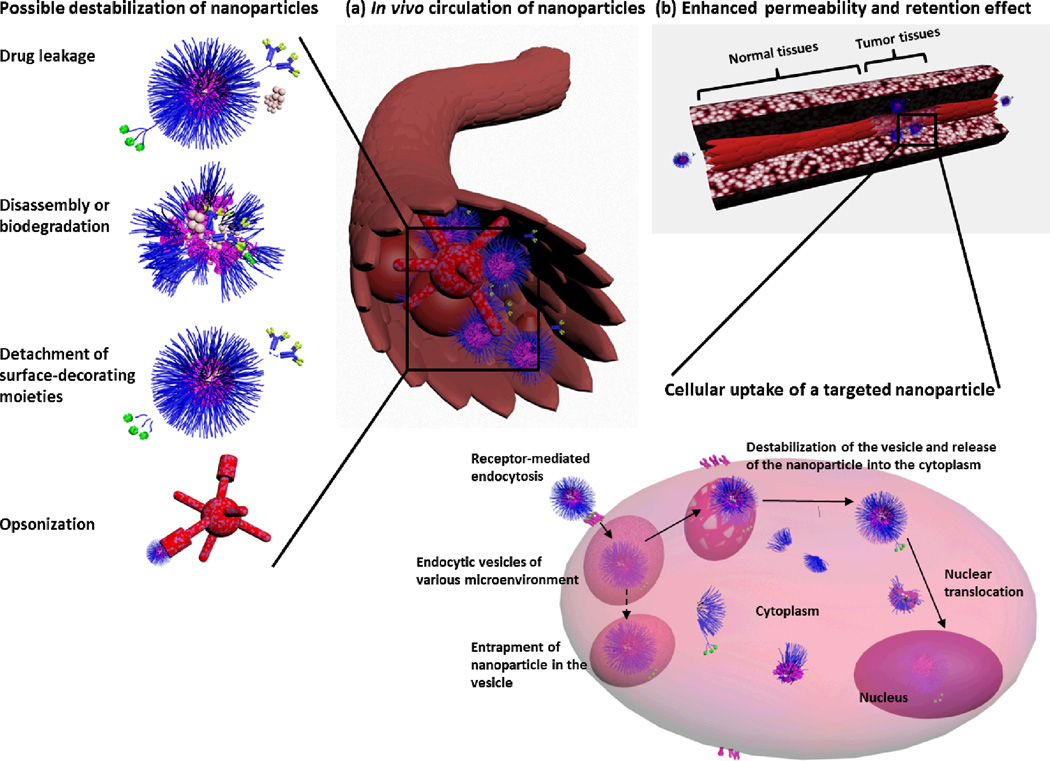
Possible destabilization and degradation pathways of polymeric nanoparticles during in vivo circulation (a) and the EPR effect and intracellular fate of nanoparticles (b). Drug-leakage, disassembly or degradation, detachment of surface-decorating moieties, opsonization and clearance of nanoparticles during circulation can all be detrimental to the efficiency of nanoparticles. Tumor tissues are characterized by the leaky vasculature that allows nanoparticles to accumulate in the tumor tissues. The endocytosis of the nanoparticles can then occur via different mechanisms (e.g. via multivalent binding and receptor-mediated endocytosis), ending into endocytic vesicles of different microenvironments depending on the composition and characteristics of the nanoparticle. Entrapment of nanoparticles into the endocytic vesicles (dashed arrow) prevents them from reaching their target sites (cytoplasm, mitochondria, nucleus). The disassembly of polymeric nanoparticles and drug release can occur at various steps during the circulation and the intracellular trafficking pathway.
Fig. 5
Fig. 5
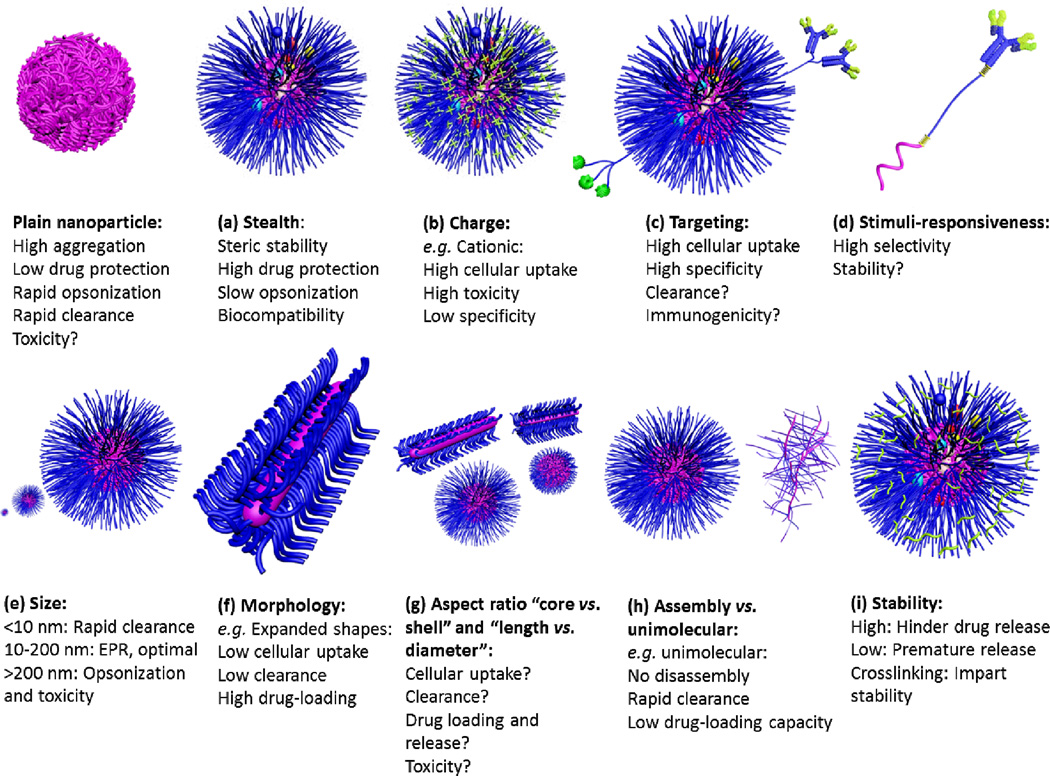
Characteristics of polymeric nanoparticles: (a) stealth: imparts biocompatibility, steric stability and protection of the encapsulated drug and reduces the opsonization and clearance of nanoparticles, but may also reduce the cellular uptake and endosomal escape capabilities, (b) charge: cationic character enhances cellular uptake and endosomal escape, but subject to uncontrolled tissue distribution and often associated with toxicity, (c) targeting: enhances cellular uptake and specificity, but sometimes can accelerate the clearance and/or immunogenicity, (d) stimuli-responsiveness: controls the dynamics of nanoparticles with possibility of releasing their cargoes at specific sites (selectivity). The stability and responsiveness of these materials under physiological and pathological conditions may vary and may result in premature release of the drug. (e) size: ~100 nm particles is optimal for delivery, being large enough to avoid renal clearance and small enough to reduce clearance and toxicity, (f) morphology: expanded morphology results in higher drug-loading capacity, lower clearance and cellular uptake, (g) aspect ratio: the shell vs. core volume and length vs. diameter can greatly affect the cellular uptake, clearance, drug loading and release, and toxicity, (h) assembly vs. unimolecular structures: unimolecular structures are more stable (no dissociation) but can be cleared rapidly depending on the size and usually have low drug-loading capacity, and (i) stability: intermediate stability to circumvent physiological barriers and at the same time be able to release the drug at the target sites is required and can be achieved with different methods, for instance, by crosslinking.
Fig. 6
Fig. 6
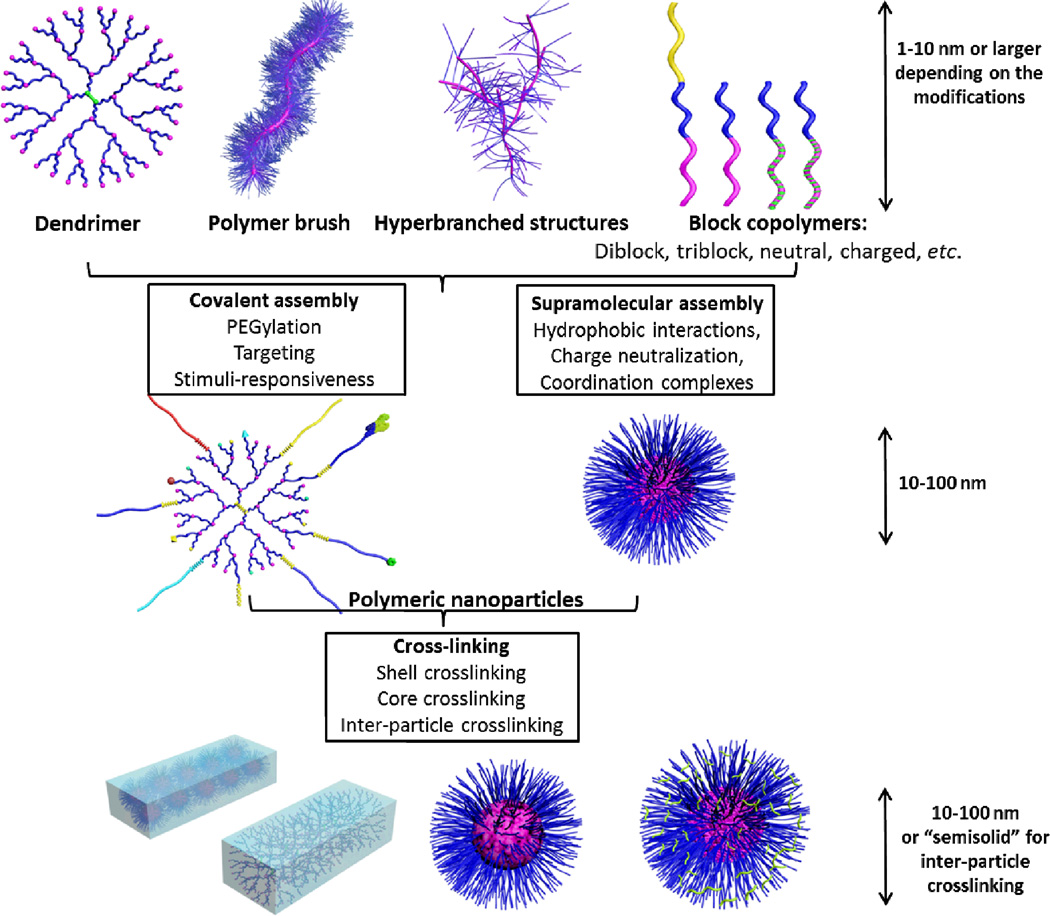
Types of polymeric nanoparticles and possible chemical modifications: polymeric blocks (dendrimer, brush, hyperbranched, block copolymer) can be either chemically modified or supramolecularly-assembled into polymeric nanoparticles. Post-modification of these nanoparticles via ligand modification, core- or shell-crosslinking or drug-loading is possible.

References

    1. Iha RK, Wooley KL, Nystrom AM, Burke DJ, Kade MJ, Hawker CJ. Chem. Rev. 2009;109:5620–5686. - PMC - PubMed
    1. O'Reilly RK, Hawker CJ, Wooley KL. Chem. Soc. Rev. 2006;35:1068–1083. - PubMed
    1. Prausnitz MR, Langer R. Nat. Biotechnol. 2008;26:1261–1268. - PMC - PubMed
    1. Lai SK, Wang YY, Hanes J. Adv. Drug Deliv. Rev. 2009;61:158–171. - PMC - PubMed
    1. Dobrovolskaia MA, McNeil SE. Nat. Nanotechnol. 2007;2:469–478. - PubMed

Publication types