


Evolution of wild cereals during 28 years of global warming in Israel
- PMID: 22334646
- PMCID: PMC3295258
- DOI: 10.1073/pnas.1121411109
Evolution of wild cereals during 28 years of global warming in Israel
Abstract
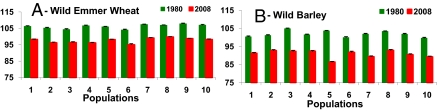
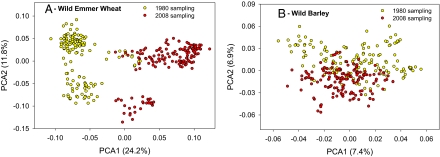
Climate change is a major environmental stress threatening biodiversity and human civilization. The best hope to secure staple food for humans and animal feed by future crop improvement depends on wild progenitors. We examined 10 wild emmer wheat (Triticum dicoccoides Koern.) populations and 10 wild barley (Hordeum spontaneum K. Koch) populations in Israel, sampling them in 1980 and again in 2008, and performed phenotypic and genotypic analyses on the collected samples. We witnessed the profound adaptive changes of these wild cereals in Israel over the last 28 y in flowering time and simple sequence repeat allelic turnover. The revealed evolutionary changes imply unrealized risks present in genetic resources for crop improvement and human food production.
Conflict of interest statement
The authors declare no conflict of interest.
Figures
References
-
- Haughton JT, et al., editors. Climate Change 1995: The Science of Climate Change. Cambridge: Cambridge Univ. Press; 1996.
-
- Committee to Review the IPCC . Climate Change Assessments: Review of the Processes and Procedures of the IPCC. Amsterdam: Interacademy Council; 2010.
-
- Parmesan C. Ecological and evolutionary responses to recent climate change. Annu Rev Ecol Evol Syst. 2006;37:637–669.
-
- Lobell DB, Schlenker W, Costa-Roberts J. Climate trends and global crop production since 1980. Science. 2011;333:616–620. - PubMed
-
- Chen I-C, Hill JK, Ohlemüller R, Roy DB, Thomas CD. Rapid range shifts of species associated with high levels of climate warming. Science. 2011;333:1024–1026. - PubMed
Publication types
MeSH terms
Substances
LinkOut - more resources
Full Text Sources
Molecular Biology Databases
