Epidemic vitamin D deficiency among patients in an elderly care rehabilitation facility
- PMID: 22334819
- PMCID: PMC3272588
- DOI: 10.3238/arztebl.2012.0033
Epidemic vitamin D deficiency among patients in an elderly care rehabilitation facility
Abstract
Background: Many benefits are ascribed to vitamin D beyond its well-known effects on calcium and bone metabolism. Vitamin D in adequate amounts is apparently beneficial to muscle, lessening the risk of falls and fractures in the elderly. The elderly produce less vitamin D in their skin than younger persons do, and they also spend less time in the sun; they are therefore at greater risk of vitamin D deficiency.
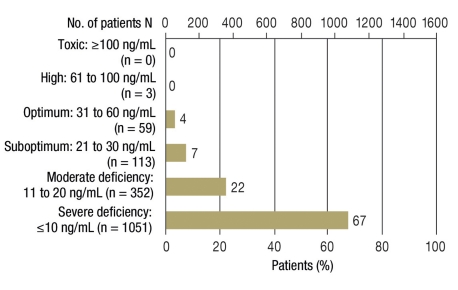
Methods: We used gas chromatography with mass spectrometry coupling to measure the 25-OH-vitamin D level of 1578 elderly persons (72% women) who were consecutively admitted to an elderly care rehabilitation facility in Trier, Germany, from July 2009 to March 2011. Their mean and median age was 82 years.
Results: 89% of the patients had 25-OH-vitamin D deficiency (defined as a level below 20 ng/mL), and 67% had a severe deficiency (below 10 ng/mL). Only 4% had levels in the target range (30-60 ng/mL); none had a level above 100 ng/mL.
Conclusion: Many of these patients were deficient in vitamin D. Persons of very advanced age need a better supply of vitamin D not only to keep their bones healthy, but also to lessen the risk of falls and fractures.
Comment in
-
Correspondence (letter to the editor): Appeal for vitamin D therapy.Dtsch Arztebl Int. 2012 May;109(19):359; author reply 359-60. doi: 10.3238/arztebl.2012.0359a. Epub 2012 May 11. Dtsch Arztebl Int. 2012. PMID: 22675407 Free PMC article. No abstract available.
References
-
- Holick MF. Vitamin D deficiency. N Engl J Med. 2007;357:266–281. - PubMed
-
- Hirani V, Primatesta P. Vitamin D concentrations among people aged 65 years and over living in private households and institutions in England: population survey. Age Ageing. 2005;34:485–491. - PubMed
-
- Hintzpeter B, Mensink GB, Thierfelder W, et al. Vitamin D status and health correlates among German adults. Eur J Clin Nutr. 2008;62:1079–1090. - PubMed
-
- Hintzpeter B, Scheidt-Nave C, Müller MJ, et al. Higher prevalence of vitamin D deficiency is associated with immigrant background among children and adolescents in Germany. J Nutr. 2008;138:1482–1490. - PubMed
-
- Priemel M, von Domarus C, Klatte TO, et al. Bone mineralization defects and vitamin D deficiency: Histomorphometric analysis of iliac crest bone biopsies and circulating 25-hydroxyvitamin D in 675 patients. Journal of Bone and Mineral Research. 2010;2(Issue 25):305–312. - PubMed
MeSH terms
Substances
LinkOut - more resources
Full Text Sources
Medical