


Enumeration of bacteriophage particles: Comparative analysis of the traditional plaque assay and real-time QPCR- and nanosight-based assays
- PMID: 22334864
- PMCID: PMC3278645
- DOI: 10.4161/bact.1.2.15456
Enumeration of bacteriophage particles: Comparative analysis of the traditional plaque assay and real-time QPCR- and nanosight-based assays
Abstract
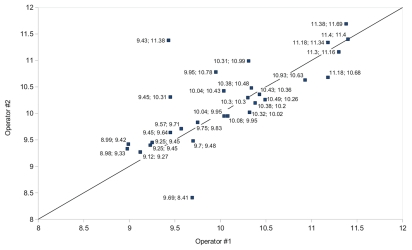
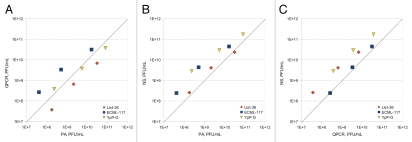
Bacteriophages are increasingly being utilized and considered for various practical applications, ranging from decontaminating foods and inanimate surfaces to human therapy; therefore, it is important to determine their concentrations quickly and reliably. Traditional plaque assay (PA) is the current "gold standard" for quantitating phage titers. However, it requires at least 18 h before results are obtained, and they may be significantly influenced by various factors. Therefore, two alternative assays based on the quantitative real-time polymerase chain reaction (QPCR) and NanoSight Limited (NS) technologies were recently proposed for enumerating phage particles. The present study compared the three approaches' abilities to quantitate Listeria monocytogenes-, Escherichia coli O157:H7- and Yersinia pestis-specific lytic phages quickly and reproducibly. The average coefficient of variation (CVS) of the PA method including all three phages was 0.15. The reproducibility of the PA method decreased dramatically when multiple investigators performed the assays, and mean differences of as much as 0.33 log were observed. The QPC R method required costly equipment and the synthesis of phage-specific oligonucleotide primers, but it determined phage concentrations faster (within about 4 h) and more precisely than did PA (CVS = 0.13). NS technology required costly equipment, was less precise (CVS = 0.28) than the PA and QPCR methods, and only worked when the phages were suspended in clear medium. However, it provided results within 5 min. After the overall correlation is established with the PA method, either of the two assays may be useful for quickly and reproducibly determining phage concentrations.
Figures
References
-
- Sulakvelidze A, Barrow P. Phage therapy in animals and agribusiness. In: Kutter E, Sulakvelidze A, editors. Bacteriophages: Biology and Applications. Boca Raton, FL: CRC Press; 2005. pp. 335–380.
-
- Sulakvelidze A, Kutter E. Bacteriophage therapy in humans. In: Kutter E, Sulakvelidze A, editors. Bacteriophages: Biology and Application. Boca Raton, FL: CRC Press; 2005. pp. 381–436.
-
- Cairns J, Stent GS, Watson JD. Phage and the origins of molecular biology. Cold Spring Harbor, NY: Cold Spring Harbor Laboratory; 1966.
LinkOut - more resources
Full Text Sources
Other Literature Sources
Miscellaneous
