. 2012 Feb 15:13:75.
doi: 10.1186/1471-2164-13-75.

Identification and localisation of the NB-LRR gene family within the potato genome

Affiliations

Identification and localisation of the NB-LRR gene family within the potato genome

Florian Jupe et al. BMC Genomics. .

Abstract

Background: The potato genome sequence derived from the Solanum tuberosum Group Phureja clone DM1-3 516 R44 provides unparalleled insight into the genome composition and organisation of this important crop. A key class of genes that comprises the vast majority of plant resistance (R) genes contains a nucleotide-binding and leucine-rich repeat domain, and is collectively known as NB-LRRs.

Results: As part of an effort to accelerate the process of functional R gene isolation, we performed an amino acid motif based search of the annotated potato genome and identified 438 NB-LRR type genes among the ~39,000 potato gene models. Of the predicted genes, 77 contain an N-terminal toll/interleukin 1 receptor (TIR)-like domain, and 107 of the remaining 361 non-TIR genes contain an N-terminal coiled-coil (CC) domain. Physical map positions were established for 370 predicted NB-LRR genes across all 12 potato chromosomes. The majority of NB-LRRs are physically organised within 63 identified clusters, of which 50 are homogeneous in that they contain NB-LRRs derived from a recent common ancestor.

Conclusions: By establishing the phylogenetic and positional relationship of potato NB-LRRs, our analysis offers significant insight into the evolution of potato R genes. Furthermore, the data provide a blueprint for future efforts to identify and more rapidly clone functional NB-LRR genes from Solanum species.


Figures
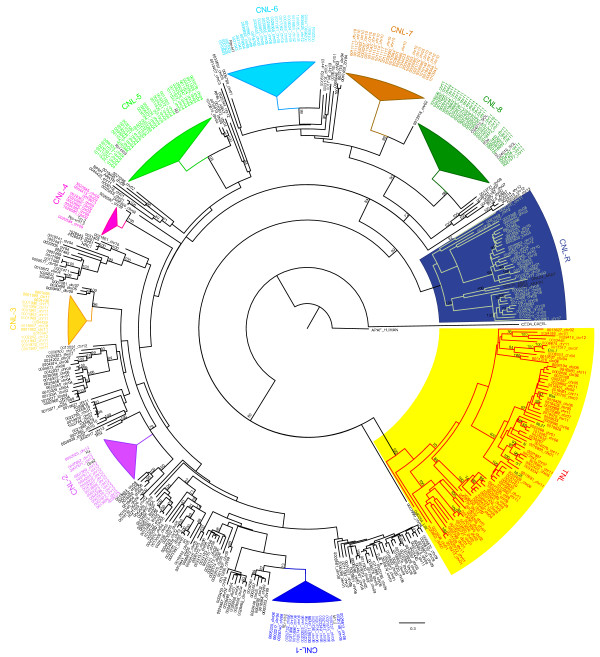
Figure 1
Figure 1
Maximum Likelihood Phylogenetic analysis of the predicted DM NB-LRR genes. The NB-ARC domains of TNL and CNL type genes were used, alongside selected NB-ARC domains from functional resistance genes, to study the phylogenetic relationships between them. Subgroups with highly similar gene products are marked: TNL genes have a yellow background, CNL-R type NB-LRR genes a blue background and CNL-1 to CNL-8 are shown in various colours. The gene product labels contain the 7 last informative digits from the DMG identifier, followed by their chromosomal position if known. Bootstraps over 70 (out of 100) are shown.
Figure 2
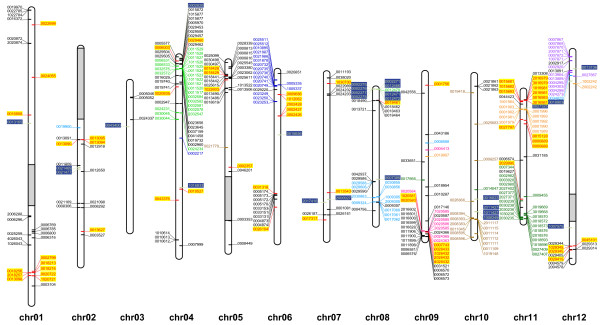
Figure 2
Physical map of the 12 potato chromosomes with individual CNLs and TNLs. The relative map position of 366 unique DMGs encoding for NB-LRR type genes is shown on the individual pseudomolecules depicting the chromosomes 1-12. Each gene has a unique label representing the 7 last informative digits from the DMG identifier. Genes encoded by the positive DNA strand are depicted on the left hand side of the chromosomes, whereas those encoded by the negative strand are shown on the right. Colours and background of the genes are identical to the phylogenetic subgroups (TNL, CNL-R, CNL-1 to CNL-8) shown in Figure 1. Grey bars on chromosomes 1, 2, 5 and 12 represent known gaps in the assembly.
Figure 3
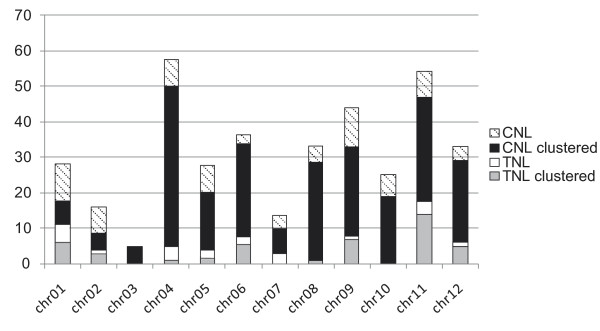
Figure 3
CNL and TNL organisation within the potato genome. The distribution of NB-LRR genes is shown for each chromosome. Bars are divided into CNL genes (white-textured for non-clustered genes and black for those found in clusters) and TNL genes (white for non-clustered genes and grey for clustered TNLs).
Figure 4
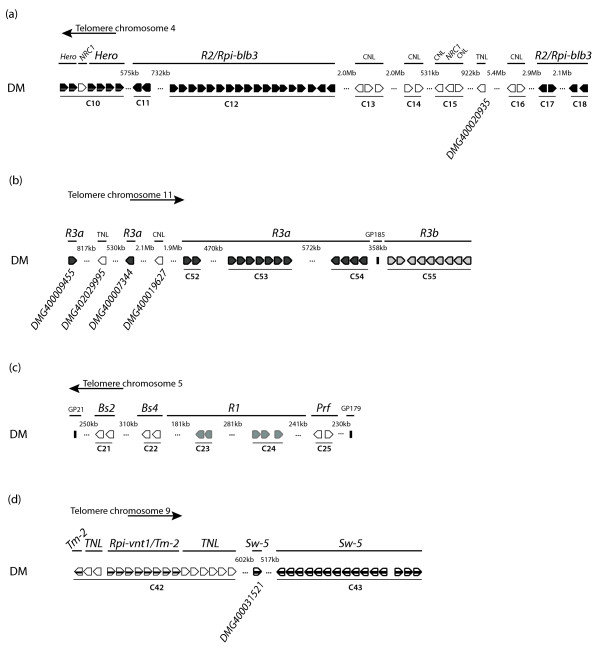
Figure 4
Physical overview of selected resistance loci. R2 (a), R3 (b), R1 (c) and Rpi-vnt1/Tm-2/Sw-5 (d). The directions towards the respective telomeres are shown. Boxed arrows symbolise NB-LRR genes and clusters are indicated by horizontal lines. Known genetic markers are shown. The distances between NB-LRR clusters are indicated above the gaps. Identifiers for single NB-LRRs are shown.
Figure 5
Figure 5
Global gene density versus repeat density analysis. The contours represent a genome-wide Gaussian mixture model (GMM) with two components fitted to the gene/repeat density data in a 250 kb analysis window. Overlaid on the calculations are the CNLs and TNL type genes (shown as red crosses).

References

    1. Jones JD, Dangl JL. The plant immune system. Nature. 2006;444:323–329. doi: 10.1038/nature05286. - DOI - PubMed
    1. Schulze-Lefert P, Panstruga R. A molecular evolutionary concept connecting nonhost resistance, pathogen host range, and pathogen speciation. Trends Plant Sci. 2011;16:117–125. doi: 10.1016/j.tplants.2011.01.001. - DOI - PubMed
    1. Lukasik E, Takken FL. STANDing strong, resistance proteins instigators of plant defence. Curr Opin Plant Biol. 2009;12:427–436. doi: 10.1016/j.pbi.2009.03.001. - DOI - PubMed
    1. Van der Biezen EA, Jones JD. Plant disease-resistance proteins and the gene-for-gene concept. Trends Biochem Sci. 1998;23:454–456. doi: 10.1016/S0968-0004(98)01311-5. - DOI - PubMed
    1. Van der Biezen EA, Jones JD. The NB-ARC domain: a novel signalling motif shared by plant resistance gene products and regulators of cell death in animals. Curr Biol. 1998;8:R226–R227. doi: 10.1016/S0960-9822(98)70145-9. - DOI - PubMed

Publication types