


Arsenic, organic foods, and brown rice syrup
- PMID: 22336149
- PMCID: PMC3346791
- DOI: 10.1289/ehp.1104619
Arsenic, organic foods, and brown rice syrup
Abstract
Background: Rice can be a major source of inorganic arsenic (Asi) for many sub-populations. Rice products are also used as ingredients in prepared foods, some of which may not be obviously rice based. Organic brown rice syrup (OBRS) is used as a sweetener in organic food products as an alternative to high-fructose corn syrup. We hypothesized that OBRS introduces As into these products.
Objective: We determined the concentration and speciation of As in commercially available brown rice syrups and in products containing OBRS, including toddler formula, cereal/energy bars, and high-energy foods used by endurance athletes.
Methods: We used inductively coupled plasma mass spectrometry (ICP-MS) and ion chromatography coupled to ICP-MS to determine total As (Astotal) concentrations and As speciation in products purchased via the Internet or in stores in the Hanover, New Hampshire, area.
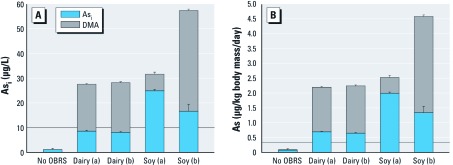
Discussion: We found that OBRS can contain high concentrations of Asi and dimethyl-arsenate (DMA). An "organic" toddler milk formula containing OBRS as the primary ingredient had Astotal concentrations up to six times the U.S. Environmental Protection Agency safe drinking water limit. Cereal bars and high-energy foods containing OBRS also had higher As concentrations than equivalent products that did not contain OBRS. Asi was the main As species in most food products tested in this study.
Conclusions: There are currently no U.S. regulations applicable to As in food, but our findings suggest that the OBRS products we evaluated may introduce significant concentrations of Asi into an individual's diet. Thus, we conclude that there is an urgent need for regulatory limits on As in food.
Conflict of interest statement
The NIEHS and U.S. EPA were not involved in the design and conduct of the study or collection, management, analysis, and interpretation of the data. The contents of this manuscript are solely the responsibility of the authors and do not necessarily represent the official views of the NIEHS or U.S. EPA. Further, the U.S. EPA does not endorse the purchase of any commercial products or services mentioned in the publication.
The authors declare they have no actual or potential competing financial interests.
Figures
Comment in
-
Suspect sweetener: arsenic detected in organic brown rice syrup.Environ Health Perspect. 2012 May;120(5):A204. doi: 10.1289/ehp.120-a204a. Environ Health Perspect. 2012. PMID: 22549048 Free PMC article. No abstract available.
References
-
- EFSA (European Food Safety Authority) Panel on Contaminants in the Food Chain 2009Scientific Opinion on Arsenic in Food. EFSA J 7101351 doi: [Online 22 October 2009] 10.2903/j.efsa.2009.1351 - DOI
-
- Food and Agriculture Organization of the United Nations/World Health Organization (FAO/WHO) Geneva: WHO; 1983. Evaluation of Certain Food Additives and Contaminants. WHO Food Additive Report Series No. 18.
-
- Foster S, Maher W, Krikowa F, Apte S. A microwave-assisted sequential extraction of water and dilute acid soluble arsenic species from marine plant and animal tissues. Talanta. 2007;71(2):537–549. - PubMed
-
- Huang JH, Ilgen G, Fecher P. Quantitative chemical extraction for arsenic speciation in rice grains. J Anal At Spectrom. 2010;25(6):800–802.
Publication types
MeSH terms
Substances
Grants and funding
LinkOut - more resources
Full Text Sources
Medical
Research Materials