. 2012 May;132(5):1384-91.
doi: 10.1038/jid.2012.6. Epub 2012 Feb 16.

Keratin 16-null mice develop palmoplantar keratoderma, a hallmark feature of pachyonychia congenita and related disorders

Affiliations

Keratin 16-null mice develop palmoplantar keratoderma, a hallmark feature of pachyonychia congenita and related disorders

Juliane C Lessard et al. J Invest Dermatol. 2012 May.

Abstract

Keratin 16 (KRT16 in human, Krt16 in mouse), a type I intermediate filament protein, is constitutively expressed in epithelial appendages and is induced in the epidermis upon wounding and other stressors. Mutations altering the coding sequence of KRT16 cause pachyonychia congenita (PC), a rare autosomal dominant disorder characterized by hypertrophic nail dystrophy, oral leukokeratosis, and palmoplantar keratoderma (PPK). PPK associated with PC is extremely painful and compromises patient mobility, making it the most debilitating PC symptom. In this study, we show that, although inherited in a recessive manner, the inactivation of Krt16 in mice consistently causes oral lesions as well as PPK-like hyperkeratotic calluses on Krt16(-/-) front and hind paws, which severely compromise the animals' ability to walk. Our findings call into question the view that PC-related PPK arises exclusively as a gain-of-function on account of dominantly acting mutated keratins, and highlight the key role of modifiers in the clinical heterogeneity of PC symptoms.


Conflict of interest statement

Conflict of Interest

The authors declare no conflict of interest.

Figures
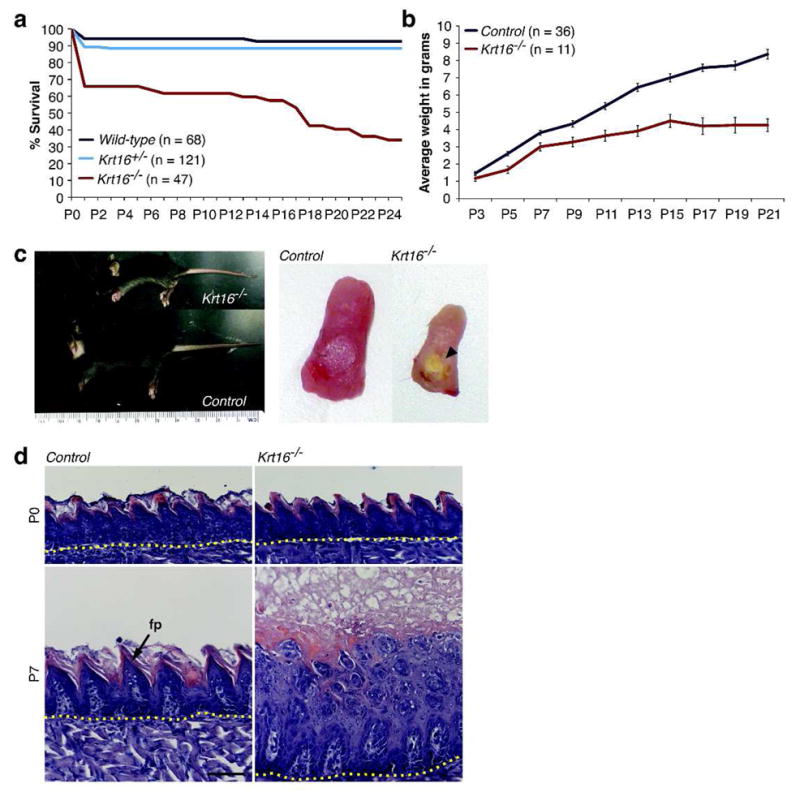
Figure 1
Figure 1. Failure to thrive, high postnatal mortality, and posterior tongue lesions in Krt16−/− mice
(a) High postnatal mortality in Krt16−/− mice. 34% of Krt16−/− mice die within 24 h after birth; only a third survive past weaning. (b) Krt16−/− mice weigh significantly less than control littermates. Error bars = SEM. (c) P17 Krt16−/− mice are smaller than littermates and a white-yellow plaque covers the posterior dorsal area of their tongues (arrowhead). (d) H&E-stained sections of posterior tongues at P0 and P7. Krt16−/− mice show no obvious defects at birth. By P7, the architecture of filiform papillae (fp) is markedly disrupted, and massive hyperkeratosis leads to macroscopically visible plaques. Note the paucity of cell lysis in the suprabasal layer. Dotted line = epithelial/muscle junction. Scale bar, 50μm.
Figure 2
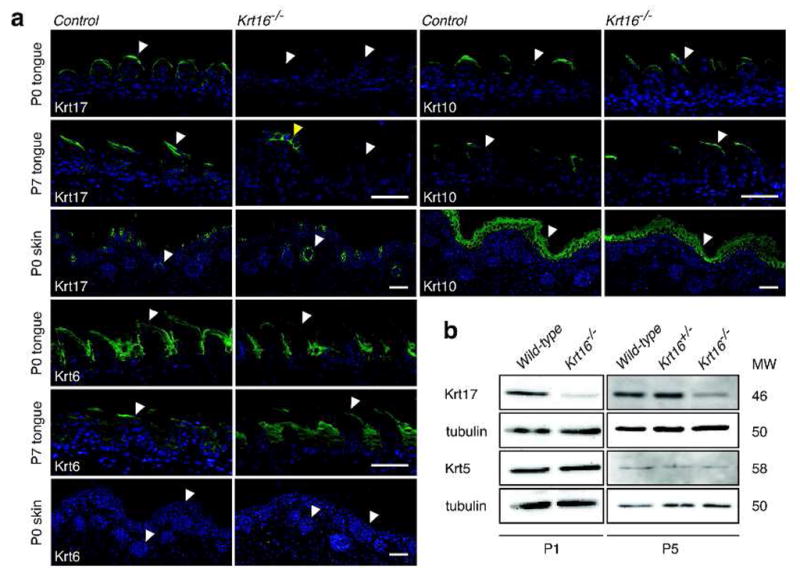
Figure 2. Krt17 levels are selectively reduced in Krt16−/− filiform papillae
(a) Immunofluorescent stainings in P0 and P7 tongue cross-sections show a reduction of Krt17 in Krt16−/− filiform papillae (white arrowheads), but not in fungiform papillae (yellow arrowhead). Constitutive expression of Krt17 in hair follicles at P0 is not affected. Krt6 and Krt10 are unchanged in both filiform papillae in Krt16−/− tongues and skin (white arrowheads). Scale bars, 50μm. (b) Whole tongue lysates show a universal reduction in Krt17 expression in Krt16−/− tongue epithelium. Krt5 expression is unaltered. To a lesser extent, Krt17 mRNA levels are also reduced (data not shown).
Figure 3
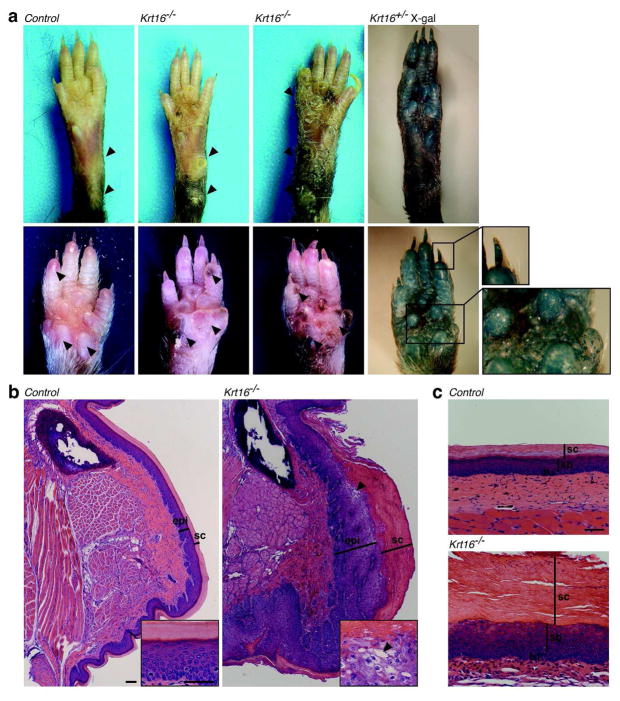
Figure 3. Krt16−/− mice develop palmoplantar keratoderma
(a) Adult Krt16−/− mice develop PPK-like lesions in their front and hind paws. Callus formation is common in areas of high physical impact (arrowheads), despite the global Krt16 expression pattern in glabrous skin (see Xgal stain). Note the presence of focal hyperpigmentation in front paw calluses. (b) H&E-stained cross-sections of front paws, showing expansion of the epidermis and massive hyperkeratosis in Krt16−/− mice. Occasionally, focal suprabasal lysis is observed in Krt16−/− calluses (arrowheads). sc = stratum corneum, epi = epidermis. Scale bars, 100μm (calluses), 50μm (insets). (c) Hyperkeratosis without lysis in Krt16−/− hind paw epidermis. Note the change in shape and arrangement of suprabasal nuclei. sc = stratum corneum, sb = suprabasal layer, b = basal layer. Scale bar, 50μm.
Figure 4
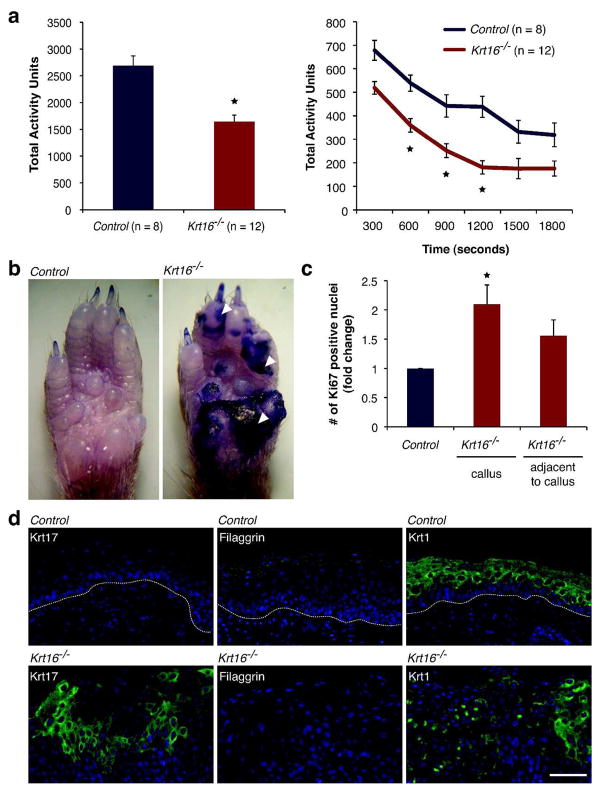
Figure 4. Krt16−/− calluses - impaired mobility, hyperproliferation, and compromised epidermal barrier function
(a) Krt16−/− mice are less active than controls in a behavioral assay (experimental time frame of 30 min). Asterisks = p-value < 0.002, Student’s T-test. (b) Toluidine Blue dye penetration in adult front paws highlights focal loss of epidermal barrier function in weight bearing areas (arrowheads). (c) Krt16−/− front paw calluses show a 2-fold increase in proliferation and a more modest increase in uninvolved areas adjacent to established calluses. Asterisk = p-value < 0.03, Student’s T-test. (d) Basal/suprabasal induction of Krt17 and marked reduction of barrier protein filaggrin in Krt16−/− front paw calluses. Krt1 expression is patchy in areas subject to barrier breach, but otherwise normal. Dotted line = epidermal/dermal junction. Scale bar, 50μm.

Comment in

References

    1. Bernot KM, Coulombe PA, McGowan KM. Keratin 16 expression defines a subset of epithelial cells during skin morphogenesis and the hair cycle. J Invest Dermatol. 2002;119:1137–1149. - PubMed
    1. Bowden PE. Mutations in a keratin 6 isomer (K6c) cause a type of focal palmoplantar keratoderma. J Invest Dermatol. 2010;130:336–338. - PubMed
    1. Bowden PE, Stark HJ, Breitkreutz D, et al. Expression and modification of keratins during terminal differentiation of mammalian epidermis. Curr Top Dev Biol. 1987;22:35–68. - PubMed
    1. Cao LH, Luo Y, Wen W, et al. A novel frameshift mutation in keratin 16 underlies Pachyonychia congenita with focal palmoplantar keratoderma. Br J Dermatol. 2011;165:1145–7. - PubMed
    1. Chen J, Jaeger K, Den Z, et al. Mice expressing a mutant Krt75 (K6hf) allele develop hair and nail defects resembling pachyonychia congenita. J Invest Dermatol. 2008;128:270–279. - PubMed

Publication types