


Combined use of leaf size and economics traits allows direct comparison of hydrophyte and terrestrial herbaceous adaptive strategies
- PMID: 22337079
- PMCID: PMC3310502
- DOI: 10.1093/aob/mcs021
Combined use of leaf size and economics traits allows direct comparison of hydrophyte and terrestrial herbaceous adaptive strategies
Abstract
Background and aims: Hydrophytes generally exhibit highly acquisitive leaf economics. However, a range of growth forms is evident, from small, free-floating and rapidly growing Lemniden to large, broad-leaved Nymphaeiden, denoting variability in adaptive strategies. Traits used to classify adaptive strategies in terrestrial species, such as canopy height, are not applicable to hydrophytes. We hypothesize that hydrophyte leaf size traits and economics exhibit sufficient overlap with terrestrial species to allow a common classification of plant functional types, sensu Grime's CSR theory.
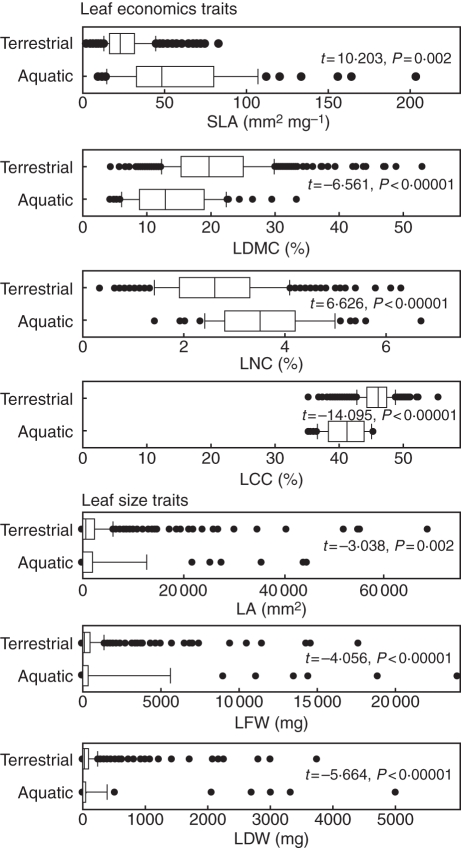
Methods: Leaf morpho-functional traits were measured for 61 species from 47 water bodies in lowland continental, sub-alpine and alpine bioclimatic zones in southern Europe and compared against the full leaf economics spectrum and leaf size range of terrestrial herbs, and between hydrophyte growth forms.
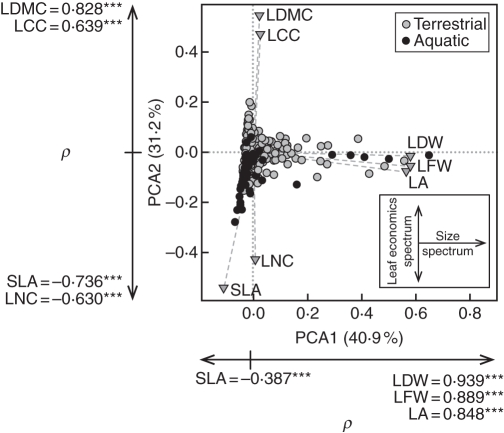
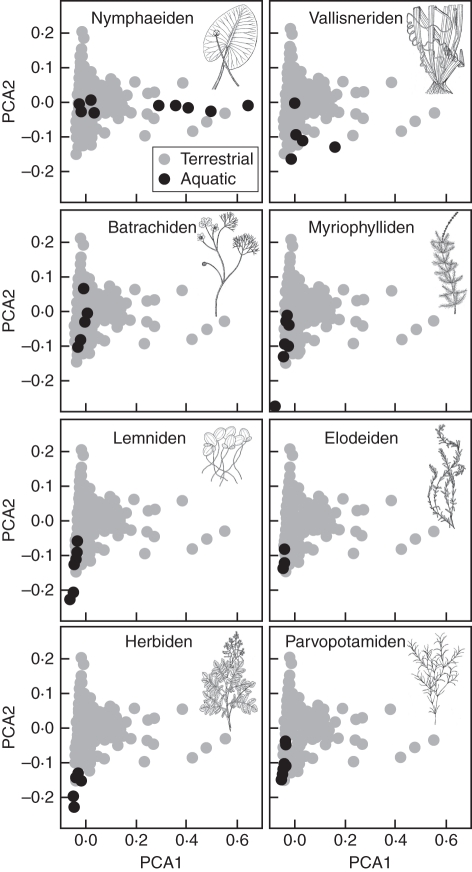
Key results: Hydrophytes differed in the ranges and mean values of traits compared with herbs, but principal components analysis (PCA) demonstrated that both groups shared axes of trait variability: PCA1 encompassed size variation (area and mass), and PCA2 ranged from relatively dense, carbon-rich leaves to nitrogen-rich leaves of high specific leaf area (SLA). Most growth forms exhibited trait syndromes directly equivalent to herbs classified as R adapted, although Nymphaeiden ranged between C and SR adaptation.
Conclusions: Our findings support the hypothesis that hydrophyte adaptive strategy variation reflects fundamental trade-offs in economics and size that govern all plants, and that hydrophyte adaptive strategies can be directly compared with terrestrial species by combining leaf economics and size traits.
Figures
References
-
- Bornette G, Tabacchi E, Hupp C, Puijalon S, Rostan JC. A model of plant strategies in fluvial hydrosystems. Freshwater Biology. 2008;53:1692–1705.
-
- Britton NL, Brown A. An illustrated flora of the northern United States, Canada and the British Possessions. New York: Charles Scribner's Sons; 1913.
-
- Caccianiga M, Luzzaro A, Pierce S, Ceriani RM, Cerabolini B. The functional basis of a primary succession resolved by CSR classification. Oikos. 2006;112:10–20.
-
- Cerabolini BEL, Brusa G, Ceriani RM, De Andreis R, Luzzaro A, Pierce S. Can CSR classification be generally applied outside Britain? Plant Ecology. 2010a;210:253–261.
-
- Cerabolini B, Pierce S, Luzzaro A, Ossola A. Species evenness affects ecosystem processes in situ via diversity in the adaptive strategies of dominant species. Plant Ecology. 2010b;207:333–345.
Publication types
MeSH terms
Substances
LinkOut - more resources
Full Text Sources
Research Materials
