


Validity of child anthropometric measurements in the Special Supplemental Nutrition Program for Women, Infants, and Children
- PMID: 22337260
- PMCID: PMC3282987
- DOI: 10.1038/pr.2011.37
Validity of child anthropometric measurements in the Special Supplemental Nutrition Program for Women, Infants, and Children
Abstract
Introduction: The Special Supplemental Nutrition Program for Women, Infants, and Children (WIC) serves 50% of infants and 25% of preschool-aged children in the United States and collects height and weight measurements from eligible children every 6 mo, making WIC data a valuable resource for studying childhood growth and obesity. We assessed the accuracy of measurements collected by WIC staff by comparing them to "gold standard" measurements collected by trained research staff.
Results: Intraclass correlation coefficients (ICCs) measuring agreement between WIC and research protocol measurements for height, weight, and BMI were 0.96, 0.99, and 0.93, respectively. Although WIC measurements overestimated height by 0.6 cm and weight by 0.05 kg on average, BMI was underestimated by only 0.15 kg/m(2) on average. WIC BMI percentiles classified children as overweight/obese vs. underweight/normal with 86% sensitivity and 92% specificity.
Discussion: We conclude that height, weight, and BMI measurements of children aged 2-5 y collected by trained WIC staff are sufficiently accurate for monitoring and research purposes.
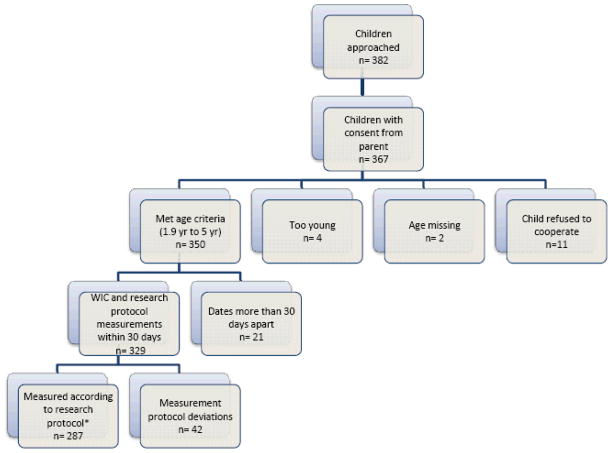
Methods: At seven WIC clinics in southern California, 287 children aged 2-5 y measured for height and weight by WIC staff using WIC standard protocol were remeasured by research staff using a research protocol (duplicate measurements with shoes and outerwear removed were taken by trained personnel).
Figures
References
-
- Wang Y, Lobstein T. Worldwide trends in childhood overweight and obesity. Int J Pediatr Obes. 2006;1:11–25. - PubMed
-
- Guo SS, Wu W, Chumlea WC, Roche AF. Predicting overweight and obesity in adulthood from body mass index values in childhood and adolescence. Am J Clin Nutr. 2002;76:653–658. - PubMed
-
- Bjorge T, Engeland A, Tverdal A, Smith GD. Body mass index in adolescence in relation to cause-specific mortality: a follow-up of 230,000 Norwegian adolescents. Am J Epidemiol. 2008;168:30–37. - PubMed
