


The impact of early CD4+ lymphocyte recovery on the outcome of patients who undergo allogeneic bone marrow or peripheral blood stem cell transplantation
- PMID: 22337266
- PMCID: PMC3320776
- DOI: 10.2450/2012.0034-11
The impact of early CD4+ lymphocyte recovery on the outcome of patients who undergo allogeneic bone marrow or peripheral blood stem cell transplantation
Abstract
Background: Different factors influence the clinical outcome of allogeneic transplants, the foremost being good immune recovery.
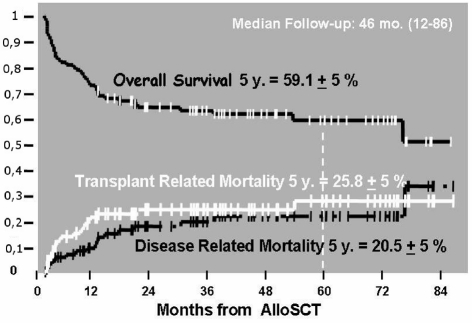
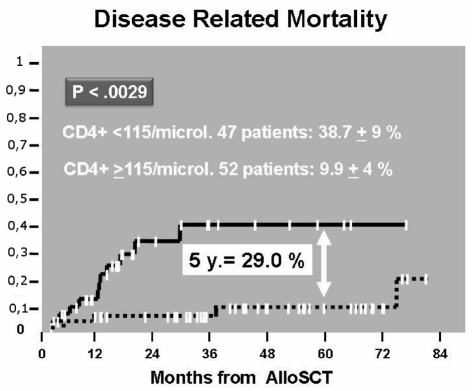
Materials and methods: The purpose of this study was to evaluate the influence of different factors, such as stem cell source, type of donor, conditioning regimen and acute graft-versus-host disease, on early lymphocyte recovery after transplantation. We then analyzed the impact of early CD4+ cell count on overall survival, transplant-related mortality and disease-related mortality.
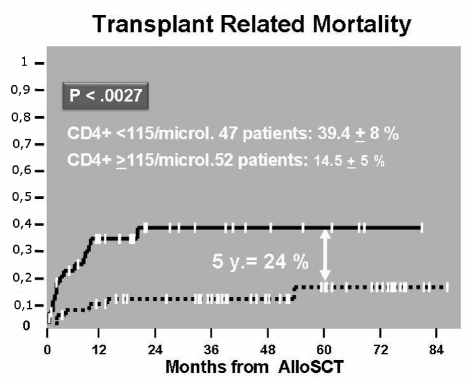
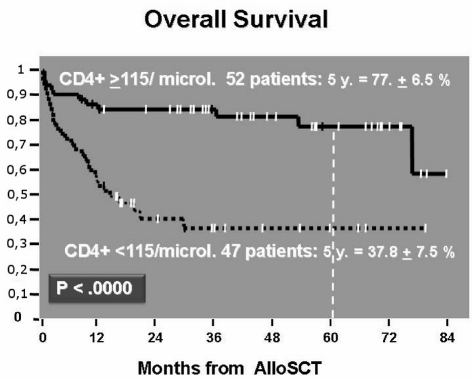
Results: Univariate analysis with Spearman's rho showed a significant correlation between early CD4+ cell recovery and overall survival, transplant-related mortality, stem cell source and type of donor. In multivariate analysis CD4+ cell count was significantly associated with (i) stem cell source, being higher in patients whose haematopoietic progenitor cells were obtained by apheresis than in those whose source of grafted cells was bone marrow, and (ii) type of donor, being higher in patients transplanted from sibling donors than in those whose graft was from an alternative donor. The ROC curve of CD4+ cell count indicated that a cut-off of 115 CD4+ cells/mL could differentiate groups with different outcomes. At 2 years follow-up, patients achieving this CD4+ cell count had significantly lower cumulative transplant-related mortality compared to patients who did not have this count (10%±4% versus 40%±8%, p=0.0026). At the 5-year follow-up, the overall survival rates were 77.5%±0.6% and 36%±7% (p=0.000) in patients with a CD4+ cell count ≥115/mL and in patients with CD4+ cell count ≤ 115/mL, respectively.
Conclusion: Early CD4+ cell recovery after allogeneic transplantation has a relevant impact on overall survival and transplant-related mortality and is influenced by two factors: stem cell source and type of donor.
Figures
References
-
- Appelbaum FR. Haematopoietic cell transplantation as immunotherapy. Nature. 2001;411:385–9. - PubMed
-
- Auletta JJ. Immune restoration following hematopoietic stem cell transplantation: an evolving target. Bone Marrow Transplant. 2005;35:835–7. - PubMed
-
- Antin JH. Immune reconstitution: the major barrier to successful stem cell transplantation. Biol Blood Marrow Transplant. 2005;11:43–5. - PubMed
-
- Storek J, Gooley T, Witherspoon RP, et al. Infectious morbidity in long-term survivors of allogeneic marrow transplantation is associated with low CD4T cell counts. Am J Hematol. 1997;54:131–8. - PubMed
-
- Maraninchi D, Gluckman E, Blaise D, et al. Impact of T-cell depletion on outcome of allogeneic bone-marrow transplantation for standard-risk leukemias. Lancet. 1987;2:175–8. - PubMed
MeSH terms
LinkOut - more resources
Full Text Sources
Medical
Research Materials
