


Effect of extended-release niacin on new-onset diabetes among hyperlipidemic patients treated with ezetimibe/simvastatin in a randomized controlled trial
- PMID: 22338103
- PMCID: PMC3308290
- DOI: 10.2337/dc11-1369
Effect of extended-release niacin on new-onset diabetes among hyperlipidemic patients treated with ezetimibe/simvastatin in a randomized controlled trial
Abstract
Objective: To determine the effect of niacin on fasting glucose (FG) and new-onset diabetes in statin/ezetimibe-treated patients.
Research design and methods: This was a prespecified secondary analysis among 942 hyperlipidemic patients randomized to ezetimibe/simvastatin (E/S; 10/20 mg) or E/S + extended-release niacin (N; titrated to 2 g) over 64 weeks.
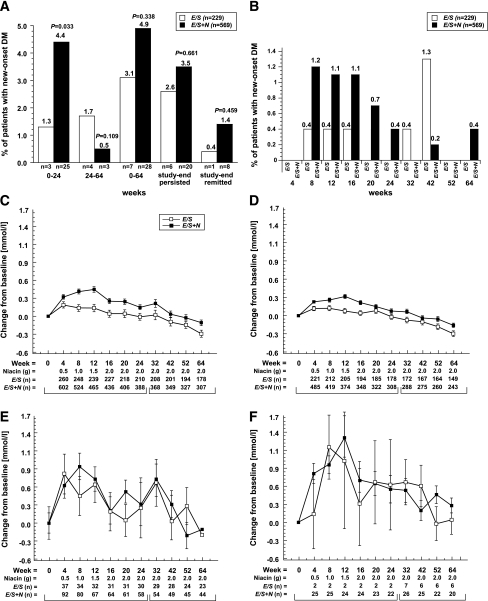
Results: FG levels peaked by 8-12 weeks, then declined even without antidiabetic medication. At 64 weeks, 3.5% taking E/S+N versus 2.6% taking E/S met criteria for new-onset diabetes (P = 0.66). An additional 1.4% taking E/S+N versus 0.4% taking E/S transiently met criteria for diabetes and then remitted (P = 0.46). Of 28 new-diabetes diagnoses in the E/S+N group, 25 occurred by 24 weeks. Among patients with baseline diabetes, 13.9% taking E/S+N and 11.6% taking E/S underwent antidiabetic treatment modification.
Conclusions: Increased FG and new-onset diabetes with E/S+N occurred mainly around the time of initial uptitration of N and often improved or remitted without specific treatment.
Trial registration: ClinicalTrials.gov NCT00271817.
Figures
References
-
- Guyton JR. Niacin in cardiovascular prevention: mechanisms, efficacy, and safety. Curr Opin Lipidol 2007;18:415–420 - PubMed
-
- Guyton JR, Brown BG, Fazio S, Polis A, Tomassini JE, Tershakovec AM. Lipid-altering efficacy and safety of ezetimibe/simvastatin coadministered with extended-release niacin in patients with type IIa or type IIb hyperlipidemia. J Am Coll Cardiol 2008;51:1564–1572 - PubMed
-
- Fazio S, Guyton JR, Polis AB, et al. Long-term safety and efficacy of triple combination ezetimibe/simvastatin plus extended-release niacin in patients with hyperlipidemia. Am J Cardiol 2010;105:487–494 - PubMed
Publication types
MeSH terms
Substances
Associated data
LinkOut - more resources
Full Text Sources
Medical
Miscellaneous
