American Indian parents' assessment of and concern about their kindergarten child's weight status, South Dakota, 2005-2006
- PMID: 22338596
- PMCID: PMC3359100
American Indian parents' assessment of and concern about their kindergarten child's weight status, South Dakota, 2005-2006
Abstract
Introduction: Obesity is highly prevalent among American Indians, and effective prevention efforts require caregiver involvement. We examined American Indian (AI) parents' assessment of and level of concern about their kindergarten child's weight status.
Methods: We collected baseline data (fall of 2005 and fall of 2006) on children and their parents or caregivers for a school-based obesity prevention trial (Bright Start) on an AI reservation in South Dakota. The current study uses 413 parent-child pairs. Age- and sex-adjusted body mass index percentiles were categorized as very underweight (<5th percentile), slightly underweight (5th to <15th percentile), normal weight (15th to <85th percentile), overweight (85th to <95th percentile), and obese (≥ 95th percentile). Parents or caregivers reported their assessment of and concerns about their child's weight status as well as sociodemographic characteristics. We used mixed-model multivariable analysis to examine associations between sociodemographic characteristics and the probability of parents underclassifying or overclassifying their child's weight status; analyses were adjusted for school as a random effect.
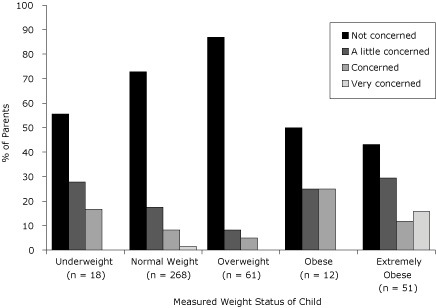
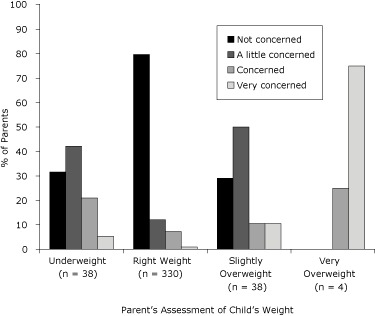
Results: Children were evenly divided by sex and had a mean age of 5.8 years. Twenty-nine percent of children and 86% of parents were overweight or obese. Approximately 33% (n = 138) of parents underclassified and 7% (n = 29) of parents overclassified their child's weight status. Higher parental weight status and higher concern about their child's weight status increased the probability of underclassification (P for trend = .02 for both).
Conclusion: In this sample of at-risk children, one-third of parents underclassified their child's weight status. Childhood obesity prevention programs need to increase awareness and recognition of childhood obesity and address parental weight issues.
Figures
References
-
- Ogden CL, Carroll MD, Flegal KM. High body mass index for age among US children and adolescents, 2003-2006. JAMA. 2008;299(20):2401–2405. - PubMed
-
- Story M, Stevens J, Himes J, Stone E, Rock BH, Ethelbah B, Davis S. Obesity in American-Indian children: prevalence, consequences, and prevention. Prev Med. 2003;37(6 Pt 2):S3–12. - PubMed
-
- Wilcox LS, Marks JS. From data to action. CDC's public health surveillance for women, infants, and children. Washington (DC): US Department of Health and Human Services, Centers for Disease Control and Prevention; 1994.
-
- Eisenmann JC, Katzmarzyk PT, Arnall DA, Kanuho V, Interpreter C, Malina RM. Growth and overweight of Navajo youth: secular changes from 1955 to 1997. Int J Obes Relat Metab Disord. 2000;24(2):211–218. - PubMed
-
- Zephier E, Himes JH, Story M, Zhou X. Increasing prevalences of overweight and obesity in Northern Plains American Indian children. Arch Pediatr Adolesc Med. 2006;160(1):34–39. - PubMed
Publication types
MeSH terms
Grants and funding
LinkOut - more resources
Full Text Sources
Medical