


Human platelets efficiently kill IgG-opsonized E. coli
- PMID: 22340259
- PMCID: PMC3342444
- DOI: 10.1111/j.1574-695X.2012.00945.x
Human platelets efficiently kill IgG-opsonized E. coli
Abstract
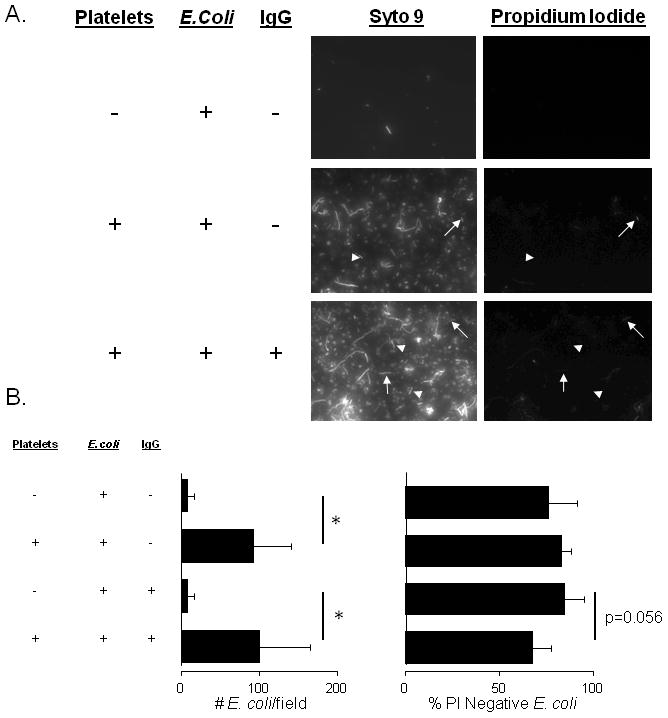
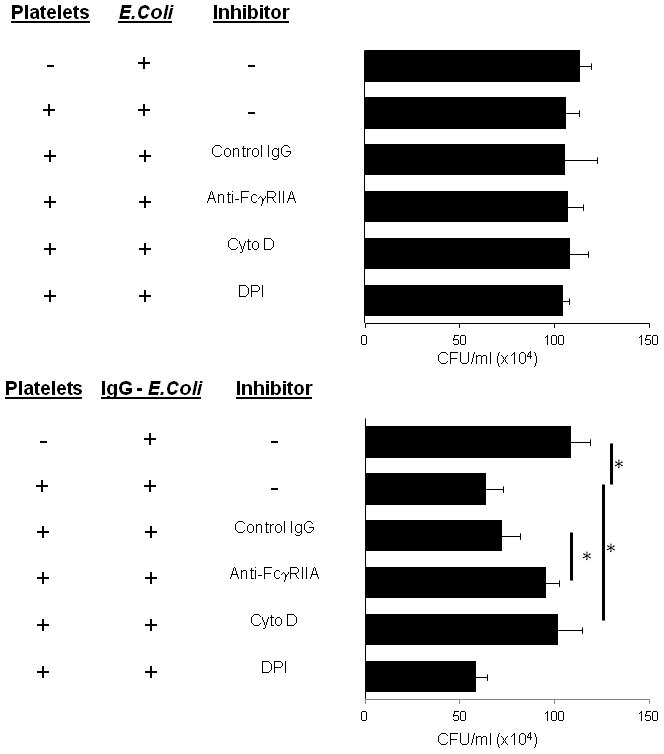
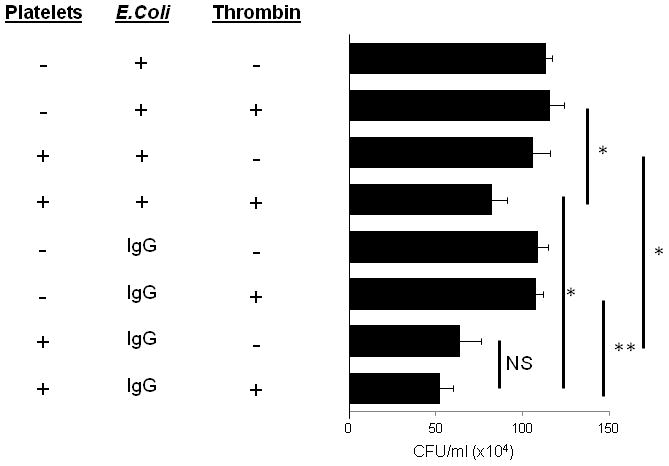
Platelets are known contributors of hemostasis but have recently been shown to be important in inflammation and infectious diseases. Moreover, thrombocytopenia is often observed in patients with sepsis. We previously reported that platelets actively phagocytosed IgG-coated latex beads. In this study, the capacity of human platelets to participate in host defense against bacterial infections was determined by assessing their ability to kill Escherichia coli. Washed human platelets were incubated with unopsonized or IgG-opsonized E. coli and evaluated for binding and killing of E. coli. We found that although both unopsonized and IgG-opsonized E. coli were associated with platelets, only IgG-opsonized E. coli were efficiently killed unless platelets were activated by a potent agonist. The bactericidal activity was dependent on FcγRIIA, was sensitive to cytochalasin D, but was not due to reactive oxygen metabolites. These data suggest that platelets may play an important role in protection against infection.
© 2012 Federation of European Microbiological Societies. Published by Blackwell Publishing Ltd. All rights reserved.
Figures
References
-
- Cognasse F, Hamzeh H, Chavarin P, Acquart S, Genin C, Garraud O. Evidence of Toll-like receptor molecules on human platelets. Immunol Cell Biol. 2005;83:196–198. - PubMed
-
- Fitzgerald JR, Foster TJ, Cox D. The interaction of bacterial pathogens with platelets. Nat Rev Microbiol. 2006;4:445–457. - PubMed
-
- Fitzgerald JR, Loughman A, Keane F, Brennan M, Knobel M, Higgins J, Visai L, Speziale P, Cox D, Foster TJ. Fibronectin-binding proteins of Staphylococcus aureus mediate activation of human platelets via fibrinogen and fibronectin bridges to integrin GPIIb/IIIa and IgG binding to the FcgammaRIIa receptor. Mol Microbiol. 2006;59:212–230. - PubMed
Publication types
MeSH terms
Substances
Grants and funding
LinkOut - more resources
Full Text Sources