


Clinical correlates of co-occurring cannabis and tobacco use: a systematic review
- PMID: 22340422
- PMCID: PMC3377777
- DOI: 10.1111/j.1360-0443.2012.03843.x
Clinical correlates of co-occurring cannabis and tobacco use: a systematic review
Abstract
Aims: A growing literature has documented the substantial prevalence of and putative mechanisms underlying co-occurring (i.e. concurrent or simultaneous) cannabis and tobacco use. Greater understanding of the clinical correlates of co-occurring cannabis and tobacco use may suggest how intervention strategies may be refined to improve cessation outcomes and decrease the public health burden associated with cannabis and tobacco use.
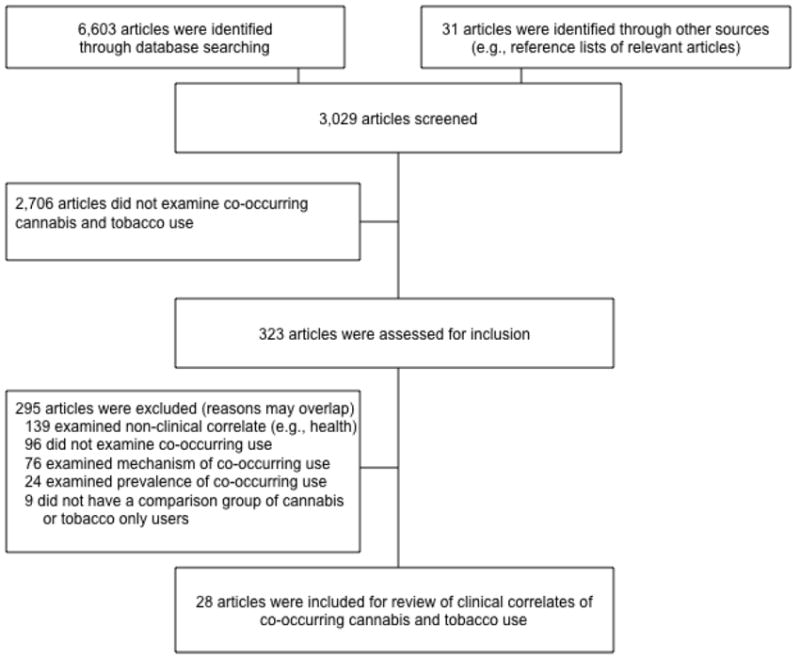
Methods: A systematic review of the literature on clinical diagnoses, psychosocial problems and outcomes associated with co-occurring cannabis and tobacco use. Twenty-eight studies compared clinical correlates in co-occurring cannabis and tobacco users versus cannabis- or tobacco-only users. These included studies of treatment-seekers in clinical trials and non-treatment-seekers in cross-sectional or longitudinal epidemiological or non-population-based surveys.
Results: Sixteen studies examined clinical diagnoses, four studies examined psychosocial problems and 11 studies examined cessation outcomes in co-occurring cannabis and tobacco users (several studies examined multiple clinical correlates). Relative to cannabis use only, co-occurring cannabis and tobacco use was associated with a greater likelihood of cannabis use disorders, more psychosocial problems and poorer cannabis cessation outcomes. Relative to tobacco use only, co-occurring use did not appear to be associated consistently with a greater likelihood of tobacco use disorders, more psychosocial problems or poorer tobacco cessation outcomes.
Conclusions: Cannabis users who also smoke tobacco are more dependent on cannabis, have more psychosocial problems and have poorer cessation outcomes than those who use cannabis but not tobacco. The converse does not appear to be the case.
© 2012 The Authors, Addiction © 2012 Society for the Study of Addiction.
Conflict of interest statement
Declaration of Interest: Drs. Peters and Carroll have no conflicts to declare.
Figures
Comment in
-
Commentary on Peters et al. (2012): cannabis and tobacco policy correlates--why not try to reduce harm?Addiction. 2012 Aug;107(8):1418-9. doi: 10.1111/j.1360-0443.2012.03915.x. Addiction. 2012. PMID: 22779415 No abstract available.
References
-
- Clough AR, D’Abbs P, Cairney S, Gray D, Maruff P, Parker R, et al. Emerging patterns of cannabis and other substance use in Aboriginal communities in Arnhem Land, Northern Territory: A study of two communities. Drug Alcohol Rev. 2004;23:381–90. - PubMed
-
- Martin CS, Clifford PR, Clapper RL. Patterns and predictors of simultaneous and concurrent use of alcohol, tobacco, marijuana, and hallucinogens in first-year college students. J Subst Abuse. 1992;4:319–26. - PubMed
-
- Richter KP, Kaur H, Resnicow K, Nazir N, Mosier MC, Ahluwalia JS. Cigarette smoking among marijuana users in the United States. Subst Abuse. 2005;25:35–43. - PubMed
-
- Rigotti NA, Lee JE, Wechsler H. US college students’ use of tobacco products: Results of a national survey. JAMA. 2000;284:699–705. - PubMed
Publication types
MeSH terms
Grants and funding
LinkOut - more resources
Full Text Sources
Medical
