


Performance of total testosterone measurement to predict free testosterone for the biochemical evaluation of male hypogonadism
- PMID: 22341266
- PMCID: PMC10368284
- DOI: 10.1016/j.juro.2011.11.095
Performance of total testosterone measurement to predict free testosterone for the biochemical evaluation of male hypogonadism
Abstract
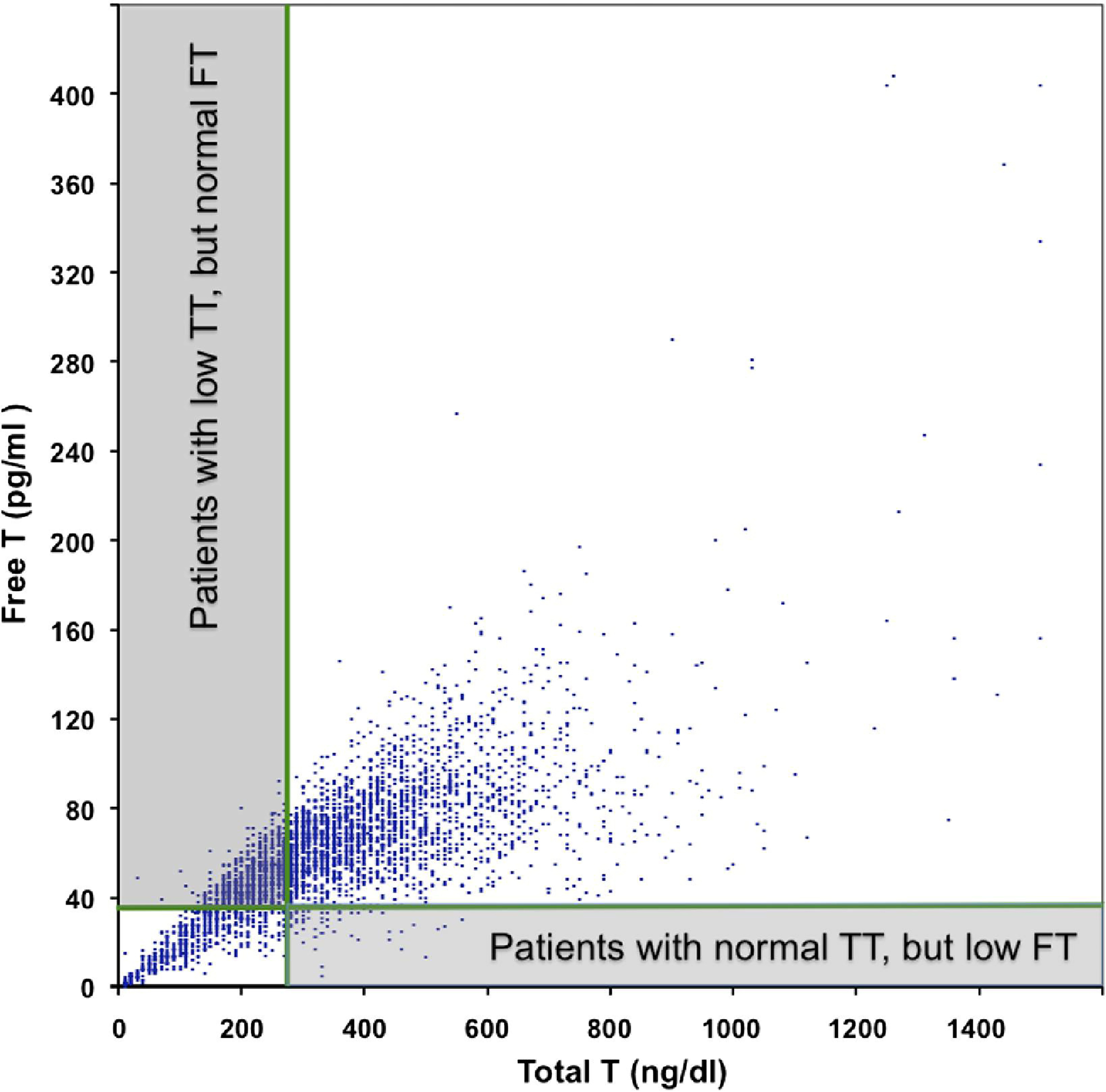
Purpose: Guidelines recommend serum total testosterone measurement as the initial test to evaluate male hypogonadism, reserving free testosterone assessment for men with suspected sex hormone-binding globulin abnormalities or total testosterone near the lower limit of normal. We determined the performance of total testosterone measurement as a test to identify men with normal vs low free testosterone.
Materials and methods: We examined the electronic medical records of all 3,672 men evaluated for hypogonadism by a serum testosterone panel, including total testosterone, sex hormone-binding globulin, albumin and calculated free testosterone, from January 1, 1997 through December 31, 2007 in a network that serves veterans in Washington.
Results: The sensitivity and specificity of low total testosterone (less than 280 ng/dl) to rule out and predict low calculated free testosterone was 91.0% and 73.7%, respectively. At thresholds of less than 350 and less than 400 ng/dl the sensitivity of total testosterone for low calculated free testosterone increased to 96.8% and 98.2%, and at thresholds of less than 150 and less than 200 ng/dl specificity increased to 98.9% and 92.6%, respectively.
Conclusions: Total testosterone between 280 and 350 ng/dl is not sensitive enough to reliably exclude hypogonadism. Total testosterone must exceed 350 to 400 ng/dl to reliably predict normal free testosterone. Except when levels are less than 150 ng/dl total testosterone measurement has low specificity for the biochemical diagnosis of hypogonadism.
Copyright © 2012 American Urological Association Education and Research, Inc. Published by Elsevier Inc. All rights reserved.
Figures
References
-
- Araujo AB, Esche GR, Kupelian V et al. : Prevalence of symptomatic androgen deficiency in men. J Clin Endocrinol Metab 2007; 92: 4241. - PubMed
-
- Araujo AB, O’Donnell AB, Brambilla DJ et al. : Prevalence and incidence of androgen deficiency in middle-aged and older men: estimates from the Massachusetts Male Aging Study. J Clin Endocrinol Metab 2004; 89: 5920. - PubMed
-
- Harman SM, Metter EJ, Tobin JD et al. : Longitudinal effects of aging on serum total and free testosterone levels in healthy men. Baltimore Longitudinal Study of Aging. J Clin Endocrinol Metab 2001; 86: 724. - PubMed
-
- Bhasin S, Cunningham GR, Hayes FJ et al. : Testosterone therapy in adult men with androgen deficiency syndromes: an Endocrine Society Clinical Practice Guideline. J Clin Endocrinol Metab 2010; 95: 2536. - PubMed
-
- Rosner W, Auchus RJ, Azziz R et al. : Utility, limitations and pitfalls in measuring testosterone: an Endocrine Society Position Statement. J Clin Endocrinol Metab 2007; 92: 405. - PubMed
Publication types
MeSH terms
Substances
Grants and funding
LinkOut - more resources
Full Text Sources
Other Literature Sources
