. 2012 Apr 6;287(15):11798-809.
doi: 10.1074/jbc.M111.333732. Epub 2012 Feb 16.

Refinement of structural leads for centrally acting oxime reactivators of phosphylated cholinesterases

Affiliations

Refinement of structural leads for centrally acting oxime reactivators of phosphylated cholinesterases

Zoran Radić et al. J Biol Chem. .

Erratum in

  • J Biol Chem. 2012 Jun 1;287(23):19337

Abstract

We present a systematic structural optimization of uncharged but ionizable N-substituted 2-hydroxyiminoacetamido alkylamine reactivators of phosphylated human acetylcholinesterase (hAChE) intended to catalyze the hydrolysis of organophosphate (OP)-inhibited hAChE in the CNS. Starting with the initial lead oxime RS41A identified in our earlier study and extending to the azepine analog RS194B, reactivation rates for OP-hAChE conjugates formed by sarin, cyclosarin, VX, paraoxon, and tabun are enhanced severalfold in vitro. To analyze the mechanism of intrinsic reactivation of the OP-AChE conjugate and penetration of the blood-brain barrier, the pH dependence of the oxime and amine ionizing groups of the compounds and their nucleophilic potential were examined by UV-visible spectroscopy, (1)H NMR, and oximolysis rates for acetylthiocholine and phosphoester hydrolysis. Oximolysis rates were compared in solution and on AChE conjugates and analyzed in terms of the ionization states for reactivation of the OP-conjugated AChE. In addition, toxicity and pharmacokinetic studies in mice show significantly improved CNS penetration and retention for RS194B when compared with RS41A. The enhanced intrinsic reactivity against the OP-AChE target combined with favorable pharmacokinetic properties resulted in great improvement of antidotal properties of RS194B compared with RS41A and the standard peripherally active oxime, 2-pyridinealdoxime methiodide. Improvement was particularly noticeable when pretreatment of mice with RS194B before OP exposure was combined with RS194B reactivation therapy after the OP insult.


Figures
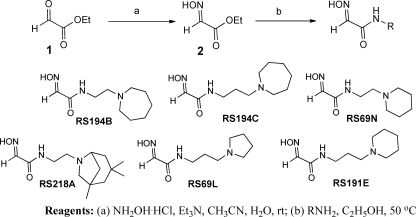
SCHEME 1
SCHEME 1
FIGURE 1.
FIGURE 1.
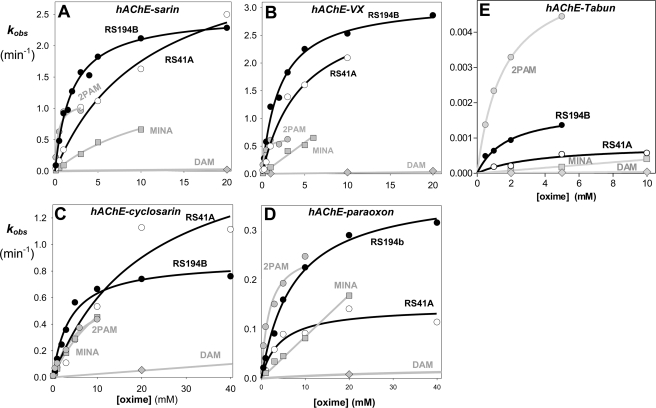
Concentration dependence of oxime reactivation of sarin (A)-, VX (B)-, cyclosarin (C)-, paraoxon (D)-, and tabun (E)-inhibited (conjugated) hAChE. Dependence for the lead oxime RS194B (black circle) and the initial lead RS41A (open circle) compared with reference uncharged (DAM (gray diamond) and MINA (gray square)) and cationic (2PAM (gray square) oximes (measured at 37 °C in 0.10 m phosphate buffer pH 7.4).
FIGURE 2.
FIGURE 2.
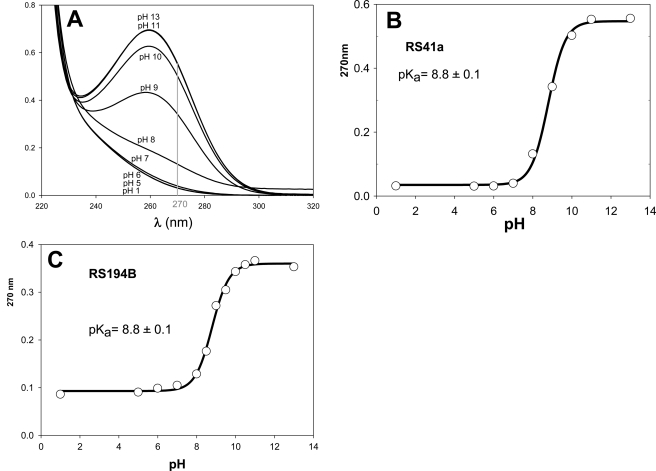
pH dependence of UV spectra of 50 μm RS41A and pH dependence of A270 nm of 50 μm (A) RS41A (B), and RS194B along with corresponding pKa values calculated by nonlinear regression using Equation 1 (C).
FIGURE 3.
FIGURE 3.
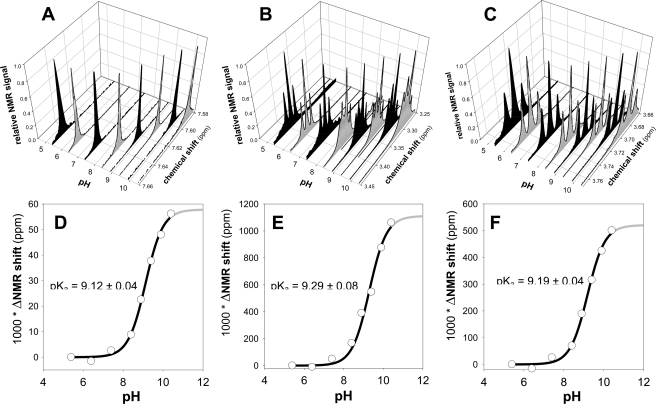
pH dependence of 1H NMR spectra of 2.0 mm RS194B in D2O buffers (A, B, and C) along with corresponding pKa values calculated from the observed pH-induced difference in chemical shifts (D, E, and F) by nonlinear regression using Equation 1. NMR signals in panels A, B, and C were normalized relative to the maximal peak height in the given chemical shift region. Spectra were aligned using a benzene external standard singlet at 7.16 ppm.
FIGURE 4.
FIGURE 4.
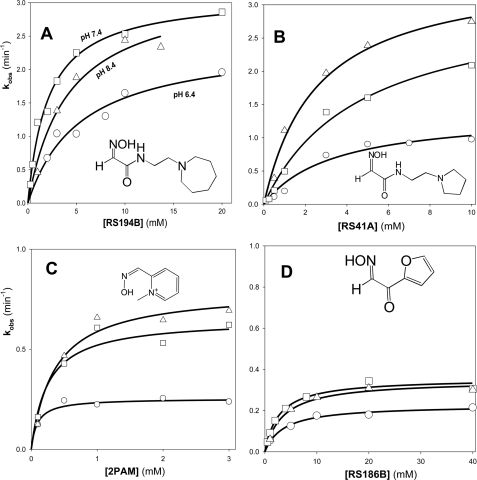
Concentration dependence of oxime reactivation of VX-inhibited hAChE by the lead oxime RS194B (A), initial lead oxime RS41A (B), and reference oxime 2PAM (C) and oxime RS186B (D) measured at pH 6. 4 (○), pH 7.4 (□), and pH 8.4 (△) at 37 °C in 0.10 m phosphate buffers.
FIGURE 5.
FIGURE 5.
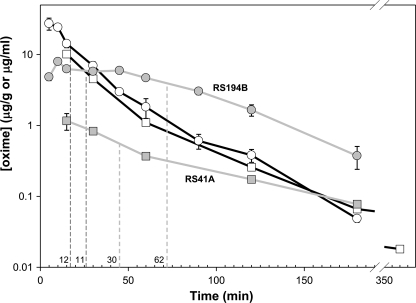
Pharmacokinetics of RS194B (circles) and RS41A (squares) in mice. Brain (gray lines) and plasma (black lines) compound concentrations were determined at discrete time points upon single, 80 mg/kg (RS194B), or 30 mg/kg (RS41A) dose administered to mice i.m. Each point represents average of determinations from three mice. S.E. of determination are indicated by error bars. Times required for halving maximal compound concentrations in plasma and in brain are indicated by dashed lines for each of two oximes.
FIGURE 6.
FIGURE 6.
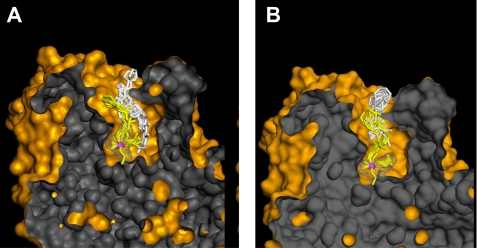
Computational molecular modeling of VX-inhibited AChE showing the reversible Michaelis type complex (white sticks) and covalent pentacoordinate trigonal bipyramidal intermediate (yellow sticks) for interaction of initial lead oxime RS41A (A) and the lead oxime RS194B (B). Ten conformers of each oxime are shown in each of two interaction states. The phosphorus atom is colored purple. The solvent-accessible part of the hAChE Connolly surface is represented in orange, and the solvent-inaccessible part of the hAChE molecule is in dark gray. Pronounced overlapping similarity in global geometries of the reversible complex (white sticks) and trigonal bipyramidal intermediate (yellow sticks) was observed for RS194B oxime, but not with RS41A oxime.
FIGURE 7.
FIGURE 7.
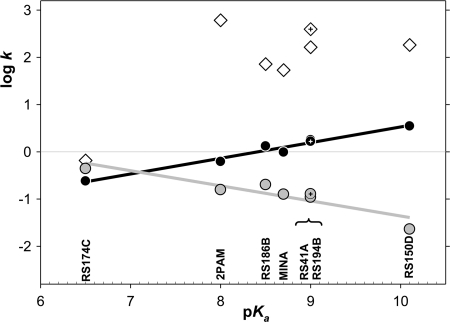
Free energy relationships between nucleophilic reactivities and oxime group ionization states of selected oxime reactivators. Rate constants (k) of maximal pH-dependent ATCh oximolysis (black line and circles), oximolysis at pH 7.4 (gray line and circles), and an average overall rate constant kr (m−1min−1) for oxime reactivation of VX, sarin, cyclosarin, and paraoxon inhibited hAChE (white diamonds) in relation to pKa values were determined for reactivator oxime groups. The lead reactivator RS194B data is indicated by cross-haired symbols. kr for RS174C and RS150D (not extensively studied in this series) were extrapolated from reactivation rates determined at single (0.67 mm) oxime concentration.

References

    1. Sit R. K., Radić Z., Gerardi V., Zhang L., Garcia E., Katalinić M., Amitai G., Kovarik Z., Fokin V. V., Sharpless K. B., Taylor P. (2011) New structural scaffolds for centrally acting oxime reactivators of phosphylated cholinesterases. J. Biol. Chem. 286, 19422–19430 - PMC - PubMed
    1. Mercey G., Verdelet T., Saint-André G., Gillon E., Wagner A., Baati R., Jean L., Nachon F., Renard P. Y. (2011) First efficient uncharged reactivators for the dephosphylation of poisoned human acetylcholinesterase. Chem. Commun. 475, 5295–5297 - PubMed
    1. de Koning M. C., van Grol M., Noort D. (2011) Peripheral site ligand conjugation to a non-quaternary oxime enhances reactivation of nerve agent-inhibited human acetylcholinesterase. Toxicol. Lett. 206, 54–59 - PubMed
    1. Kalisiak J., Ralph E. C., Zhang J., Cashman J. R. (2011) Amidine-oximes. Reactivators for organophosphate exposure. J. Med Chem. 54, 3319–3330 - PubMed
    1. Demar J. C., Clarkson E. D., Ratcliffe R. H., Campbell A. J., Thangavelu S. G., Herdman C. A., Leader H., Schulz S. M., Marek E., Medynets M. A., Ku T. C., Evans S. A., Khan F. A., Owens R. R., Nambiar M. P., Gordon R. K. (2010) Pro-2-PAM therapy for central and peripheral cholinesterases. Chem. Biol. Interact. 187, 191–198 - PMC - PubMed

Publication types

MeSH terms