


Weight loss and exercise training effect on oxygen uptake and heart rate response to locomotion
- PMID: 22344063
- PMCID: PMC3664274
- DOI: 10.1519/JSC.0b013e31824f236c
Weight loss and exercise training effect on oxygen uptake and heart rate response to locomotion
Abstract
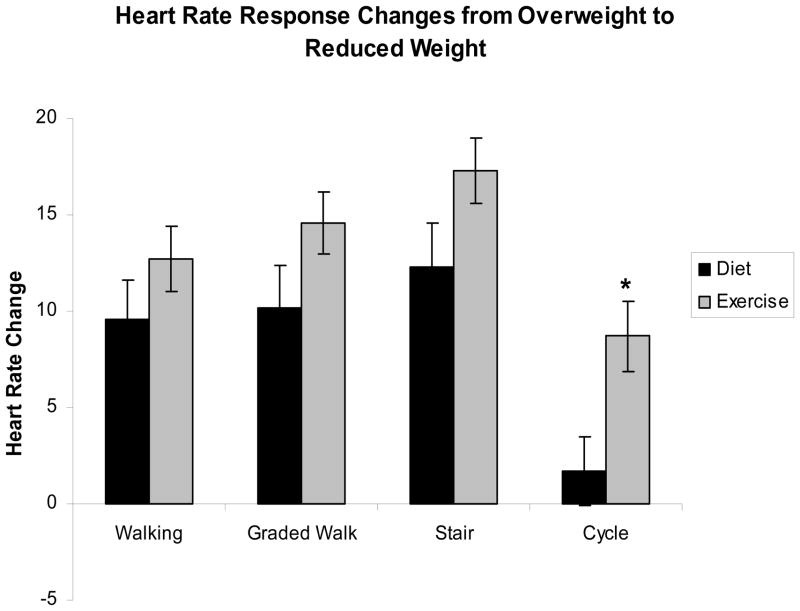
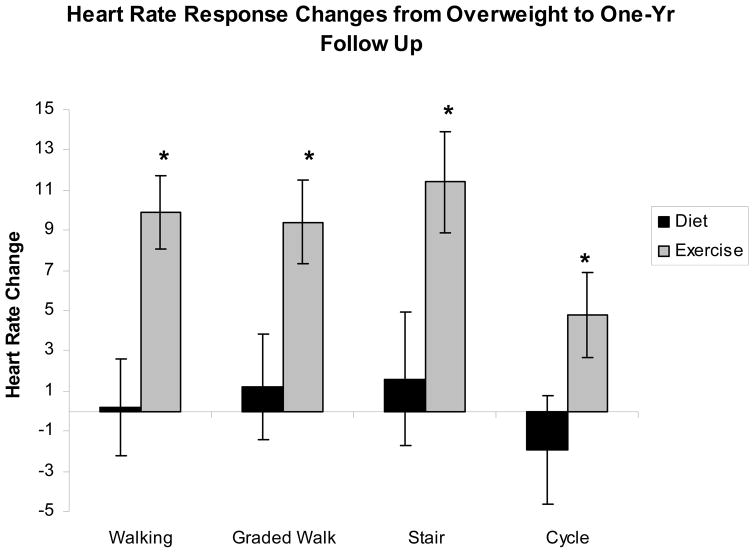
Effects of resistance and aerobic training on the ease of physical activity during and after weight loss are unknown. The purpose of the study was to determine what effect weight loss combined with either aerobic or resistance training has on the ease of locomotion (net V[Combining Dot Above]O2 and heart rate). It is hypothesized that exercise training will result in an increased ease, lowers heart rate during locomotion. Seventy-three overweight premenopausal women were assigned to diet and aerobic training, diet and resistance training, or diet only. Subjects were evaluated while overweight, after diet-induced weight loss (average, 12.5 kg loss), and 1 year after weight loss (5.5 kg regain). Submaximal walking, grade walking, stair climbing, and bike oxygen uptake and heart rate were measured at all time points. Weight loss diet was 800 kcal per day. Exercisers trained 3 times per week during weight loss and 2 times per week during 1-year follow-up. Resistance training increased strength, and aerobic training increased maximum oxygen uptake. Net submaximal oxygen uptake was not affected by weight loss or exercise training. However, heart rate during walking, stair climbing, and bicycling was reduced after weight loss. No significant differences in reduction in heart rate were observed among the 3 treatment groups for locomotion after weight loss. However, during 1-year follow-up, exercise training resulted in maintenance of lower submaximal heart rate, whereas nonexercisers increased heart rate during locomotion. Results suggest that moderately intense exercise is helpful in improving the ease of movement after weight loss. Exercise training may be helpful in increasing the participation in free-living physical activity.
Conflict of interest statement
The authors declare no conflict of interest.
Figures
References
-
- Hartman MJ, Fields DA, Byrne NM, Hunter GR. Resistance training improves metabolic economy during functional tasks in older adults. J Str Cond Res. 2007;21:91–95. - PubMed
-
- Hellerstein HK, Franklin BA. Exercise Testing and Prescription. In: Wenger NK, Hellerstein HK, editors. Rehabilitation of the Coronary Patient. New York, NY: John Wiley & Sons, Inc; 1984. pp. 197–284.
-
- Hunter GR, Byrne NM. Physical activity and muscle function but not resting energy expenditure impact on weight gain. J Str Cond Res. 2005;19:225–230. - PubMed
Publication types
MeSH terms
Grants and funding
- P60DK079626/DK/NIDDK NIH HHS/United States
- R01DK49779/DK/NIDDK NIH HHS/United States
- R01 DK051684/DK/NIDDK NIH HHS/United States
- R01DK51684/DK/NIDDK NIH HHS/United States
- P30-DK56336/DK/NIDDK NIH HHS/United States
- T32 DK062710/DK/NIDDK NIH HHS/United States
- P60 DK079626/DK/NIDDK NIH HHS/United States
- M01 RR000032/RR/NCRR NIH HHS/United States
- P30 DK056336/DK/NIDDK NIH HHS/United States
- UL1RR025777/RR/NCRR NIH HHS/United States
- R01 DK049779/DK/NIDDK NIH HHS/United States
- MO1-RR-00032/RR/NCRR NIH HHS/United States
- 2T32DK062710-07/DK/NIDDK NIH HHS/United States
