. 2012 Feb 19;44(3):302-6.
doi: 10.1038/ng.1086.

Common variants at CDKAL1 and KLF9 are associated with body mass index in east Asian populations

Affiliations

Common variants at CDKAL1 and KLF9 are associated with body mass index in east Asian populations

Yukinori Okada et al. Nat Genet. .

Abstract

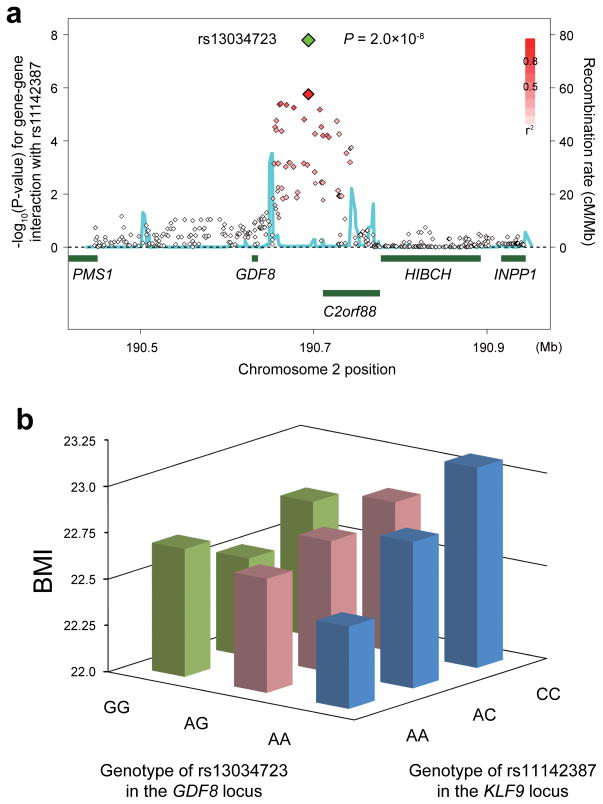
Obesity is a disorder with a complex genetic etiology, and its epidemic is a worldwide problem. Although multiple genetic loci associated with body mass index, the most common measure of obesity, have been identified in European populations, few studies have focused on Asian populations. Here we report a genome-wide association study and replication studies with 62,245 east Asian subjects, which identified two new body mass index-associated loci in the CDKAL1 locus at 6p22 (rs2206734, P = 1.4 × 10(-11)) and the KLF9 locus at 9q21 (rs11142387, P = 1.3 × 10(-9)), as well as several previously reported loci (the SEC16B, BDNF, FTO, MC4R and GIPR loci, P < 5.0 × 10(-8)). We subsequently performed gene-gene interaction analyses and identified an interaction (P = 2.0 × 10(-8)) between a SNP in the KLF9 locus (rs11142387) and one in the MSTN (also known as GDF8) locus at 2q32 (rs13034723). These findings should provide useful insights into the etiology of obesity.


Conflict of interest statement

COMPETING FINANCIAL INTERESTS

The authors declare no competing financial interests.

Figures
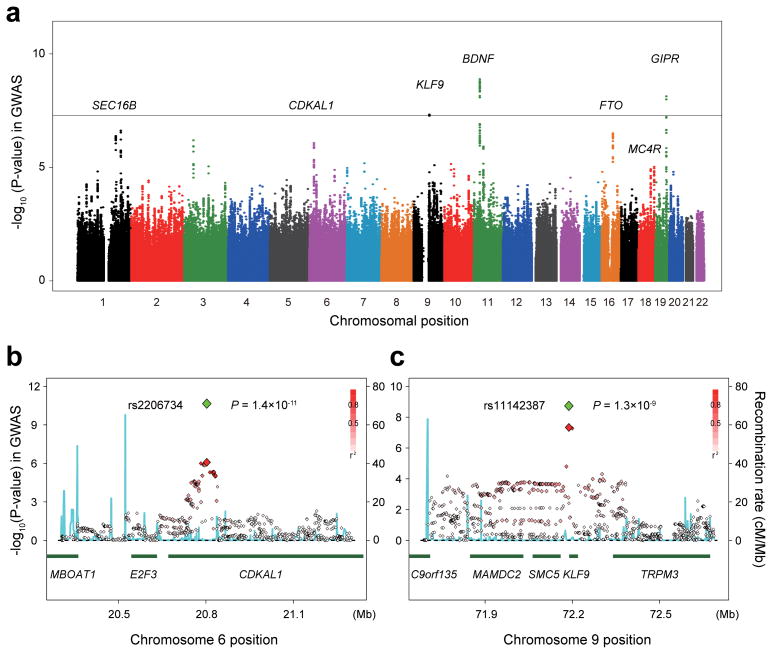
Figure 1
Figure 1
Results of the genome-wide association study (GWAS) for BMI. (a) Manhattan plot showing the −log10 (P-values) of the SNPs in the GWAS for BMI in 26,620 Japanese subjects. The genetic loci that satisfied the genome-wide significance threshold of P < 5.0 × 10⁻⁸ in the combined study of the GWAS and the replication studies are labeled. The gray horizontal line represents the threshold of P = 5.0 × 10⁻⁸. Regional plots of the SNPs (b) in the CDKAL1 locus and (c) in the KLF9 locus. The red diamond-shaped dots represent −log10 (P-values) of the SNPs in the GWAS, and the green dots represent the P-value of the most significantly associated SNP in each of the loci in the combined study. The density of the red color in the small-sized dots represents the r2 value with the most significantly associated SNP of the large-sized red dot. The blue line shows the recombination rates given by the HapMap Phase II East Asian populations (release 22). The lower part indicates the RefSeq genes in the loci.
Figure 2
Figure 2
Gene–gene interaction between the KLF9 and GDF8 loci. (a) Regional plots of the SNPs. Diamond-shaped dots represent −log10 (P-values) of the SNPs for gene–gene interaction with the landmark SNP in the KLF9 locus (rs11142387). The green dot indicates the P-value of the most significantly associated SNP in the combined study, and the red dot indicates its P-value in the genome-wide gene–gene interaction analysis. The density of the red color in the small-sized dots represents the r2 value with the most significantly associated SNP of the large-sized red dot. The blue line shows the recombination rates given by the HapMap database. The lower part indicates the RefSeq genes in the locus. (b) Mean BMI values of the subjects stratified with the genotypes of rs13034723 in the GDF8 locus and rs11142387 in the KLF9 locus.

References

    1. Kopelman PG. Obesity as a medical problem. Nature. 2000;404:635–643. - PubMed
    1. Maes HH, Neale MC, Eaves LJ. Genetic and environmental factors in relative body weight and human adiposity. Behav Genet. 1997;27:325–351. - PubMed
    1. Frayling TM, et al. A common variant in the FTO gene is associated with body mass index and predisposes to childhood and adult obesity. Science. 2007;316:889–894. - PMC - PubMed
    1. Liu YJ, et al. Genome-wide association scans identified CTNNBL1 as a novel gene for obesity. Hum Mol Genet. 2008;17:1803–1813. - PMC - PubMed
    1. Chambers JC, et al. Common genetic variation near MC4R is associated with waist circumference and insulin resistance. Nat Genet. 2008;40:716–718. - PubMed

Publication types

Substances