


Neurotoxin gene profiling of clostridium botulinum types C and D native to different countries within Europe
- PMID: 22344654
- PMCID: PMC3346454
- DOI: 10.1128/AEM.07568-11
Neurotoxin gene profiling of clostridium botulinum types C and D native to different countries within Europe
Abstract
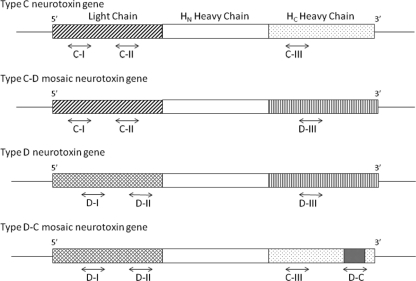
Clostridium botulinum types C and D, as well as their mosaic variants C-D and D-C, are associated with avian and mammalian botulism. This study reports on the development of low-density macroarrays based on the GeneDisc cycler platform (Pall-GeneDisc Technologies) applied to the simultaneous detection of the C. botulinum subtypes C, C-D, D, and D-C. The limit of detection of the PCR assays was 38 fg of total DNA, corresponding to 15 genome copies. Artificially contaminated samples of cecum showed a limit of detection below 50 spores/g. The tests were performed with a large variety of bacterial strains, including C. botulinum types C (n = 12), C-D (n = 29), D (n = 5), and D-C (n = 10), other botulinum neurotoxin (BoNT)-producing Clostridium strains (n = 20), non-BoNT-producing clostridia (n = 20), and other bacterial species (n = 23), and showed a high specificity. These PCR assays were compared to previously published real-time PCRs for the detection of C. botulinum in 292 samples collected from cases of botulism events in four European regions. The majority of the samples originated from wild birds (n = 108), poultry (n = 60), and bovines (n = 56). Among the 292 samples, 144 were positive for either the bont/C-D or the bont/D-C gene by using the GeneDisc arrays. The reliability of the results tallied to 97.94%. Interestingly, only BoNT mosaics, types C-D and D-C, were found in naturally contaminated samples whatever their animal origin and their geographical location. Further investigations should now be performed in order to check that mosaic types dominate in Europe and that acquisition of mosaic types helps in survival or adaptation to particular niche.
Figures
References
-
- Aranda E, Rodriguez MM, Asensio MA, Cordoba JJ. 1997. Detection of Clostridium botulinum types A, B, E, and F in foods by PCR and DNA probe. Lett. Appl. Microbiol. 25:186–190 - PubMed
-
- Braconnier A, et al. 2001. Screening for clostridium botulinum type A, B, and E in cooked chilled foods containing vegetables and raw material using polymerase chain reaction and molecular probes. J. Food Prot. 64:201–207 - PubMed
-
- Braun U, Feige K, Schweizer G, Pospischil A. 2005. Clinical findings and treatment of 30 cattle with botulism. Vet. Rec. 156:438–441 - PubMed
Publication types
MeSH terms
Substances
LinkOut - more resources
Full Text Sources
Other Literature Sources
Medical
