. 2012 Feb;24(2):415-27.
doi: 10.1105/tpc.111.094144. Epub 2012 Feb 17.

Effective small RNA destruction by the expression of a short tandem target mimic in Arabidopsis

Affiliations

Effective small RNA destruction by the expression of a short tandem target mimic in Arabidopsis

Jun Yan et al. Plant Cell. 2012 Feb.

Erratum in

  • Plant Cell. 2012 Mar;24(3):1301

Abstract

MicroRNAs (miRNAs) and other endogenous small RNAs act as sequence-specific regulators of the genome, transcriptome, and proteome in eukaryotes. The interrogation of small RNA functions requires an effective, widely applicable method to specifically block small RNA function. Here, we report the development of a highly effective technology that targets specific endogenous miRNAs or small interfering RNAs for destruction in Arabidopsis thaliana. We show that the expression of a short tandem target mimic (STTM), which is composed of two short sequences mimicking small RNA target sites, separated by a linker of an empirically determined optimal size, leads to the degradation of targeted small RNAs by small RNA degrading nucleases. The efficacy of the technology was demonstrated by the strong and specific developmental defects triggered by STTMs targeting three miRNAs and an endogenous siRNA. In summary, we developed an effective approach for the destruction of endogenous small RNAs, thereby providing a powerful tool for functional genomics of small RNA molecules in plants and potentially animals.


Figures
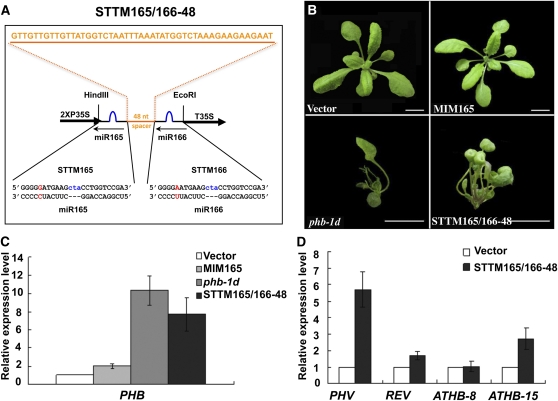
Figure 1.
Figure 1.
STTM165/166-48 Induced Dramatic Alterations in Arabidopsis Development. (A) Diagram of STTM165/166-48 structure showing the design strategy. Orange indicates the spacer region and the spacer sequence. Blue indicates the bulge sequences in the miRNA binding sites. Red indicates the nucleotides that are different between miR165 and miR166. nt, nucleotides. (B) Phenotypes of 3-week-old STTM165/166-48 transformants compared with vector control (Columbia-0), MIM165, and phb-1d plants. phb-1d is a dominant genetic mutant of the PHB (AT2G34710) gene in the Landsberg erecta background, and this mutation abolishes the binding of miR165/166 to PHB mRNA. Bars = 1.0 cm. (C) qRT-PCR analysis of the target gene PHB in STTM165/166-48 transformants compared with vector control, MIM165, and phb-1d plants. Bars show se. (D) qRT-PCR analysis of selected targets of miR165/166 in STTM165/166-48 transformants. Bars show se.
Figure 2.
Figure 2.
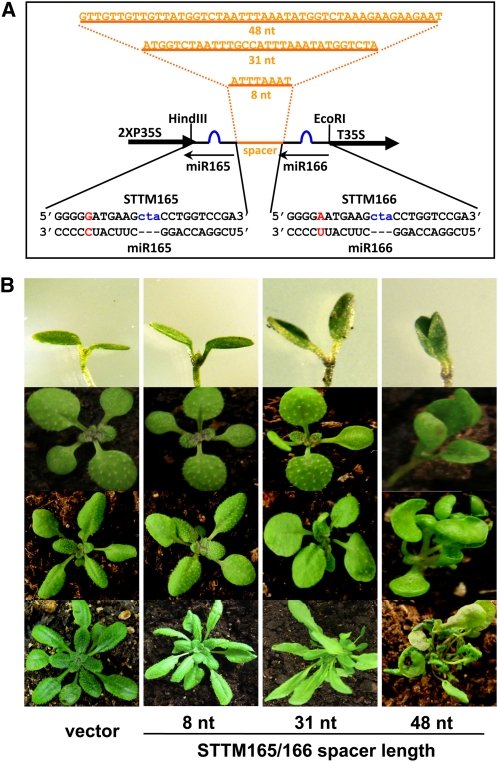
The Length of the RNA Spacer between the miR165 and miR166 Complementary Regions Is Crucial for STTM165/166 Function. (A) Diagrams of the STTM structures with varying lengths of the spacer region. Orange indicates the spacer region and the spacer sequence. Blue indicates the bulge sequences in the miRNA binding sites. Red indicates the nucleotides that are different between miR165 and miR166. (B) The phenotypes of representative STTM165/166 transgenic plants with different lengths of the RNA spacers at different developmental stages. Rows 1 to 4 represent plants at days 4, 8, 15, and 30, respectively. nt, nucleotides.
Figure 3.
Figure 3.
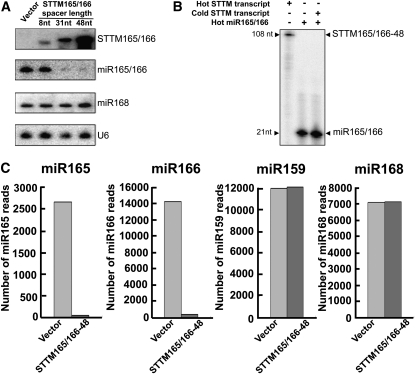
STTM165/166 Triggered Drastic Reduction of miR165/166 Levels. (A) Representative RNA gel blotting to detect STTM165/166, miR165/166, and miR168. U6 served as an internal control. nt, nucleotides. (B) STTM165/166-48 was unable to affect the migration of miR165/166 on a denaturing polyacrylamide gel. (C) Copy numbers of small RNA reads in vector control and STTM165/166-48 by deep sequencing.
Figure 4.
Figure 4.
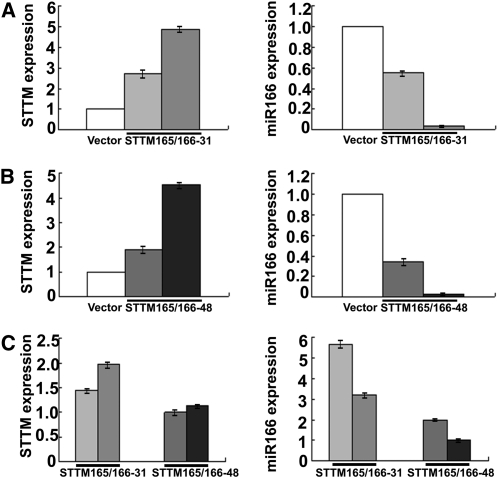
Comparisons of STTM and miR166 levels in STTM165/166 Transformants with Different Spacer Lengths. (A) qRT-PCR analysis of STTM and miR166 levels in independent STTM165/166-31 transgenic plants. Bars show se. (B) qRT-PCR analysis of STTM and miR166 levels in independent STTM165/166-48 transgenic plants. Bars show se. (C) Comparison of STTM and miR166 levels between independent STTM165/166-31 transgenic plants and independent STTM165/166-48 transgenic plants. Transgenic plants used in (A) to (C) were independent lines. Actin mRNA (for STTM) or SnoR101 (for miRNA) was used as an internal control. Values were obtained by normalizing to Actin or SnoR101 and then comparing the normalized values to those of control plants. Different shades of gray are used to indicate different independent lines to allow for the easy comparison between STTM and miR165/166 levels in the same lines. Bars show se. Note: The vector controls also contain 2XP35S and T35S (see Supplemental Figure 7 online), which bind the common qRT-PCR primers for the quantification of STTM expression and thus gave a value by qRT-PCR.
Figure 5.
Figure 5.
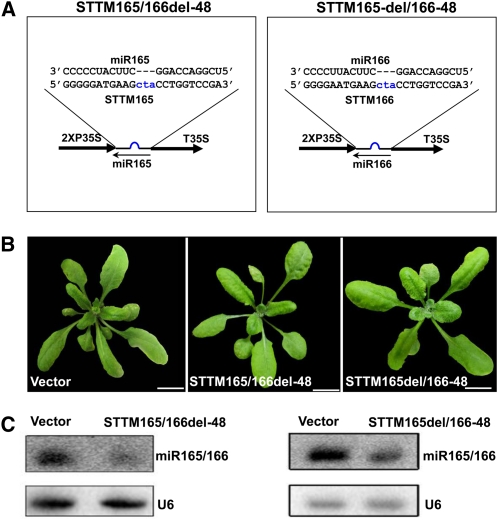
Comparison of the Efficacy of STTM Constructs with One miRNA Binding Site. (A) Diagram of STTM with one miR165 binding site or one miR166 binding site. Blue indicates the bulge sequences in the miRNA binding sites. (B) Phenotypes of transgenic plants containing STTM constructs with one miR165 binding site or one miR166 binding site. Bars = 1.0 cm. (C) RNA gel blotting to determine the levels of miR165/166 in transgenic plants containing STTM with one miR165 binding site or one miR166 binding site. Total RNAs were prepared from multiple primary transformants.
Figure 6.
Figure 6.
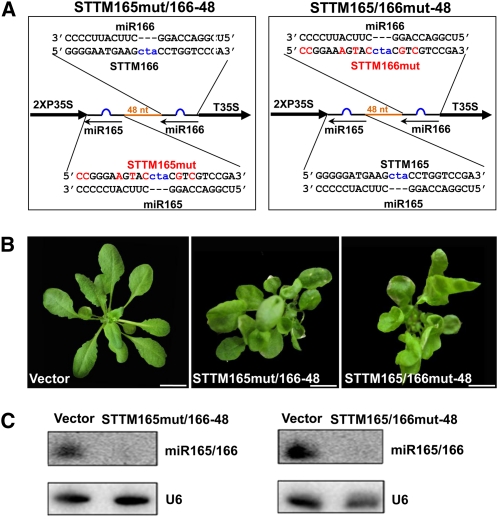
Comparison of the Efficacy of STTM with One Mutated Binding Site. (A) Diagram of STTM with mutated miR165 binding site or mutated miR166 binding site. Orange indicates the spacer region. Blue indicates the bulge sequences in the miRNA binding sites. Red indicates mutations in the miRNA binding sites. (B) Phenotypes of transgenic plants containing STTM with mutated miR165 binding site or mutated miR166 binding site. Bars = 1.0 cm. (C) RNA gel blotting to determine the levels of miR165/166 in transgenic plants containing STTM constructs with mutated miR165 binding site or mutated miR166 binding site. Total RNAs were prepared from multiple primary transformants.
Figure 7.
Figure 7.
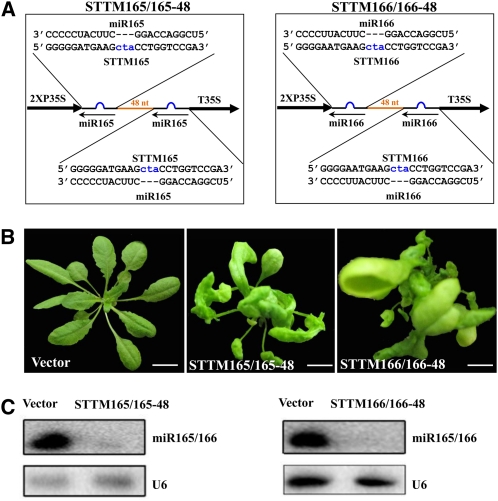
Comparison of the Efficacy of STTMs with Two Identical Binding Sites. (A) Diagram of STTMs with two miR165 binding sites or two miR166 binding sites. Orange indicates the spacer region. Blue indicates the bulge sequences in the miRNA binding sites. (B) Phenotypes of transgenic plants containing STTMs with two miR165 binding sites or two miR166 binding sites. Bars = 1.0 cm. (C) RNA gel blotting to determine the levels of miR165/166 in transgenic plants containing STTMs with two miR165 binding sites or two miR166 binding sites. Total RNAs were prepared from multiple primary transformants.
Figure 8.
Figure 8.
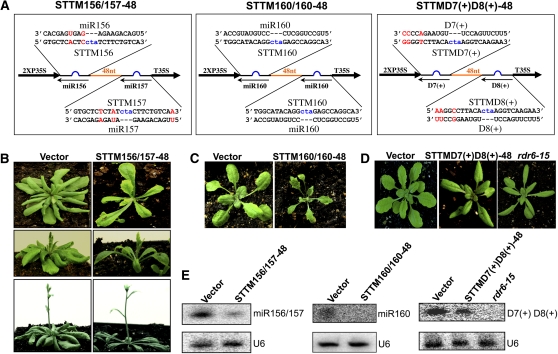
STTM Is Effective in Triggering the Reduction of miRNAs and siRNAs. (A) Diagram of STTMs containing miR156/157, miR160, or tasiRNAs (D7[+] and D8[+]) binding sites. Orange indicates the spacer region. Blue indicates the bulge sequences in the miRNA binding sites. Red indicates the nucleotides that are different between the two miRNAs or the two tasiRNAs. (B) to (D) Phenotypes of STTM156/157, STTM160/160, and STTMD7(+)D8(+) transgenic plants. (E) RNA gel blotting to determine the levels of miR156/157, miR160, or tasiRNAs (D7[+] and D8[+]) in STTM156/157, STTM160/160, or STTMD7(+)D8(+) transgenic plants. Total RNAs were prepared from multiple primary transformants.
Figure 9.
Figure 9.
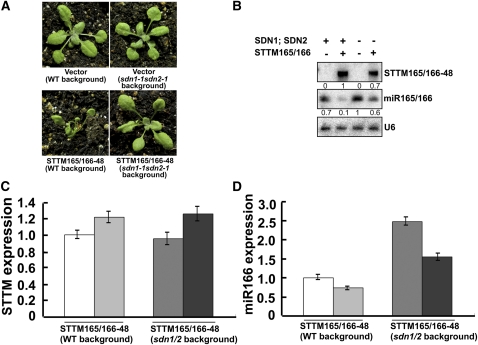
Degradation of miR165/166 by the SDNs Contributes to the Reduction of miR165/166 Triggered by STTM in Arabidopsis. (A) Phenotypes of vector and STTM165/166-48 transgenic plants in the sdn1-1 sdn2-1 background (at right) compared with those in the wild type (WT) background (at left). (B) RNA gel blotting to determine the levels of STTM165/166-48 RNA, miR165/166, and the U6 control RNA in the wild type (SDN1; SDN2 +) or sdn1-1 sdn2-1 (SDN1; SDN2 −) background. The numbers indicate the relative levels of the RNAs. (C) Comparison of STTM expression in STTM165/166-48 transgenic plants in sdn1-1 sdn2-1 background and in wild-type background. Bars show se. (D) Comparison of miR166 levels in STTM165/166-48 transgenic plants in sdn1-1 sdn2-1 background and in wild-type background. Bars show se. (C) and (D) Different shades of gray are used to indicate different independent lines to allow for the easy comparison between STTM and miR165/166 levels in the same lines. [See online article for color version of this figure.]

Comment in

References

    1. Ameres S.L., Horwich M.D., Hung J.H., Xu J., Ghildiyal M., Weng Z., Zamore P.D. (2010). Target RNA-directed trimming and tailing of small silencing RNAs. Science 328: 1534–1539 - PMC - PubMed
    1. Baker C.C., Sieber P., Wellmer F., Meyerowitz E.M. (2005). The early extra petals1 mutant uncovers a role for microRNA miR164c in regulating petal number in Arabidopsis. Curr. Biol. 15: 303–315 - PubMed
    1. Bartel D.P. (2009). MicroRNAs: Target recognition and regulatory functions. Cell 136: 215–233 - PMC - PubMed
    1. Brosnan C.A., Voinnet O. (2009). The long and the short of noncoding RNAs. Curr. Opin. Cell Biol. 21: 416–425 - PubMed
    1. Case C.C., Roels S.M., Jensen P.D., Lee J., Kleckner N., Simons R.W. (1989). The unusual stability of the IS10 anti-sense RNA is critical for its function and is determined by the structure of its stem-domain. EMBO J. 8: 4297–4305 - PMC - PubMed

Publication types