. 2012 Feb 15;26(4):384-94.
doi: 10.1101/gad.175802.111.

mtDNA lineage analysis of mouse L-cell lines reveals the accumulation of multiple mtDNA mutants and intermolecular recombination

Affiliations

mtDNA lineage analysis of mouse L-cell lines reveals the accumulation of multiple mtDNA mutants and intermolecular recombination

Weiwei Fan et al. Genes Dev. .

Abstract

The role of mitochondrial DNA (mtDNA) mutations and mtDNA recombination in cancer cell proliferation and developmental biology remains controversial. While analyzing the mtDNAs of several mouse L cell lines, we discovered that every cell line harbored multiple mtDNA mutants. These included four missense mutations, two frameshift mutations, and one tRNA homopolymer expansion. The LA9 cell lines lacked wild-type mtDNAs but harbored a heteroplasmic mixture of mtDNAs, each with a different combination of these variants. We isolated each of the mtDNAs in a separate cybrid cell line. This permitted determination of the linkage phase of each mtDNA and its physiological characteristics. All of the polypeptide mutations inhibited their oxidative phosphorylation (OXPHOS) complexes. However, they also increased mitochondrial reactive oxygen species (ROS) production, and the level of ROS production was proportional to the cellular proliferation rate. By comparing the mtDNA haplotypes of the different cell lines, we were able to reconstruct the mtDNA mutational history of the L-L929 cell line. This revealed that every heteroplasmic L-cell line harbored a mtDNA that had been generated by intracellular mtDNA homologous recombination. Therefore, deleterious mtDNA mutations that increase ROS production can provide a proliferative advantage to cancer or stem cells, and optimal combinations of mutant loci can be generated through recombination.


Figures
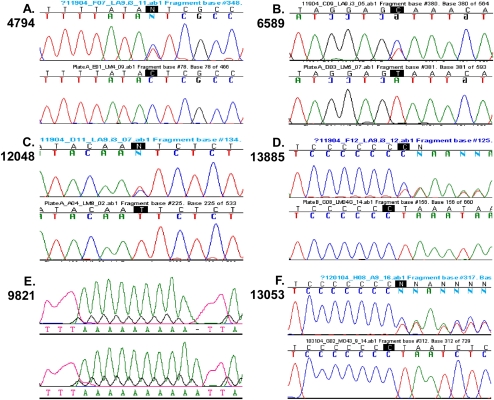
Figure 1.
Figure 1.
Sequence profiles of the mtDNA mutations in LA9 and LMTK cells. AF show six heteroplasmic mtDNA polypeptide mutations. These include ND2 C4794T (A), COI T6589C (B), ND5 T12048C (C), ND6 13885insC (D), [tRNAArg 9821(9A)] versus [tRNAArg 9821(10A)] (E), and ND5 13053insC (F) found in LA9W1998 and/or LA9W2002. In E, the tRNAArg 9821 locus 9As is a wild-type allele and 10As is a mutant. This locus is heteroplasmic in LA9W1998, homoplasmic wild type in LA9W2002 (top; 9As), and homoplasmic mutant in LMTK (bottom; 10As). With the exception of tRNAArg 9821, the top trace is mutant, and the bottom is wild type. The wild-type genotype for C3H and 129 mice is [ND2 4794C]-[COI 6589T]-[tRNAArg 9821(9A)]-[ND5 12048T]-[ND5 13050(7C)]-[ND6 13885insC].
Figure 2.
Figure 2.
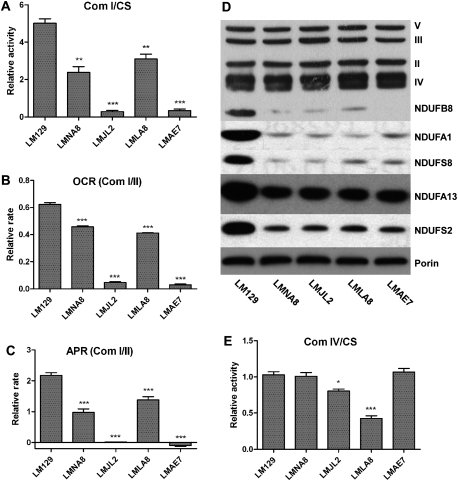
Reduced complex I and complex IV function in mutant cybrids. (A) Com (OXPHOS complex activity). Reduced complex I activity (normalized to citrate synthase activity) in all four homoplasmic cybrids: LMNA8 ([ND2 4794T]-[ ND5 12048C]), LMJL2 ([COI 6589C]-[tRNAArg 9821(10A)]-[ND6 13885insC]), LMLA8 ([COI 6589C]-[tRNAArg 9821(10A)]-[ND5 12048C]), and LMAE7 ([ND2 4794T]-[ND5 12048C]-[ND5 13053insC]) relative to the wild-type mtDNA LM129 cybrid. n = 6; (**) P < 0.01; (***) P < 0.001. (B) OCR (Oxygen consumption rate). Reduced complex I-dependent oxygen consumption rate (normalized to complex II-dependent oxygen consumption rate) in all four mutant cybrids. n = 6; (***) P < 0.001. (C) APR (ATP production rate). Reduced complex I-dependent ATP production (normalized to complex II-dependent ATP production) in all four mutant cybrids. n = 6; (***) P < 0.001. (D) Reduced levels of assembled complex I subunits, including subunits of the membrane subcomplex (NDUFB8 [20-kD], NDUFS8 [23-kD], and NDUFA1 [MWFE]), as well as subunits of the peripheral subcomplex (NDUFS2 [49 kD] and NDUFA13 [Grim19]). Subunits of other ETC complexes (II, III, IV, and V) remained unaffected. Porin was used as the loading control. (E) Reduced complex IV activity (normalized to citrate synthase activity) in mutant cybrids containing the COI T6589C mutation (LMJL2 and LMLA8). n = 6; (*) P < 0.05; (***) P < 0.001.
Figure 3.
Figure 3.
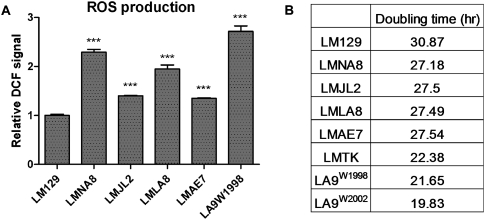
Increased ROS production and cellular proliferation in mutant cybrids and cells. (A) All four mutant cybrids and LA9W1998 have higher ROS production than the wild-type LM129; the bars report cell line values divided by the LM129 value. n = 6; (***) P < 0.001. (B) Doubling times calculated from growth curves of the control LM129 cybrid; the homoplasmic mutant mtDNA cybrids LMNA8, LMJL2, LMLA8, and LMAE7 (see Table 3); and the mature L-cell lines LMTK, LA9W1998, and LA9W2002.
Figure 4.
Figure 4.
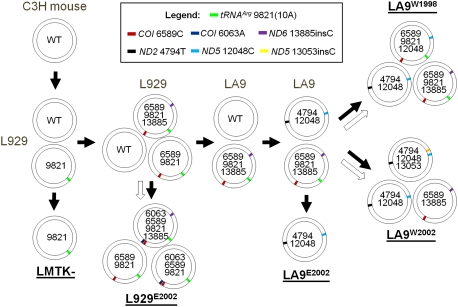
Reconstruction of the L-cell lineage mtDNA mutational and recombinational history. Each double circle represents one type of mtDNA, with the numbers inside being the mutation sites that differ from the wild-type allele. The relative position of the mutations on the mtDNA circle is indicated by the colored sector, and the colors are defined in the figure. Filled arrows indicate direction of the evolution of the L-cell genotypes. Open arrows indicate stages at which intra-mtDNA recombination must have occurred.

References

    1. Acin-Perez R, Bayona-Bafaluy MP, Bueno M, Machicado C, Fernandez-Silva P, Perez-Martos A, Montoya J, Lopez-Perez MJ, Sancho J, Enriquez JA 2003. An intragenic suppressor in the cytochrome c oxidase I gene of mouse mitochondrial DNA. Hum Mol Genet 12: 329–339 - PubMed
    1. Bacman SR, Williams SL, Moraes CT 2009. Intra- and inter-molecular recombination of mitochondrial DNA after in vivo induction of multiple double-strand breaks. Nucleic Acids Res 37: 4218–4226 - PMC - PubMed
    1. Bai Y, Attardi G 1998. The mtDNA-encoded ND6 subunit of mitochondrial NADH dehydrogenase is essential for the assembly of the membrane arm and the respiratory function of the enzyme. EMBO J 17: 4848–4858 - PMC - PubMed
    1. Bai U, Seidman MD, Hinojosa R, Quirk WS 1997. Mitochondrial DNA deletions associated with aging and possibly presbycusis: A human archival temporal bone study. Am J Otol 18: 449–453 - PubMed
    1. Bai Y, Hajek P, Chomyn A, Chan E, Seo BB, Matsuno-Yagi A, Yagi T, Attardi G 2001. Lack of complex I activity in human cells carrying a mutation in mtDNA-encoded ND4 subunit is corrected by the Saccharomyces cerevisiae NADH-quinone oxidoreductase (NDI1) gene. J Biol Chem 276: 38808–38813 - PubMed

Publication types

LinkOut - more resources