


Genotype probabilities at intermediate generations in the construction of recombinant inbred lines
- PMID: 22345609
- PMCID: PMC3276635
- DOI: 10.1534/genetics.111.132647
Genotype probabilities at intermediate generations in the construction of recombinant inbred lines
Abstract
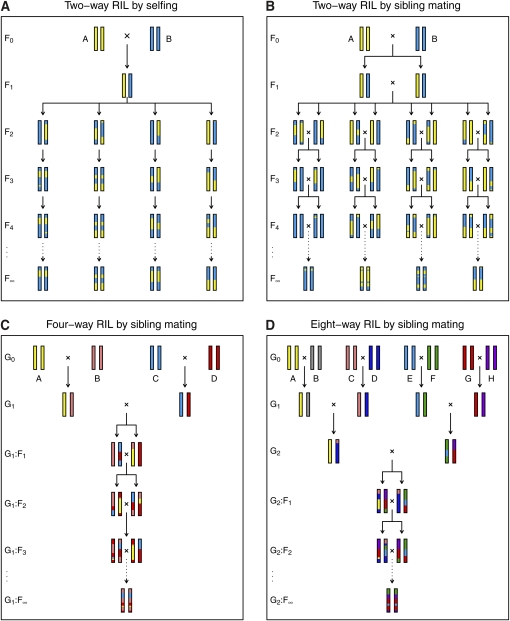
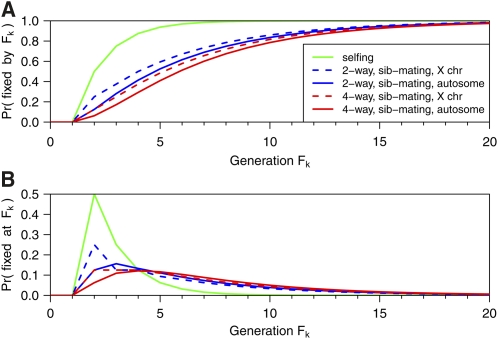
The mouse Collaborative Cross (CC) is a panel of eight-way recombinant inbred lines: eight diverse parental strains are intermated, followed by repeated sibling mating, many times in parallel, to create a new set of inbred lines whose genomes are random mosaics of the genomes of the original eight strains. Many generations are required to reach inbreeding, and so a number of investigators have sought to make use of phenotype and genotype data on mice from intermediate generations during the formation of the CC lines (so-called pre-CC mice). The development of a hidden Markov model for genotype reconstruction in such pre-CC mice, on the basis of incompletely informative genetic markers (such as single-nucleotide polymorphisms), formally requires the two-locus genotype probabilities at an arbitrary generation along the path to inbreeding. In this article, I describe my efforts to calculate such probabilities. While closed-form solutions for the two-locus genotype probabilities could not be derived, I provide a prescription for calculating such probabilities numerically. In addition, I present a number of useful quantities, including single-locus genotype probabilities, two-locus haplotype probabilities, and the fixation probability and map expansion at each generation along the course to inbreeding.
Figures

References
-
- Broman K. W., Wu H., Sen S., Churchill G. A., 2003. R/qtl: QTL mapping in experimental crosses. Bioinformatics 19: 889–890 - PubMed
-
- Burke C. J., Rosenblatt M., 1958. A Markovian function of a Markov chain. Ann. Math. Stat. 29: 1112–1122
Publication types
MeSH terms
Grants and funding
LinkOut - more resources
Full Text Sources
Other Literature Sources
