Cellular Mechanism of Newly Synthesized Indoledione Derivative-induced Immunological Death of Tumor Cell
- PMID: 22346779
- PMCID: PMC3275708
- DOI: 10.4110/in.2011.11.6.383
Cellular Mechanism of Newly Synthesized Indoledione Derivative-induced Immunological Death of Tumor Cell
Abstract
Background: EY-6 is one of the newly synthesized indoledione derivatives to induce tumor cell-specific cell death. In this study, we investigated the mechanism of immunological death induced by EY-6 at mouse colon cancer cell as well as at the normal immune cell represented by dendritic cell.
Methods: C57BL/6 mouse syngeneic colon cancer cell MC38 was treated with EY-6, and analyzed by MTT for viability test, flow cytometry for confirming surface expressing molecules and ELISA for detection of cytokine secretion. Normal myeloid-dendritic cell (DC) was ex vivo cultured from bone marrow hematopoietic stem cells of C57BL/6 mice with GM-CSF and IL-4 to analyze the DC uptake of dead tumor cells and to observe the effect of EY-6 on the normal DC.
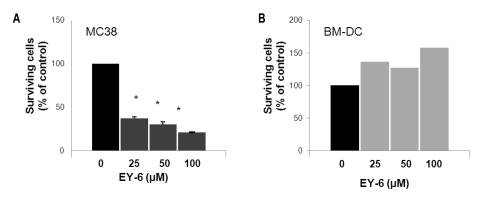
Results: EY-6 killed the MC38 tumor cells in a dose dependent manner (25, 50 and 100 µM) with carleticulin induction. And EY-6 induced the secretion of IFN-γ but not of TNF-α from the MC38 tumor cells. EY-6 did not kill the ex-vivo cultured DCs at the dose killing tumor cells and did slightly but not significantly induced the DC maturation. The OVA-specific cross-presentation ability of DC was not induced by chemical treatment (both MHC II and MHC I-restricted antigen presentation).
Conclusion: Data indicate that the EY-6 induced tumor cell specific and immunological cell death by modulation of tumor cell phenotype and cytokine secretion favoring induction of specific immunity eliminating tumor cells.
Keywords: Carleticulin; Dendritic cell; Immunological death of tumor cell; Indoledione derivatives.
Conflict of interest statement
The author have no financial conflict of interest.
Figures


References
-
- Obeid M, Panaretakis T, Tesniere A, Joza N, Tufi R, Apetoh L, Ghiringhelli F, Zitvogel L, Kroemer G. Leveraging the immune system during chemotherapy: moving calreticulin to the cell surface converts apoptotic death from "silent" to immunogenic. Cancer Res. 2007;67:7941–7944. - PubMed
-
- Galon J, Costes A, Sanchez-Cabo F, Kirilovsky A, Mlecnik B, Lagorce-Pagès C, Tosolini M, Camus M, Berger A, Wind P, Zinzindohoué F, Bruneval P, Cugnenc PH, Trajanoski Z, Fridman WH, Pagès F. Type, density, and location of immune cells within human colorectal tumors predict clinical outcome. Science. 2006;313:1960–1964. - PubMed
-
- Apetoh L, Mignot G, Panaretakis T, Kroemer G, Zitvogel L. Immunogenicity of anthracyclines: moving towards more personalized medicine. Trends Mol Med. 2008;14:141–151. - PubMed
-
- Zitvogel L, Apetoh L, Ghiringhelli F, Kroemer G. Immunological aspects of cancer chemotherapy. Nat Rev Immunol. 2008;8:59–73. - PubMed
LinkOut - more resources
Full Text Sources
Research Materials