. 2012 Feb 7:3:15.
doi: 10.3389/fpsyg.2012.00015. eCollection 2012.

Attention, awareness, and the perception of auditory scenes

Affiliations

Attention, awareness, and the perception of auditory scenes

Joel S Snyder et al. Front Psychol. .

Abstract

Auditory perception and cognition entails both low-level and high-level processes, which are likely to interact with each other to create our rich conscious experience of soundscapes. Recent research that we review has revealed numerous influences of high-level factors, such as attention, intention, and prior experience, on conscious auditory perception. And recently, studies have shown that auditory scene analysis tasks can exhibit multistability in a manner very similar to ambiguous visual stimuli, presenting a unique opportunity to study neural correlates of auditory awareness and the extent to which mechanisms of perception are shared across sensory modalities. Research has also led to a growing number of techniques through which auditory perception can be manipulated and even completely suppressed. Such findings have important consequences for our understanding of the mechanisms of perception and also should allow scientists to precisely distinguish the influences of different higher-level influences.

Keywords: attentional blink; auditory scene analysis; change deafness; informational masking; multistability; priming.


Figures
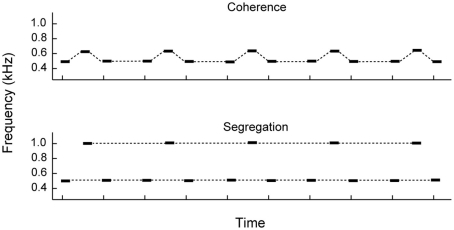
Figure 1
Figure 1
In auditory stream segregation experiments, low and high tones are alternated repeatedly. When the frequency difference between the tones is small (top), this typically leads to perception of one coherent stream. For large frequency differences (bottom), one is more likely to be heard as two segregated streams.
Figure 2
Figure 2
In mistuned harmonic experiments, a complex harmonic sound composed of frequency components that are all multiples of the fundamental frequency (f0) is heard as a single sound with a buzzy quality (left). When one of the components is mistuned, it stands out as a separate pure-tone object in addition to the remaining complex sound (right).
Figure 3
Figure 3
A neural marker of concurrent sound segregation based on harmonicity. (A) Neuromagnetic activity elicited by harmonic complexes that had all harmonics in tune or the third harmonic mistuned by 16% of its original value. The magnetic version of the ORN (ORNm) is isolated in the difference wave between responses elicited by the tuned and mistuned stimuli. The group mean responses are from 12 young adults. (B) Source modeling using the beamforming technique called event-related synthetic aperture magnetometry (ER-SAM). The activation maps (group image results) are overlaid on a brain image conforming to Talairach space. Green cross hairs highlight the location of the peak maxima for the ORNm sources (blue) derived from subtracting the ER-SAM results for the 0% mistuned stimulus from that of the 16% mistuned stimulus. For comparison, ER-SAM source maps at the time interval of the peak N1m and P2m responses (red) are plotted at the same ORNm axial (z-plane) level.
Figure 4
Figure 4
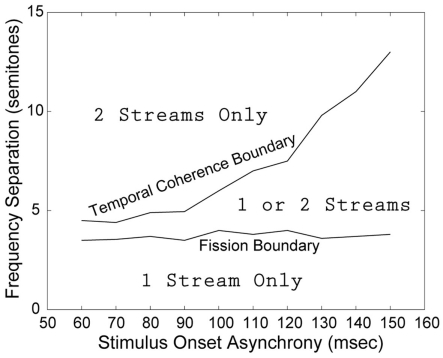
A reproduction of  Van Noorden’s (1975) streaming diagram, showing the combinations of frequency separation and stimulus onset asynchrony between low and high tones that lead to perception of only one stream, only two streams, or either perceptual organization.
Figure 5
Figure 5
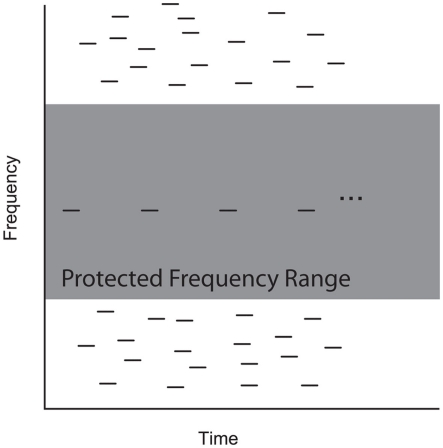
In informational masking experiments, presenting a series of fixed-frequency target tones in the midst of a multi-tone masker stimulus can prevent awareness of the target, even when the masker tones are prevented from overlapping in frequency with the target by using a protected frequency range.

References

    1. Ahveninen J., Hamalainen M., Jaaskelainen I. P., Ahlfors S. P., Huang S., Lin F. H., Raij T., Sams M., Vasios C. E., Belliveau J. W. (2011). Attention-driven auditory cortex short-term plasticity helps segregate relevant sounds from noise. Proc. Natl. Acad. Sci. U.S.A. 108, 4182–4187 10.1073/pnas.1016134108 - DOI - PMC - PubMed
    1. Alain C. (2007). Breaking the wave: effects of attention and learning on concurrent sound perception. Hear. Res. 229, 225–236 10.1016/j.heares.2007.01.011 - DOI - PubMed
    1. Alain C., Arnott S. R. (2000). Selectively attending to auditory objects. Front. Biosci. 5, D202–D212 10.2741/Alain - DOI - PubMed
    1. Alain C., Arnott S. R., Picton T. W. (2001). Bottom-up and top-down influences on auditory scene analysis: evidence from event-related brain potentials. J. Exp. Psychol. Hum. Percept. Perform. 27, 1072–1089 10.1037/0096-1523.27.5.1072 - DOI - PubMed
    1. Alain C., Izenberg A. (2003). Effects of attentional load on auditory scene analysis. J. Cogn. Neurosci. 15, 1063–1073 10.1162/089892903770007443 - DOI - PubMed

LinkOut - more resources