. 2011 Aug;6(3):1-18.

Genomic organization of leishmania species

Affiliations

Genomic organization of leishmania species

B Kazemi. Iran J Parasitol. 2011 Aug.

Abstract

Leishmania is a protozoan parasite belonging to the family Trypanosomatidae, which is found among 88 different countries. The parasite lives as an amastigote in vertebrate macrophages and as a promastigote in the digestive tract of sand fly. It can be cultured in the laboratory using appropriate culture media. Although the sexual cycle of Leishmania has not been observed during the promastigote and amastigote stages, it has been reported by some researchers. Leishmania has eukaryotic cell organization. Cell culture is convenient and cost effective, and because posttranslational modifications are common processes in the cultured cells, the cells are used as hosts for preparing eukaryotic recombinant proteins for research. Several transcripts of rDNA in the Leishmania genome are suitable regions for conducting gene transfer. Old World Leishmania spp. has 36 chromosomes, while New World Leishmania spp. has 34 or 35 chromosomes. The genomic organization and parasitic characteristics have been investigated. Leishmania spp. has a unique genomic organization among eukaryotes; the genes do not have introns, and the chromosomes are smaller with larger numbers of genes confined to a smaller space within the nucleus. Leishmania spp. genes are organized on one or both DNA strands and are transcribed as polycistronic (prokaryotic-like) transcripts from undefined promoters. Regulation of gene expression in the members of Trypanosomatidae differs from that in other eukaryotes. The trans-splicing phenomenon is a necessary step for mRNA processing in lower eukaryotes and is observed in Leishmania spp. Another particular feature of RNA editing in Leishmania spp. is that mitochondrial genes encoding respiratory enzymes are edited and transcribed. This review will discuss the chromosomal and mitochondrial (kinetoplast) genomes of Leishmania spp. as well as the phenomenon of RNA editing in the kinetoplast genome.

Keywords: Genome; Kinetoplast; Leishmania; RNA editing; Trans-splicing.


Figures

Fig. 1
Fig. 1
Organization of chromosomes of Leishmania genes: clusters of genes on chromosomes 1, 2, 3, 4, and 35 are shown as thick lines. The direction of mRNA transcription is indicated. Vertical lines indicate the right side of the chromosome 1 repeated sub-telomeric sequence. The arrows indicate chromosome 2 splice leader categories. The arrows between the individual genes in chromosome 3 genes indicate tRNA. The space on chromosome 35 indicates an area of undetermined sequence (Source Ref. 30).
Fig. 2
Fig. 2
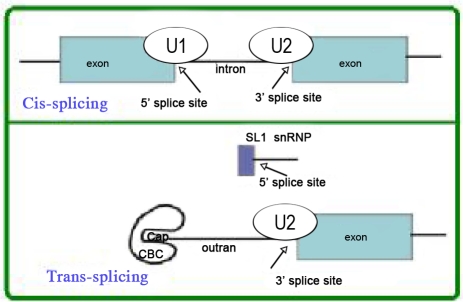
Comparison of cis- and trans-splicing: In cis-splicing, pair bases U1 small nuclear ribonucleoprotein (snRNP) are in the 5′ SL [?] and U2 snRNPs are in the break point, while intron breaks two exons are connected. In trans-splicing, a 5′-splice site on the mRNA for binding to U1 snRNP is absent. Instead, a 5′-splice site produced by the donor SL snRNP interacts with U2 in the 3′-splice site. The splice leader connects to the next exon. (http://www.wormbook.org/chapters/www_transsplicingoperons/transsplicingoperons.pdf)
Fig. 3
Fig. 3
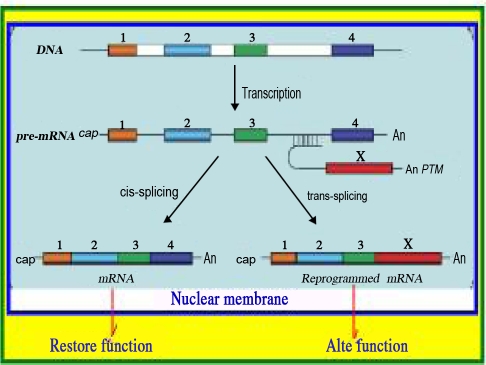
Cis-splicing and trans-splicing: There are 4 exons in the initial transcript, which contains both exons and introns. In the cis-splicing phenomenon, the mRNA contains 4 exons and 3 introns. The 3 introns are removed, and the exons are connected. In trans-trans-splicing, a pre-trans-splicing molecule attaches exon X to intron 3. The 5'-splice donor is attached to the 3'-splice acceptor (Source Ref. 52).
Fig. 4
Fig. 4
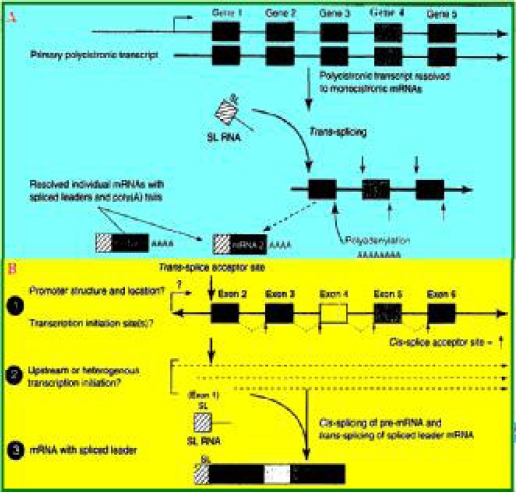
Trans-splicing in metazoan parasites: A) Transcription occurs via a polycistronic transcript and trans-splicing. The initial transcript contains mRNAs with 5′-trans-splicing and polyadenylation. Each box represents 1 gene with an exon and an intron. The bent arrows indicate the promoter and the transcription start site. B) The phenomenon of transcription and trans-splicing in metazoan genes (worms). The solid squares indicate genes with an intron between them. 1) Promoter and possible transcription start site. 2) The position of transcription initiation. 3) mRNA molecules with SL (Source Ref. 60).
Fig. 5
Fig. 5
Structure of the kinetoplast disk and the proteins involved in its replication SSE1, Structure -specific endonuclease 1; UMSBP, Universal minicircle sequence-binding protein (http://www.pnas.org/content/101/13/4333/F2.expansion.html)
Fig. 6
Fig. 6
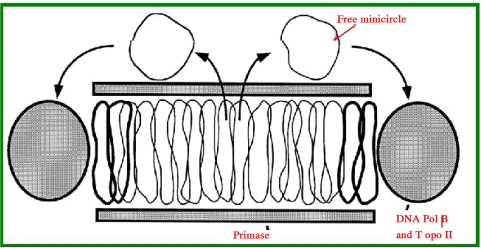
In vivo replication of a kinetoplast shown as a disk section with catenated minicircles surrounded by DNA polymerase beta and DNA topoisomerase II. Primase is located at the top and bottom. During replication, the minicircles are released and connected to the network after replication is complete. Two newly synthesized minicircles are shown in bold (http://www.jbc.org/content/272/33/20787.full.pdf+html)
Fig. 7
Fig. 7
RNA editing of cytochrome oxidase B of Leishmania tarantula (http://dna.kdna.ucla.edu/trypanosome/index.html)
Fig. 8
Fig. 8
Model RNA editing in the kinetoplast: addition of U (left), removal of U (center) or formation of a chimera (right) in an mRNA transcript are performed by TUTase (http://dna.kdna.ucla.edu/trypanosome/images/kablea.JPG)
Fig. 9
Fig. 9
RNA editing in human apolipoprotein B

References

    1. Handman E. Cell biology of Leishmania . Adv Parasitol. 1999;44:1–39. - PubMed
    1. Bard E. Molecular biology of Lei-shmania . Biochem Cell Biol. 1989;67(9):516–24. - PubMed
    1. Panton LJ, Tesh RB, Nadeau KC, Beverley SM. A test for genetic exchange in mixed infections of Leishmania major in the sand fly Phlebotomus papatasi. J Protozool. 1991;38(3):224–8. - PubMed
    1. Cruz AK, Titus R, Beverley SM. Plasticity in chromosome number and testing of essential genes in Leishmania by targeting. Proc Nati Acad Sci USA. 1993;90:1599–603. - PMC - PubMed
    1. Victoir k, Dujardin JC. How to succeed in parasitic life without sex? Asking leishmania . Trends Parasitol. 2002;18(2):81–5. - PubMed

LinkOut - more resources