


Clotrimazole preferentially inhibits human breast cancer cell proliferation, viability and glycolysis
- PMID: 22347377
- PMCID: PMC3275602
- DOI: 10.1371/journal.pone.0030462
Clotrimazole preferentially inhibits human breast cancer cell proliferation, viability and glycolysis
Abstract
Background: Clotrimazole is an azole derivative with promising anti-cancer effects. This drug interferes with the activity of glycolytic enzymes altering their cellular distribution and inhibiting their activities. The aim of the present study was to analyze the effects of clotrimazole on the growth pattern of breast cancer cells correlating with their metabolic profiles.
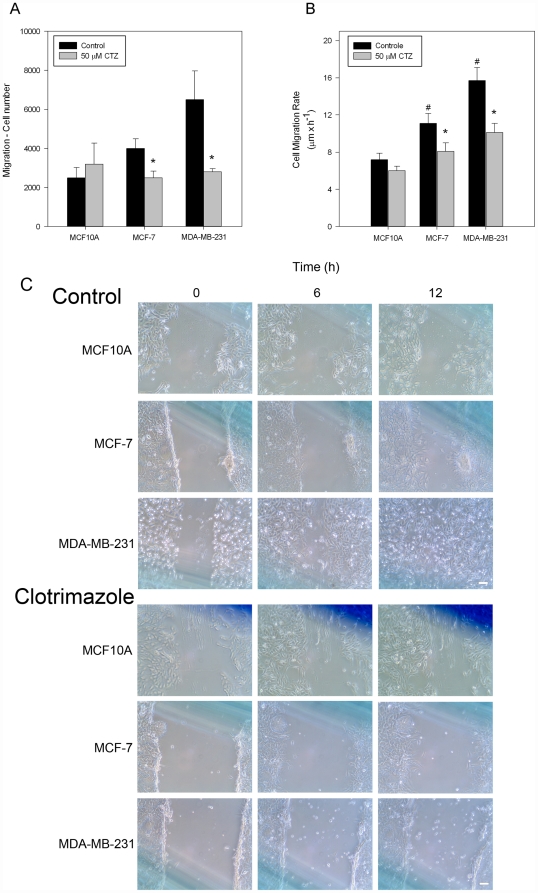
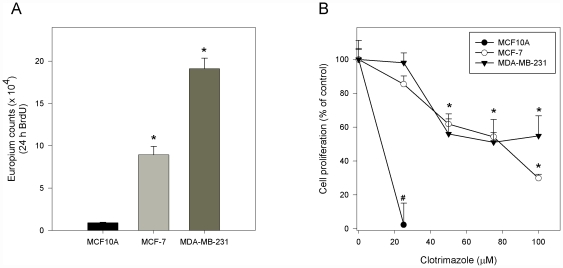
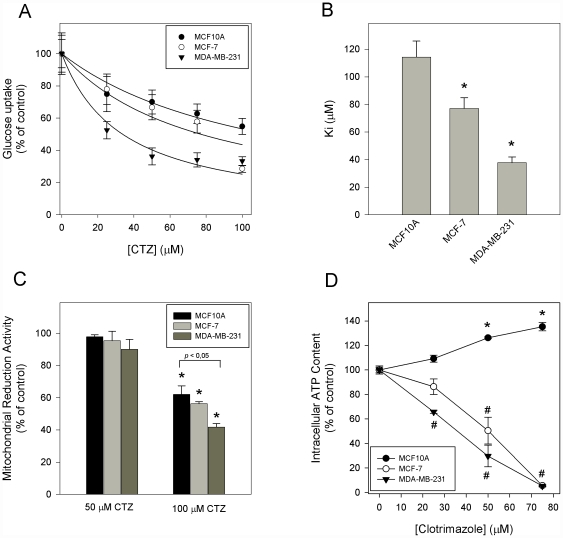
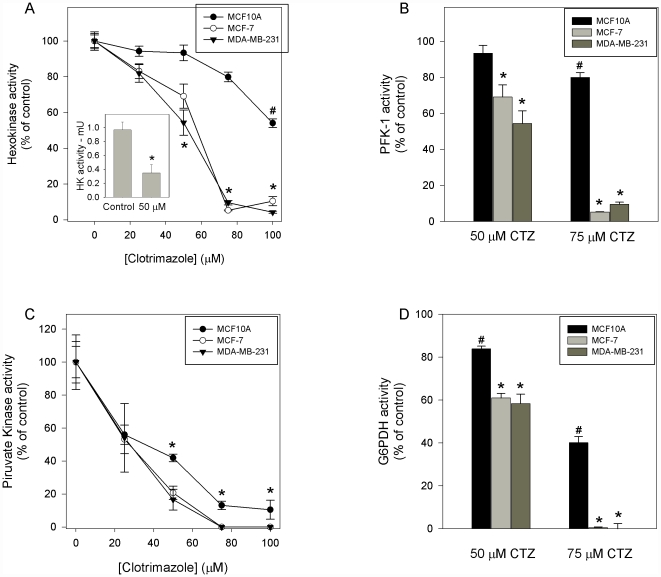
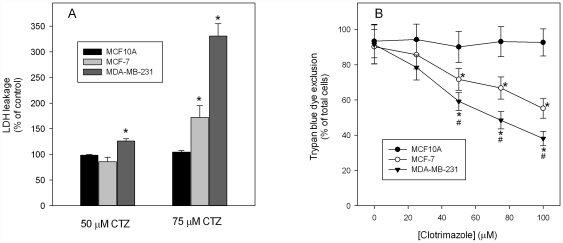
Methodology/principal findings: Three cell lines derived from human breast tissue (MCF10A, MCF-7 and MDA-MB-231) that present increasingly aggressive profiles were used. Clotrimazole induces a dose-dependent decrease in glucose uptake in all three cell lines, with K(i) values of 114.3±11.7, 77.1±7.8 and 37.8±4.2 µM for MCF10A, MCF-7 and MDA-MB-231, respectively. Furthermore, the drug also decreases intracellular ATP content and inhibits the major glycolytic enzymes, hexokinase, phosphofructokinase-1 and pyruvate kinase, especially in the highly metastatic cell line, MDA-MB-231. In this last cell lineage, clotrimazole attenuates the robust migratory response, an effect that is progressively attenuated in MCF-7 and MCF10A, respectively. Moreover, clotrimazole reduces the viability of breast cancer cells, which is more pronounced on MDA-MB-231.
Conclusions/significance: Clotrimazole presents deleterious effects on two human breast cancer cell lines metabolism, growth and migration, where the most aggressive cell line is more affected by the drug. Moreover, clotrimazole presents little or no effect on a non-tumor human breast cell line. These results suggest, at least for these three cell lines studied, that the more aggressive the cell is the more effective clotrimazole is.
Conflict of interest statement
Figures
References
-
- Marin-Hernandez A, Rodriguez-Enriquez S, Vital-Gonzalez PA, Flores-Rodriguez FL, Macias-Silva M, et al. Determining and understanding the control of glycolysis in fast-growth tumor cells. Flux control by an over-expressed but strongly product-inhibited hexokinase. FEBS J. 2006;273:1975–1988. - PubMed
-
- Meadows AL, Kong B, Berdichevsky M, Roy S, Rosiva R, et al. Metabolic and morphological differences between rapidly proliferating cancerous and normal breast epithelial cells. Biotechnol Prog. 2008;24:334–341. - PubMed
-
- Hsu PP, Sabatini DM. Cancer Cell Metabolism: Warburg and Beyond. Cell. 2008;134:703–707. - PubMed
-
- Gillies RJ, Robey I, Gatenby RA. Causes and consequences of increased glucose metabolism of cancers. J Nucl Med. 2008;49(Suppl 2):24S–42S. - PubMed
Publication types
MeSH terms
Substances
LinkOut - more resources
Full Text Sources
Medical
Miscellaneous
