


Development and psychometric evaluation of a clinical global impression for schizoaffective disorder scale
- PMID: 22347687
- PMCID: PMC3280074
Development and psychometric evaluation of a clinical global impression for schizoaffective disorder scale
Abstract
Objective: The Clinical Global Impression for Schizoaffective Disorder scale is a new rating scale adapted from the Clinical Global Impression scale for use in patients with schizoaffective disorder. The psychometric characteristics of the Clinical Global Impression for Schizoaffective Disorder are described.
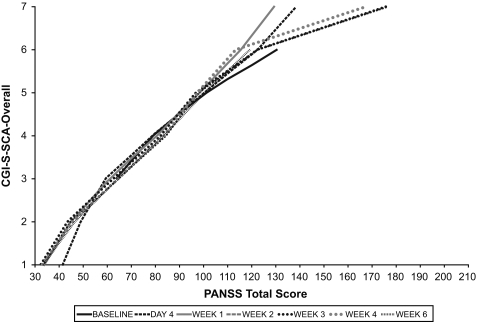
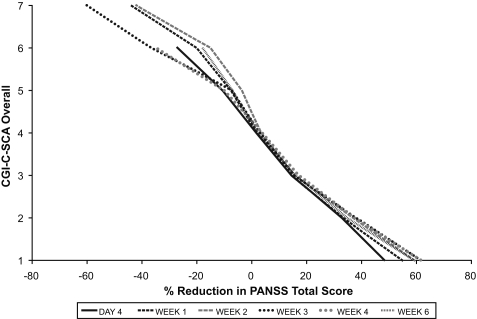
Design: Content validity was assessed using an investigator questionnaire. Inter-rater reliability was determined with 12 sets of videotaped interviews rated independently by two trained individuals. Test-retest reliability was assessed using 30 randomly selected raters from clinical trials who evaluated the same videos on separate occasions two weeks apart. Convergent and divergent validity and effect size were evaluated by comparing scores between the Clinical Global Impression for Schizoaffective Disorder and the Positive and Negative Syndrome Scale, 21-item Hamilton Rating Scale for Depression, and Young Mania Rating Scale scales using pooled patient data from two clinical trials. Clinical Global Impression for Schizoaffective Disorder scores were then linked to corresponding Positive and Negative Syndrome Scale scores.
Results: Content validity was strong. Inter-rater agreement was good to excellent for most scales and subscales (intra-class correlation coefficient ≥ 0.50). Test-retest showed good reproducibility, with intraclass correlation coefficients ranging from 0.444 to 0.898. Spearman correlations between Clinical Global Impression for Schizoaffective Disorder domains and corresponding symptom scales were 0.60 or greater, and effect sizes for Clinical Global Impression for Schizoaffective Disorder overall and domain scores were similar to Positive and Negative Syndrome Scale Young Mania Rating Scale, and 21-item Hamilton Rating Scale for Depression scores. Raters anticipated that the scale might be less effective in distinguishing negative from depressive symptoms, and, in fact, the results here may reflect that clinical reality.
Conclusion: Multiple lines of evidence support the reliability and validity of the Clinical Global Impression for Schizoaffective Disorder for studies in schizoaffective disorder.
Keywords: Schizoaffective disorder; antipsychotics; methodology; psychometrics.
Figures
References
-
- Cheniaux E, Landeira-Fernandez J, Lessa TL, et al. Does schizoaffective disorder really exist? A systematic review of the studies that compared schizoaffective disorder with schizophrenia or mood disorders. J Affect Discord. 2008;106:209–217. - PubMed
-
- Harrow M, Grossman LS, Herbener ES, Davies EW. Ten-year outcome: patients with schizoaffective disorders, schizophrenia, affective disorders and mood-incongruent psychotic symptoms. Br J Psychiatry. 2000;177:421–426. - PubMed
-
- American Psychiatric Association . Diagnostic and Statistical Manual of Mental Disorders, Fourth Edition, Text Revision. Washington, DC: American Psychiatric Association; 2000.
LinkOut - more resources
Full Text Sources