


Association between polymorphisms in the promoter regions of matrix metalloproteinases (MMPs) and risk of cancer metastasis: a meta-analysis
- PMID: 22348060
- PMCID: PMC3279370
- DOI: 10.1371/journal.pone.0031251
Association between polymorphisms in the promoter regions of matrix metalloproteinases (MMPs) and risk of cancer metastasis: a meta-analysis
Abstract
Background: A variety of studies have evaluated the associations between polymorphisms in the promoter regions of Matrix metalloproteinases (MMPs) and cancer metastasis. However, the results remain inconclusive. To better understand the roles of MMP polymorphisms in metastasis, we conducted a comprehensive meta-analysis.
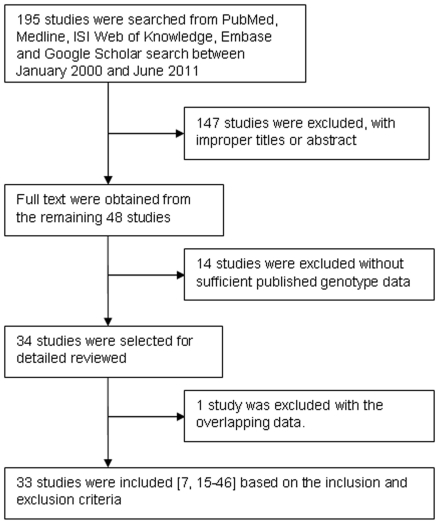
Methods: Electronic databases were searched (from January 2000 to June 2011) for any MMP genetic association studies in metastasis. Overall and subgroup analyses were performed. Odds ratio (OR) and 95% confidence interval (CI) were used to evaluate the associations between MMP polymorphisms and metastasis. Statistical analysis was performed with Review Manager 5.0 and STATA11.0.
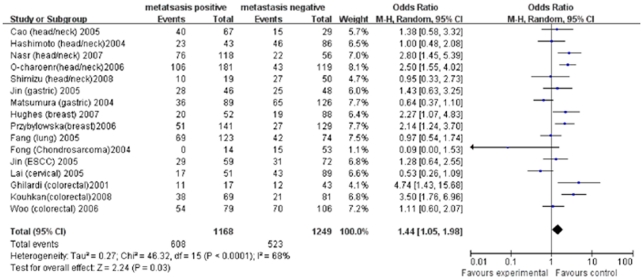
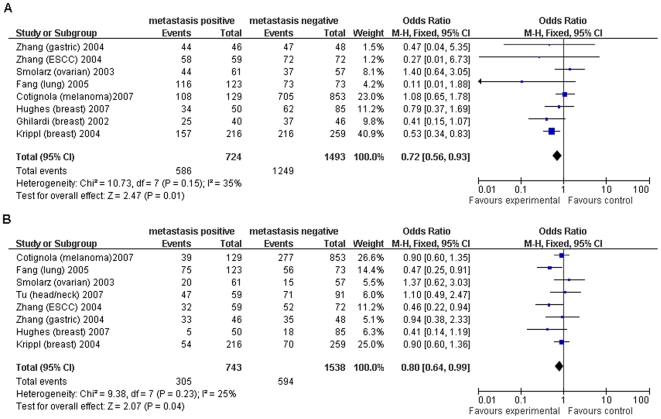
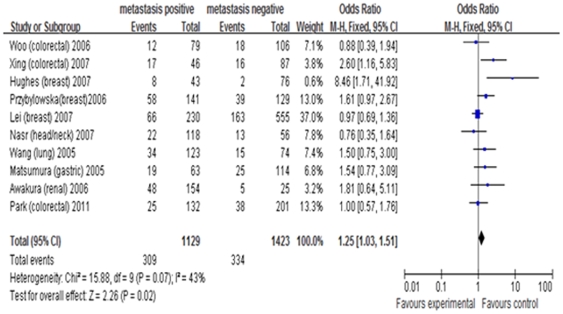
Results: Thirty-three studies addressing five MMP polymorphisms were analyzed among 10,516 cancer cases (4,059 metastasis-positive cases and 6,457 metastasis-negative cases). For MMP1 (-1607)1G/2G, genotype 2G/2G increased the overall risk of metastasis under the recessive model (OR = 1.44, 95% CI = 1.05-1.98). In subgroup analysis based on cancer type, associations were found in head/neck and breast cancer under the recessive model, and also in breast cancer under the dominant model. For MMP3 (-1171) 5A/6A, the polymorphism decreased the overall risk of metastasis under two genetic models (recessive: OR = 0.80, 95%CI = 0.64-0.99, dominant: OR = 0.72, 95%CI = 0.56-0.93). The polymorphisms of MMP7 (-181) A/G and MMP9 (-1562) C/T increased metastatic risk. However, no association was observed between MMP2 (-1306) C/T and metastasis.
Conclusions: Our investigations demonstrate that polymorphisms in the promoter regions of MMP1, 3, 7 and 9 might be associated with metastasis in some cancers. Further studies with large sample size for MMP2 should be conducted.
Conflict of interest statement
Figures
References
-
- Yoon SO, Park SJ, Yun CH, Chung AS. Roles of matrix metalloproteinases in tumor metastasis and angiogenesis. J Biochem Mol Bio. 2003;36:128–137. - PubMed
-
- Curran S, Murray GI. Matrix metalloproteinases: molecular aspects of their roles in tumour invasion and metastasis. Eur J Cancer. 2000;36:1621–1630. - PubMed
-
- Visse R, Nagase H. Matrix metalloproteinases and tissue inhibitors of metalloproteinases: structure, function, and biochemistry. Circ Res. 2003;92:827–839. - PubMed
-
- Malemud CJ. Matrix metalloproteinases (MMPs) in health and disease: an overview. Front Biosci. 2006;11:1696–1701. - PubMed
-
- Lemaitre V, D'Armiento J. Matrix metalloproteinases in development and disease. Birth Defects Res C Embryo Today. 2006;78:1–10. - PubMed
Publication types
MeSH terms
Substances
LinkOut - more resources
Full Text Sources
Miscellaneous
